More Than You Wanted to Know About Tariffs
Hello, subscribers. Some people I trust have been urging me to write a sort of primer on tariffs, and Donald Trump’s latest diktat seems to provide an occasion. This long post, practically a working paper, will, at least at first, be for paid subscribers only — while my weekday rants are always free, those of you who have contributed should get a few perks for your generosity. And something like this, a fairly big project that I hope people will find informative but isn’t part of understanding what happened in the past 24 hours, seems like a good candidate.
For those of you deciding whether to chip in, here’s what is behind the wall. First, a survey of the actual levels of tariffs around the world. Second, a summary history of how advanced economies — all of them, not just the United States — got from the protectionism of the 1930s to nearly free trade, at least in manufactured goods. Third, a brief overview of the quite different history of tariffs in emerging economies, which had very high tariffs until the 1980s, then brought them way down, although they’re still higher than those in the advanced world. Finally, what you should know about value-added taxes, which shouldn’t be part of this discussion but probably will.
OK, let’s get started.
So far there have been three phases in Trump’s now-you-see-it-now-you-don’t trade war. First there was what sounded like an unambiguous declaration that we would impose 25 percent tariffs on all imports from Canada and Mexico — but then, at the last minute, these tariffs were put on hold. Trump and company claimed to have won major concessions; the reality is that he blinked, possibly because someone actually got through to him with the news that these tariffs and the inevitable retaliation would take a sledgehammer to the intricate North American manufacturing ecosystem.
Then there were the tariffs on steel and aluminum. As I pointed out, these tariffs were ugly — we reneged on a trade agreement Trump himself signed, and largely targeted Canada, arguably our closest ally. They were also stupid, likely to reduce manufacturing employment. But they were small in the sense that they affected only a narrow slice of U.S. imports.
Now Trump has announced that he will impose “reciprocal tariffs” on everyone, doing unto others as they do unto us, but not until April, after a period of study. What will that mean?
As with much of Trumponomics, nobody really knows. If Trump actually stops with what he seems to be saying and simply imposes tariffs on foreign exports equal to the tariffs they impose on US exports, it will be a nothingburger. But I think we can assume that he doesn’t know that, and the question is what people around him will come up with to feed his conviction that America is being treated unfairly.
So what do tariffs around the world look like right now?
Tariffs on the eve of destruction Trump
When looking at the realities of trade policy, it’s important to distinguish between agriculture and manufacturing. Trade in agricultural products is nowhere close to being free. Farmers in wealthy nations get a lot of protection in the form of tariffs against imports and other trade restrictions, sometimes benefit from export subsidies, and in general receive a huge amount of special treatment. In some cases, especially the United States, this reflects overrepresentation in the electoral system: Wyoming has two Senators along with one House member, yet it has fewer people than, say, New York’s 14th district, which sprawls across parts of Queens and the Bronx and has one House member (AOC.)
Farmers also benefit from a sentimental attitude toward a traditional way of life, whether it’s the “real America” of small towns and family farms or la France profonde.
In any case, given both the asymmetry of policy and the special role manufacturing plays in the idea of Making America Great Again, it makes sense to focus on trade in manufacturing.
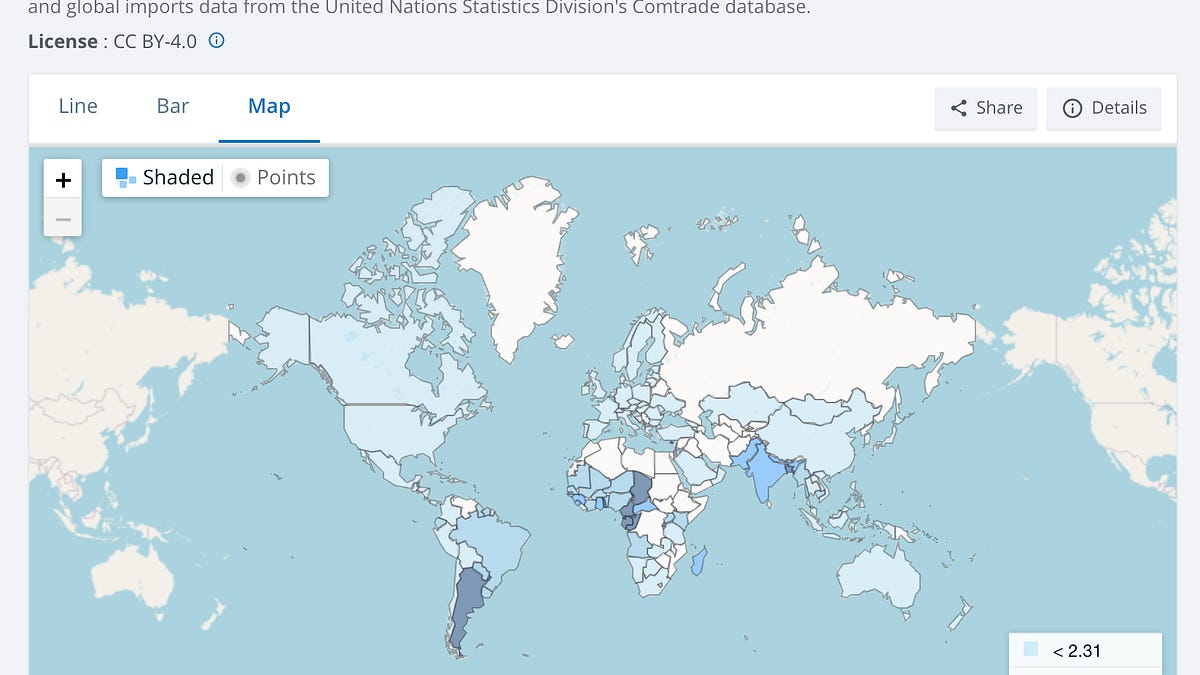
We know what Trump imagines trade in manufactured goods to be like. In his worldview, America is a big sucker, letting foreign goods in with little or no tariff while other countries impose high tariffs on our exports. But the reality is nothing like that. Here’s a map of average tariff rates on manufactured goods in 2022 from the World Bank, with darker colors meaning higher rates:

Source: World Bank
China is a special case; there’s so much government intervention in the economy that its low formal tariff rates aren’t meaningful. But the message you should take from the rest of the map is that all advanced economies — North America, Western Europe, and the developed nations of the Pacific Rim — have low tariff rates, generally under 2 percent. And we have a free trade agreement with Canada and Mexico.
Furthermore, if we look at who the United States trades with, it’s mainly with countries that have very low tariffs, just as we do:
s_!47gu!,w_1456,c_limit,f_auto,q_auto:good,fl_progressive:steep/https%3A%2F%2Fsubstack-post-media.s3.amazonaws.com%2Fpublic%2Fimages%2Fea410281-d84f-414b-a832-8d2f787fe91f_1062x674.png)
Source: BEA
Who’s in the “everyone else” category? The main players are India, with a 10 percent average tariff, and Brazil, with 9 percent. If those numbers are lower than you expected, that’s because neither country is remotely as protectionist as it used to be. But we’ll get there in a bit. And neither country is a large trading partner: India accounts for 2.7 percent of U.S. imports, Brazil 1.3 percent.
So if Trump really did simply insist on raising US tariffs to match those of other countries, hardly anything would happen.
That’s not likely to satisfy him, and there are hints about how his aides will try to justify significant tariff hikes. Before we get there, however, let’s talk about how global tariffs got so low.
We already have reciprocal tariffs
Trump’s demand for “reciprocal tariffs” had people who actually know anything about trade policy scratching their heads. OK, maybe not, since Trump’s lack of knowledge is a given here. But anyway, reciprocity is precisely how we got from the protectionism of Smoot Hawley to the almost-free trade that prevailed before Trump came along. Indeed, the long climb down from protectionism began with a 1934 law titled, wait for it, the Reciprocal Trade Agreements Act:

Source: USITC
To understand why the RTAA was necessary, start with the fact that many people say that Coca-Cola made in Mexico tastes better than Coca-Cola made in the United States. (As a black coffee guy, I have no personal view.) Why? The immediate answer is that Mexican Coke is sweetened with cane sugar, while U.S. Coke is sweetened with high-fructose corn syrup.
Behind this difference, however, lies trade policy. U.S. imports of sugar are limited by an import quota, which has effects similar to those of a tariff. As a result, raw sugar is considerably more expensive in the U.S. than it is in the rest of the world and using high-fructose corn syrup is a cheaper alternative:
s_!wBaH!,w_1456,c_limit,f_auto,q_auto:good,fl_progressive:steep/https%3A%2F%2Fsubstack-post-media.s3.amazonaws.com%2Fpublic%2Fimages%2F04627723-02e9-4cf7-afcd-be87563c4007_1148x748.png)
Source: Congressional Research Service
It’s hard to come up with any economic rationale for limits on sugar imports. For technical reasons not worth getting into, the sugar quota is even more harmful to U.S. interests than the typical tariff. And the great majority of Americans are hurt by higher sugar prices, because there’s sugar in almost everything.
But these costs are very diffuse, a few cents per person — too small to inspire a political backlash; in fact, so small that hardly any consumers even know that the sugar quota exists. There are, however, only a few hundred U.S. farms growing sugarcane, and you’d better believe that they know about the import quota and lobby hard to keep it in place.
So imagine that you’re FDR in 1934, believing that high tariffs are economically destructive, and with a Secretary of State, Cordell Hull, who believed that world trade was a force for peace. How do you overcome the special-interest politics that makes tariff reduction so hard?
The answer is to make deals with other countries: We’ll cut our tariffs if you cut yours. The RTAA was a way to make such deals and submit them to up-and-down votes in Congress which - critically - lacked any means for individual representatives to insert special provisions benefiting industries in their home districts.
By linking tariff cuts at home to reciprocal tariff cuts in other countries, the RTAA brought in domestic exporters as a countervailing political force against the power of special interests who supported tariffs.
In 1947 the RTAA in effect went global. The General Agreement on Tariffs and Trade created a process for reciprocal tariff cuts among all its signatories, not just those dealing with the United States. Nations would get together for tariff-cutting “rounds,” and the GATT set rules designed to prevent backsliding after each round was concluded.
The eighth and so far last such round was the Uruguay Round of the early 1990s, named after the country where the opening ceremonies were held. Actual negotiations took place in Geneva. That round’s main achievement was the creation of the World Trade Organization, which greatly enhanced monitoring of nations’ adherence to the GATT and provided a much faster, more effective system for resolving disputes.
Why is this history relevant to the current situation? Because it tells you that the Trumpian story about how we arrived at low tariffs is all wrong. In the world according to Trump, America, blinded by free-trade ideology, blithely opened itself to imports while the rest of the world sniggered. In reality, we spent many decades practicing the art of the deal, cutting tariffs only in return for reciprocal cuts in other nations.
And that’s why Trump will be shocked if his idea of reciprocal tariffs is implemented literally, because almost nothing would happen. The truth is that we already have tariff reciprocity — that’s how the modern world economy was built. America has low tariffs, but so do our main trading partners. The reality of world trade will give Trump almost nothing to work with.
OK, emerging markets, mainly India and Brazil, are a somewhat different story. So let’s look at that, quite different history.
Tariffs in emerging markets
As I mentioned, there are some emerging markets, notably India and Brazil, that still have tariffs noticeably higher than those applied by wealthier nations. The reason for this difference is that the history of trade policy in developing countries is quite different from the reciprocal-tariff-reduction tale I’ve just told for advanced countries.
This isn’t because developing countries refused to sign on to the GATT or defied the rules. Instead, they were given a deliberate carve-out. Article XVIII declares that
a contracting party the economy of which can only support low standards of living and is in the early stages of development shall be free to deviate temporarily from the provisions of the other Articles of this Agreement, as provided in Sections A, B and C of this Article.
Why this carve-out? At the time, many economists believed that import substitution — building up manufacturing capability behind tariff walls — was the first step on the road to economic development. Indeed, many believed that this was the story of America in the 19th century. And the creators of the GATT wanted to give less-developed countries a chance to follow the same path.
Why were they, especially the United States, willing to make this exception? As I wrote recently, the Pax Americana, for all its flaws, was an enlightened regime by the standard of past empires. In particular, U.S. leaders believed that widespread prosperity would help promote stability and peace. So they were willing to give strategies for industrialization in poor nations a chance.
And many poorer countries did, indeed, impose high tariffs in an attempt to promote development.
Unfortunately, import substitution didn’t live up to its promises. Developing countries, with their small domestic markets and limited technological capacity, couldn’t produce a wide range of manufactured goods efficiently. By the 1960s there was widespread disillusionment with import substitution. From the late 1970s onwards there was also growing awareness that some developing countries in Asia were having great success with industrialization strategies aimed at export markets rather than protected domestic markets.
Economic crises — the Latin American debt crisis of the 1980s, the Indian balance of payments crisis of 1991 — created a climate in which governments were ready to make major structural reforms including large reductions in tariffs. Here, for example, is what happened in Brazil:

Source: USITC
MFN, by the way, means Most Favored Nation: Most trade agreements stipulate that the signatories will pay no higher tariffs than anyone else, that is, that they will enjoy “most favored nation” status.
Tariffs in poorer countries did not, however, fall all the way to advanced country levels. So India and Brazil still have somewhat elevated tariffs that are legacies of a past era of high tariffs. However, **t**he current Brazilian and Indian tariffs are relatively modest and are far below the U.S. tariffs Trump has been threatening to impose. Moreover, these countries don’t account for a significant share of U.S. trade.
So while imposing “reciprocal tariffs” against emerging markets won’t be a policy as completely toothless as tariff threats against advanced economies, it will still fall far short of the kind of major change that Trump seems to expect.
So will Trump admit that he misunderstood the realities of tariffs and stand down? Of course not. His aides have already made it clear that they will look for other reasons to declare America a victim and retaliate against … something.
*Value-added taxes and other misunderstandings*
After Trump’s “reciprocity” announcement, the White House released a [memorandum](https://www.whitehouse.gov/articles/2025/02/reciprocal-trade-and-tariffs/) whose authors clearly realized that foreign tariffs weren’t going to give Trump enough to complain about. Instead, they offered a laundry list of allegedly bad actions:
> (a) tariffs imposed on United States products;
>
> (b) unfair, discriminatory, or extraterritorial taxes imposed by our trading partners on United States businesses, workers, and consumers, including a **value-added tax**;
>
> (c) costs to United States businesses, workers, and consumers arising from nontariff barriers or measures and unfair or harmful acts, policies, or practices, including subsidies, and burdensome regulatory requirements on United States businesses operating in other countries;
>
> (d) policies and practices that cause exchange rates to deviate from their market value, to the detriment of Americans; wage suppression; and other mercantilist policies that make United States businesses and workers less competitive; and
>
> (e) any other practice that, in the judgment of the United States Trade Representative, in consultation with the Secretary of the Treasury, the Secretary of Commerce, and the Senior Counselor to the President for Trade and Manufacturing, imposes any unfair limitation on market access or any structural impediment to fair competition with the market economy of the United States.
I’ve bolded “value-added tax” because I think that’s the issue where we’re most likely to say and do destructive things. Before I get there, however, a word about exchange rates. On Friday Scott Bessent, the Treasury secretary, [declared](https://www.reuters.com/markets/us-looking-currency-manipulation-tariff-row-treasury-chief-says-2025-02-14/)
> We're also looking at currency manipulation. The U.S. has a strong dollar policy, but because we have a strong dollar policy, it doesn't mean that other countries get to have a weak currency policy.
When this quote began circulating on the economics grapevine, a number of colleagues expressed skepticism that Bessent could actually have said anything that stupid. But he did. Apparently he subscribes to the Lake Wobegon theory of exchange rates, in which every currency should be above average.
But the big thing here is value-added taxes, which Trump officials have [confirmed](https://www.politico.eu/article/trumps-reciprocal-tariffs-could-target-eus-value-added-taxes/) are a possible target. When I saw that, my first reaction was “Oh no, not that again!” I mean, I co-authored a [paper](https://www.nber.org/system/files/chapters/c7211/c7211.pdf) on the subject in 1989:
s_!F94c!,w_1456,c_limit,f_auto,q_auto:good,fl_progressive:steep/https%3A%2F%2Fsubstack-post-media.s3.amazonaws.com%2Fpublic%2Fimages%2Ff3b0a2fd-c484-4ac4-b896-6dcb2e52acf9_1008x328.png)
And even then the fallacy of treating VATs as some kind of unfair competition was well understood. But these days every old fallacy is new again.
What is a value-added tax? In economic terms it’s just a sales tax on domestic consumers. But unlike the sales taxes Americans are familiar with, it isn’t collected at the cash register, for a couple of reasons. For one thing, it’s meant to be a tax on all sales of goods and services, not just stuff sold in stores. (Canada’s VAT is actually called the GST, for Goods and Services Tax.) For another, VAT rates in many European nations are quite high — 25 percent in Denmark and Sweden. Conventional sales taxes at that level would create large incentives for tax evasion — stuff might literally be sold under the counter, over the internet, or whatever.
So a VAT is administered in a way that tries to minimize these problems. If a nation has, say, a 20 percent VAT, every business is required to pay taxes equal to 20 percent of its sales — except that it can deduct taxes already paid by its suppliers. This makes it impossible for sellers to evade the tax without falsifying their books as a whole. It also gives companies an incentive to insist that their suppliers pay their full share of taxes too. The downside is that VATs require that firms fill out a lot of paperwork. But most advanced countries other than the US consider that a price worth paying for a tax that collects the revenue needed to support a wide range of social programs.
But how do VATs handle international trade? Again, they’re basically sales taxes on domestic consumers. It doesn’t make sense to exempt foreign goods from those taxes, so imports coming into the country must pay the full VAT. It also isn’t supposed to be a tax on foreign consumers, so exporters get a rebate on any VAT they or their suppliers may have paid.
These “border adjustments” are perfectly consistent with the role of a VAT as a fancy way to implement a sales tax. But a naïve — or willfully dense — observer might look at the border adjustments and cry “Taxes on imports! Subsidies for exports! Unfair competition!” And the Trump administration looks likely to do just that.
If it does, this will mean a destructive trade war with Europe. European governments depend too much on VATs to give them up. Furthermore, politics isn’t all cynical calculation: European officials know that they’re right about what VATs do, while the Trumpists are wrong, and this will reinforce their determination to dig in their heels.
How does this end?
That White House memorandum on reciprocal tariffs begins with a whine:
For many years, the United States has been treated unfairly by trading partners, both friend and foe. This lack of reciprocity is one source of our country’s large and persistent annual trade deficit in goods — closed markets abroad reduce United States exports and open markets at home result in significant imports.
Basically, none of this is true. The US has not been treated particularly unfairly, and our trade deficit mainly reflects America’s role as a magnet for foreign investment, not differences in trade policy.
But Trump believes otherwise. And if you believe that big, strong men with tears in their eyes will come up to him and say, “Sir, you’ve got this trade deficit thing all wrong,” you’re kidding yourself.
This could get very, very ugly.
Write a comment