This is why LDS women don't give blessings (anymore)
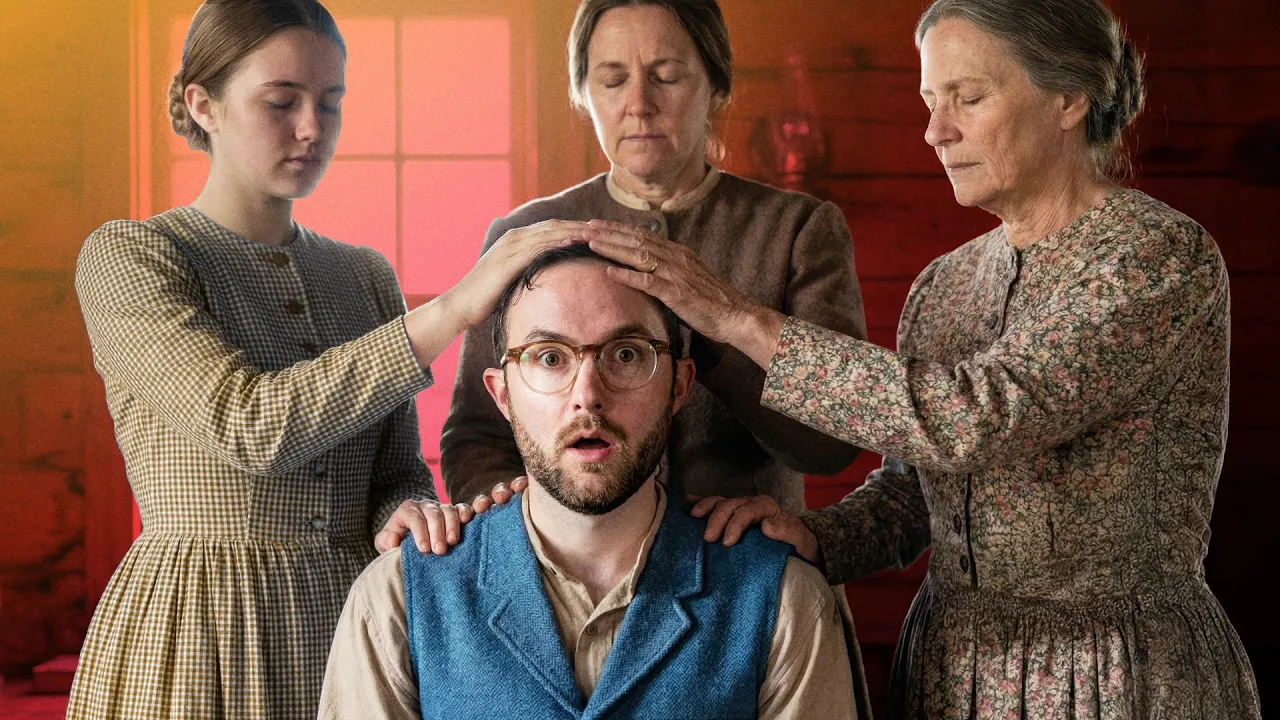
Source: This is why LDS women don’t give blessings (anymore) Channel: Keystone Published: May 11, 2026 | Archived: May 29, 2026
Video: This is why LDS women don’t give blessings (anymore)
Channel: Keystone
Published: May 11, 2026
Duration: 8:47
Views: 35,304
Category: Education
Video ID: i_svj9tGW3M
Description
For about 100 years, Latter-day Saint women were able to give blessings by the laying on of hands. Today, blessings are only given by ordained priesthood officers. What happened?
Most of the information for this episode comes from here: “Female Ritual Healing in Mormonism” by Jonathan Stapley & Kristine Wright: https://www.jstor.org/stable/23291588
Fun facts and notes:
— Another great quote from Brigham Young on this subject comes from an April 1844 general conference address: “I want a Wife that can take care of my chi\[ldre\]n when I am away—who can pray—lay on hands anoint with oil & baffle the enemy.” (Source: Thomas Bullock account of Brigham Young sermon, Special Elders Meeting, April 9, 1844. See also Stapley & Wright, pp. 9.)
— An interesting side-note: Today, we only administer a small amount of consecrated oil on the head of the individual receiving the blessing. In early years, various parts of the body could be anointed with oil, depending on where the wound or illness was active. One account even describes teeth being anointed. Sometimes, those in need of a blessing would even drink a small amount (I’m assuming it was a small amount) of consecrated oil.
— “The Relief Society was a driving force in progressive health reform. … from Brigham Young’s first calls to women to become physicians, to the establishment of the Deseret Hospital, founded in 1882 … promoting public health and hygiene, incorporating the topic in its curriculum, hosting lectures, and lobbying government officials. It also sponsored a nursing school and maternity hospitals in addition to supporting the Sheppard–Towner Act” (Stapley & Wright, “Female Ritual Healing” pg. 64, footnote 191).
— Only two months after President Penrose’s 1921 discourse, the practice of temple healing (in which men and women would serve as official healers in LDS temples) was discontinued. This was yet another blow to institutionalized female ritual healing.
Facebook: https://www.facebook.com/keystonelds/ Insta: https://www.instagram.com/keystonelds/ Website: https://www.keystonelds.com Apple podcast: https://tinyurl.com/3rx4cw4u Spotify podcast: https://tinyurl.com/33r9f737 Amazon podcast: https://tinyurl.com/5cendacy
Tags
lds mormon latter day saints jesus christ church saints unscripted david snell mormonism keystone priesthood healing women
Transcript — YouTube panel (human-authored)
0:00 For about 100 years, Latter-day Saint women were able to give blessings with consecrated oil by the laying on of hands. In contrast, today blessings are only given by ordained priesthood officers. I wanted to know what changed. And I knew just where to start because one of our previous guests, historian Jonathan Stapley, co-wrote an 85page article on precisely this question with Christine Wright. I locked in and what I found is a gamecher. Let’s lay some groundwork. I learned that female ritual healing began in the church in Kirtland, Ohio in the 1830s. When Wilfrid Woodruff was sick in 1838, his wife gave him a blessing. In 1837, there were patriarchal blessings specifically instructing women to administer to the sick by the laying on of hands. And they \[music\] did. It was a normal part of LDS culture. The women who gave blessings would not invoke priesthood authority, but oftentimes neither would the men. Men blessed women. Women blessed men.
1:03 Parents would bless their children. If you had faith in Christ, you could participate. On April 28th, 1842, Joseph Smith gave a landmark discourse to the Relief Society in Nauvoo. Respecting \[music\] the female laying on hands. There could be no devil in it. If God gave his sanction by healing, there could be no more sin in any female laying hands on the sick than in wetting the face with water. It is no sin for anybody to do it \[music\] that has faith or if the sick has faith to be healed by the administration. At the end of his remarks, he offered instruction respecting the propriety of females administering to the sick by the laying on of hands. Said it was according to revelation. This female culture of healing only grew stronger as the saints moved west to Utah. Both men and women were widely recognized in the church as healers. Women in Utah even washed, anointed, and blessed pregnant women before childbirth, a practice that became extremely common and was endorsed by church leadership. Now, since Joseph
2:06 clearly approved of women giving blessings, I wondered if maybe Brigham Young was responsible at some point for putting the kaibos on it. As it turns out, I was very wrong. He encouraged it on various occasions. My favorite being in 1869 when he taught women, “Why do you not live so as \[music\] to rebuke disease? It is your privilege to do so without sending for the elders. \[music\] It is the privilege of a mother to have faith and to administer to her child.
2:33 This she can do herself, \[music\] as well as sending for the elders to have the benefit of their faith.“ Fast forward to \[music\] 1880 and Brigham Young. Young’s successor, John Taylor, sent out this letter, which you can pause and read, reaffirming again the role women played in administering to the sick. Joseph Smith approved, Brigham Young. Young approved, John Taylor approved, Wilfr Woodruff approved. I was over 30 pages into this article, and it was abundantly clear that this practice was long-standing, widespread, and leader approved. But I still didn’t know what changed and why.
3:07 So I kept going and I learned that there’s not necessarily a simple answer. There was no groundbreaking revelation that prompted a sudden policy shift. The reality is that there was a cocktail of different factors and influences that slowly chipped away at this practice over time. Here are four of the biggest factors. Number one, shifting language. In 1900, a Relief Society presidency sent a letter to the first presidency asking if quote, “The \[music\] sisters have a right to seal the washing and anointing using no authority but doing it in the name of Jesus Christ or should men holding the priesthood be called in.” The Relief Society general president responded saying that sisters could anoint and seal the anointing. But the response also said this. President Joseph F. Smith expressed himself to the effect that in his opinion the word seal should not be used by the sisters at all, but that the word confirm might be substituted and that it should be used not in an authoritative way but in the
4:08 spirit of invocation. It’s not clear what the difference between sealing and confirming was at this time, but optically it sent the message that the participation of priesthood holders in blessings of healing was the ideal. This change was somewhat controversial at the time. One prominent member of the Relief Society noted that if women could not seal, then thousands of church members were laboring under a very serious mistake. Nonetheless, the change was adopted and the practice of women sealing anointings tapered off over the next couple of decades. Number two, canonization. Joseph’s foundational 1842 discourse was never canonized, but DNC42 was, which emphasizes calling upon the elders of the church to administer to the sick, as does James 5 in the New Testament. Thus, in 1903, the first presidency and quorum of the 12 moved that the practice be confined to the elders. But in the case of absolute
5:05 necessity, he may, if opportunity affords, avail himself of the company of a member of the ironic priesthood or \[music\] even a lay member. Even still, in 1905, the Relief Society banner still prioritized blessing the sick, and copies of Joseph Smith’s 1842 discourse were published in the 1913 and 1915 Relief Society periodicals. Number \[music\] three, institutional primacy. At the dawn of the restoration, Mormons were the only American church with institutionalized ritual healing. Both \[music\] Catholics and Protestants had abandoned the practice of ritual anointing for the healing of the sick.
5:42 But in the late 1800s, that started to change. Anointing and healing rituals started to become very popular within Protestantism. To further emphasize the church’s unique offering, leaders started to increasingly associate healing with priesthood authority. An editorial in a 1906 edition of the elders journal, for example, noted that God is able and is willing to respond to the ardent faithful prayers of his pleading children. Though healing with priesthood authority was the official way marked out by our Lord. This again sent the message that priesthood blessings were the ideal. Number four, codification. As the church grew and matured, it had to go through a process of formalization and codification. But the codification of female ritual healing largely fell through the cracks and became a matter of folk tradition quietly passed down orally rather than surviving as a formal \[music\] institutionalized practice as leaders worked to flesh out the structures and duties of priesthood quorums. Healing
6:44 blessings became even more exclusively connected with priesthood authority. Contrary to long-standing practice, President Charles W. Penrose taught in a 1921 general conference that women should not be set apart to administer to the sick \[music\] as that role belonged to the elders of the church. Around the same time, healing blessings by both men and women were discontinued in the temple and the relief society general board ruled that women should administer only in cases of expectant mothers and when the priesthood could not be obtained. By 1946, the dial had turned even further. Apostle Joseph Fielding Smith wrote that while the authorities of the church have ruled that it is permissible under certain conditions and with the approval of the priesthood for sisters to wash and anoint other sisters. Yet they feel that it is far better for us to follow the plan the Lord has given us \[music\] and send for the elders of the church to come and administer to the \[music\] sick and afflicted. This instruction was sent out
7:43 to local leaders and was included in the Relief Society handbook for decades. Over time, the generation familiar with female ritual healing passed \[music\] away and the practice faded with them. In the past, I thought that blessings intrinsically required priesthood authority to function. But our history suggests otherwise. \[music\] Instead, it seems that giving blessings is a task that has been delegated or assigned to priesthood \[music\] officers. Could that assignment change in the future? I don’t see why not. At the same time, just because something was done differently in the past doesn’t mean that our current policy is uninspired or wrong. I don’t know what our future holds, but understanding our past \[music\] has helped me make a lot more sense out of the present. Now, if you find it concerning that different leaders have had such drastically different perspectives on this topic as time has passed, I highly suggest \[music\] you watch this video, which provides a
8:41 really helpful framework for questions like these. Please \[music\] check it out. I’ll see you there.
- Reference: https://www.youtube.com/watch?v=i_svj9tGW3M
Write a comment