The Male Gaze is Uncool
Source: The Male Gaze is Uncool Publisher: Cartoons Hate Her | Author: Cartoons Hate Her Published: February 2, 2026 | Archived: March 21, 2026
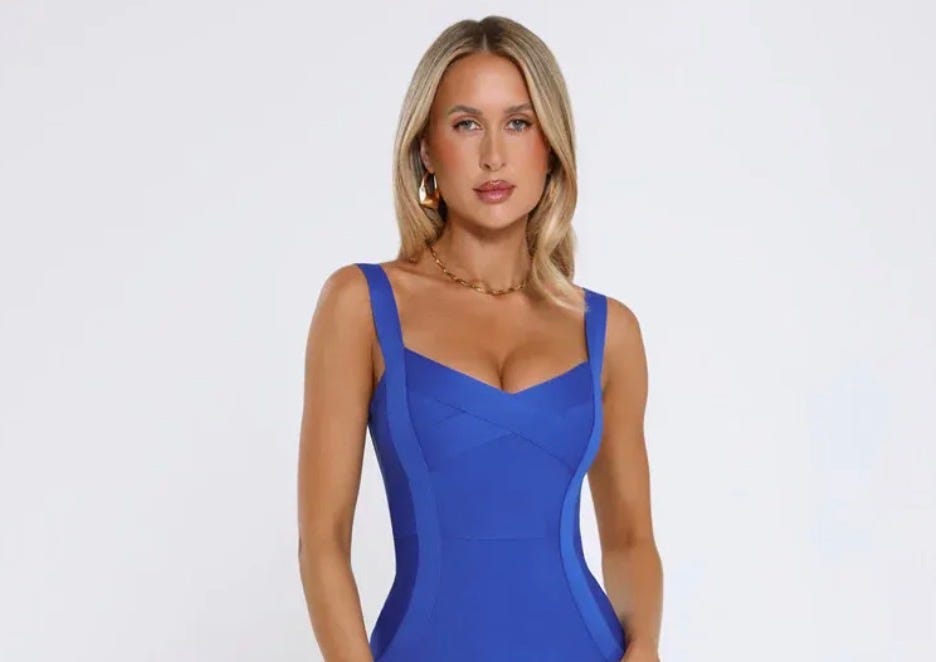
You can say many things about the below outfit and styling. The woman is (unless you plan on being obtusely oppositional for no reason) objectively attractive. She is wearing an outfit that highlights what makes her body attractive to men. This is the platonic appeal to the male gaze outfit.

*You can buy this dress here if you want.*
And I’m not just saying that because I have a porn-addled idea of what men are into. Trad guys keep insisting your average man fantasizes about hand-knit cardigans and modest linen skirts stained with raw milk and the blood of slaughtered oxen, but that’s not *really* true. When I polled a bunch of people (including straight men) on their preferred outfits for women, a dress almost [exactly like that randy blue number](https://www.cartoonshateher.com/p/dressing-for-the-male-gaze-the-female) topped the charts for straight men.
But (especially if you’re a woman) you might notice that this dress is painfully uncool. Cringe, even. Perhaps worse: *millennial*. In fact, despite constant headlines gaslighting me about how bandage dresses like this one are “[coming back](https://www.instyle.com/bandage-dress-trend-2025-vs-2007-11760118),” I have yet to see any real evidence of this, either on social media or in real life. In fact, bandage dresses are inherently antithetical to today’s womanly ideal of coolness, because for what might be the first time ever, there is virtually zero intersection between aesthetics that make someone look cool, and aesthetics that strongly appeal to the straight male gaze—and this is no accident.
I am not *happy* to say this, but ultimately, the male gaze is just not cool. And if you want to be cool, it requires not just indifference to the male gaze, but rejection of it. This isn’t a random trend or coincidence, and it’s also not really about fashion. But like all fashion changes over time, it says something fundamental about our current culture.
For the record, it wasn’t always like this. A while ago, I wrote about the fact that [sexy clothes](https://www.cartoonshateher.com/p/why-arent-sexy-clothes-high-fashion) just aren’t considered high-fashion, and I pointed out that in the ‘90s, they were! The bandage dress, shown above, made its runway debut in the early ‘90s via [Herve Leger](https://www.youtube.com/watch?v=58qRPhA6yZ4), and as far as I know, people did not see it as cringe, trying-too-hard, or basic. In fact, while it was hardly universal, plenty of ‘90s runway photos show outfits that were clearly intended to be stylish, visually interesting, and indisputably *hot*. Yes, in a straight man way. It wasn’t a requirement to highlight the shape of the body, but highlighting the shape of a body did not make an outfit “cringe,” let alone “millennial.” (I guess it helps that at the time, millennials were playing with Fisher Price light-up phones and those fairy dolls that got recalled after slashing everyone’s corneas, but still.)
s_!1Ae6!,w_1456,c_limit,f_auto,q_auto:good,fl_progressive:steep/https%3A%2F%2Fsubstack-post-media.s3.amazonaws.com%2Fpublic%2Fimages%2Fb85eca41-0111-4f95-a75b-4d9647ca0440_640x960.webp) Versace, 1994
Versace, 1994
But these days are over. In 2026, the world of “clothes that regular, non-artsy, non-intellectual straight men like” and “clothes that make you a Fashion Person” are two completely separate Venn Diagram circles, with basically zero overlap.
(This is not to say that “weird” unsexy high-fashion didn’t exist in the ‘90s. But dressing in a way that was unambiguously attractive to men was not mutually exclusive with appearing cool.)
First, when I talk about “clothes straight men like,” I will clarify because I know straight men are not a monolith (#notallmen like leggings, I know). But if I may say something controversial, straight men enjoy looking at women’s bodies. They have even been rumored to enjoy putting their penises in vaginas. That doesn’t mean your average straight man wants you to wear a skintight fishnet crop top with iridescent stars over your nipples like you’re going to Coachella, but any outfit that emphasizes the shape of the female form will probably appeal to straight men more than an outfit that doesn’t. This holds true even if the outfit is not ultra-trendy or intended to be sexy. Between the two modest photos of Kate Middleton below, the yellow outfit will probably appeal to straight men more because it highlights her figure, even though the overall aesthetic/mood is the same as the red one. The red one might be cool, but given that it’s basically cloak-adjacent, it’s not going to be as appealing to men. This is not just a generalization based on my assumptions; it was reflected in my survey.

s_!qKMz!,w_1456,c_limit,f_auto,q_auto:good,fl_progressive:steep/https%3A%2F%2Fsubstack-post-media.s3.amazonaws.com%2Fpublic%2Fimages%2F18b12514-45e6-4af6-9397-20b0e6d9daf5_800x1210.avif)
This is doubly true if the less figure-skimming outfit is deliberately weird or artsy. The below outfit, for example, just screams “you wouldn’t get it” to any straight man who may cross its path. I doubt any straight man would reject a woman over such attire, but if they were asked for their preference this one would not top the list.

Appealing to the male gaze is obviously done very easily by wearing something tight and revealing, but it’s a bit more complicated than that. The yellow dress worn by Kate Middleton is still “pandering to the male gaze” to some extent. It’s still male-gaze-coded to wear things that are reasonably modest, but flattering, classic and unsurprising in their presentation, following the same basic shape that highlights the waist.
You don’t need to be wearing clubwear or “sexy clothes” to be something that appeals to the male gaze. The below [outfit](https://www.tiktok.com/@brenna_anastasia/video/7479198564887907630), for example, is something I would consider male-gaze coded without being remotely revealing:
s_!D2jk!,w_1456,c_limit,f_auto,q_auto:good,fl_progressive:steep/https%3A%2F%2Fsubstack-post-media.s3.amazonaws.com%2Fpublic%2Fimages%2Fdb3876c0-3342-4457-8397-1b96e84a55e3_724x1156.png)
I can’t fully explain it, but I kind of have straight man taste. Maybe I’m just painfully basic and millennial, but I can’t decouple my preference for figure-skimming, deliberately pleasant-looking clothing with the fact that I’ve been told, overtly and covertly, that these things make women look better to men. Even when I attempt to “dress for myself” I have a hard time appreciating any outfit that completely obscures my shape. And as much as I could do the libfem thing and claim to only coincidentally enjoy clothes that make me look attractive (See: “I wax my pubes for myself, I have sensory issues!”) I have to just be honest and say it’s impossible to really identify what’s “for me” in a vacuum when I don’t live in a vacuum.
But as I’ve gotten older, my preference has leaned away from stretchy clubwear from Wet Seal, and into things that feel more appropriate for my age and lifestyle (36, married mother.) I enjoy belted structured blazers, high-waisted wide leg jeans with tight turtlenecks, and long rib-knit sweaterdresses—all things that showcase the figure but don’t scream “hanging around the table to mooch off bottle service.” But even as I age into some degree of modesty, I have a hard time with the idea of wearing two things that are deliberately baggy, not highlighting my waist at all, or anything else deliberately ugly for the sake of intentional, artsy ick. In other words, I cannot look cool.
Things start to get anti-male-gaze when you combine the obfuscation of the female form along with deliberate weirdness or ugliness. When I look at the following photos of fashion icon Bella Hadid, my inner straight man (I’m calling him Dale, he/him) really only appreciates the sexy cowgirl one on the far right. The first two look irredeemably ugly, but they also feel intimidating, like the first time I watched Twin Peaks and posted to Reddit to ask everyone “what is going on” and got downvoted mercilessly for being too stupid to get it. Seriously—an olive green khaki jacket with slightly mismatching shades of khaki for a sweater and a skirt, and then a weird red/orange bag? A gray plaid knee-length skirt with an athletic blue rugby shirt and…a hairdo that looks like a girl from your third grade class who came back from a family vacation to the Bahamas? What am I missing here? Why are these outfits supposed to be good?

Obviously, most women don’t dress like Bella Hadid in *any* of these images. It feels worth mentioning that most people—yes, even most young women—do not think that much about fashion at all. Their interest in fashion begins and ends with wanting to look reasonably presentable and occasionally buying something from LOFT if they absolutely have to go shopping. But if you enjoy some degree of appeal to the male gaze *and* you want to look cool, like a “[fashion insider](https://www.cartoonshateher.com/p/you-look-better-when-you-try-hard),” some might say—sorry, but you have to pick one. This is a relatively new conflict of interest that didn’t always exist. When I was a kid, the idea of a woman who was “into fashion” conjured up images in my mind of an attractive, traditionally feminine woman in sky-high heels and a slinky cocktail dress. A fashionable, cosmopolitan woman was Carrie Bradshaw from *Sex and the City—*sometimes a bit kooky-looking, yet sexily-dressed above all. But as I follow fashion trends each year, there seems to be a gradual ratcheting up of “how many men can I repel?” I mean, I refuse to believe barrel jeans existed for anything other than a prank:
s_!KiZv!,w_1456,c_limit,f_auto,q_auto:good,fl_progressive:steep/https%3A%2F%2Fsubstack-post-media.s3.amazonaws.com%2Fpublic%2Fimages%2F72d29fef-2965-46a1-aabb-c4793486a2b6_1065x1724.webp)
Versus, say…

Perhaps all of this began with the OG Man Repeller herself, Leandra Medine Cohen, in the 2010s. She began her fashion blog, literally called *The Man Repeller*, and described it as “outfitting oneself in a sartorially offensive way that will result in repelling members of the opposite sex.” And it was *wildly* popular.
s_!pi-G!,w_1456,c_limit,f_auto,q_auto:good,fl_progressive:steep/https%3A%2F%2Fsubstack-post-media.s3.amazonaws.com%2Fpublic%2Fimages%2F02170bef-0e2f-43a2-b698-4b8ccd65930b_2048x2732.webp) The OG Man Repeller
The OG Man Repeller
But Man Repeller is no more. They shut down about five years ago. And not because people wanted something sexier and more conventionally flattering, but rather because the very concept of deliberately repelling men was no longer interesting—everyone was repelling men. Per a 2020 Refinery article announcing the blog’s closure:
While 10 years ago, the concept — dressing in defiance of the opposite sex — was lauded for its girl-power approach to dressing with complete disregard for the male gaze, now the (very heteronormative) idea that we ever dressed for men seems wildly outdated.
Obviously, the word “heteronormative” is being used here so we can assume this is, to some extent, a vestige of the 2020 fever dream. But I don’t want to dismiss this quote, because it’s exactly what happened. Leandra Medine Cohen walked so many Gen Z fashion girls could run by repelling men as the default. Man-repelling is only an interesting concept if it’s a deviation from the norm, and it no longer is. Today, a fashion blog called Man Repeller makes about as much sense as a mommy blog called Child Haver.
I should point out something else about Man Repeller, because I would be remiss not to mention it: Cohen experienced controversy around the 2020 BLM protests which I still can’t fully understand, but basically, she had posted in support of BLM on Instagram and defaulted to linking to “anti-racism resources.” But she faced massive backlash for “performative activism” and refusing to “look inward and learn.” This was what counted for a racist controversy in 2020—it really was another time! (Did white male bloggers face this same pressure? Hmm…hahahahah of course not.) Cohen was later criticized for not just surrendering the entire company to more marginalized voices and blasted for the fact that had things been done correctly, she would have handed the entire blog over to other people. Per her critics, Man Repeller would ideally be a “space for non-binary and Black voices,” or better yet, “a place for queer people to take over.” You heard the people: forget about your life’s work, just hand it over the BIPOC, queer and nonbinary populations and retire yourself to the sewers like a dead goldfish. But anyway, I don’t think this particular “controversy” was responsible for Man Repeller’s downfall. Per the earlier quote, people just didn’t have the same excitement about the once-groundbreaking concept of repelling men. By 2020, in the fashion world, the concept of repelling men was about as edgy as an artisanal cocktail made with rosemary and hibiscus.
Of course, there’s something good about women wearing clothes for their own enjoyment without asking themselves “does this jacket make me look boxy?” or “does this skirt make my legs look short?” because they’re afraid of what a man might say or think. After all, we were coming off an era (the 2000s) when Maxim could randomly post a list of the “unsexist women,” and women were a little tired of being analyzed under the constant lens of “does she make my penis hard enough? And if not, HOW DARE SHE???” There is also something to be said for, even if you have positive feelings about men, allowing yourself to enjoy fashion in a way that just doesn’t center men. On some level, I enjoyed this when I was pregnant, because I had no desire or interest in appearing sexually attractive and I was able to channel my inner love of Regency styles by sewing some epic empire waist gowns. Removing the goal of wanting to “flatter” my figure opened me up to many creative options, such as this pretty dress I made myself (although you’ll notice that even without the male gaze in mind, I still do not enjoy looking edgy or ugly.)

So I don’t think this shift away from male-gaze-pandering is necessarily 100% bad. Fashion is, of course, an art form, and constantly centering it around how to look hot is eventually going to get boring and uncreative. But it’s hard not to notice how how the rise in man-repelling-as-default-cool-state coincided with a rise in [sexlessness](https://ifstudies.org/in-the-news/adults-are-having-less-sex-than-ever-with-gen-z-seeing-the-steepest-decline-study) among Gen Z (and to some extent, single millennials.) Some people present it as a bit of a chicken and egg thing—they will smugly blame “falling birth rates” on ugly clothes, as if our meemaws weren’t being railed in shapeless floral polyester house dresses. But the rejection of the male gaze—not just indifference to it, but the rejection of the male gaze *as a prerequisite for being* *cool*—is a response to how little male attention is actually valued among today’s young women. Or at least, how little young women want people to *think* they value it.
The rejection of the male gaze for “coolness” also reflects the fact that people wear clothes in part because the clothes they choose fit their lifestyles. As a mom, I refuse to give up “millennial” crossbody bags because I, frankly, need both hands to be free to wrangle my children and I really don’t have time to delicately hinge a quirky little Osoi shoulder bag on my already-too-narrow sloping shoulders while chasing a two-year-old down a busy street. There is a reason why working women are more likely to wear non-stretch blazers on any given Tuesday, while a homemaker might opt for a sweatshirt and leggings. Young women today are dressing for their lifestyle. And no matter how you shake it, that lifestyle includes fewer [parties](https://www.derekthompson.org/p/the-death-of-partying-in-the-usaand), less sex, less going out, and less social interaction. See: loungewear sweatsuits being *super in vogue* when remote work was at an all-time high. This all begs the question of how much of a role men play in the lives of young single women today. If the numbers are accurate, the answer is: not much!
s_!1v84!,w_1456,c_limit,f_auto,q_auto:good,fl_progressive:steep/https%3A%2F%2Fsubstack-post-media.s3.amazonaws.com%2Fpublic%2Fimages%2F66273f43-194b-4953-a9ab-6e87af85fa00_4000x3200.jpeg)
The best way to think about this is the fact that pandering to the male gaze used to coincide with coolness, even if it wasn’t required. When I think of how I envisioned a “cool girl” when I was in high school (in the 2000s) it was a girl who was confident, popular, stylish, and men wanted her. It wasn’t cool to be desperate to attract men (desperation is never cool) but the idea of walking down the street and having men turn their heads was cool. At least it was cool to me.
Today, it feels different. In fact, turning heads feels uncool. People defend Sabrina Carpenter’s supposed male-gaze-pandering sexual provocations with the defense that she’s actually doing it ironically and she’s really “for the girls.” But this was not a defense you needed to make about your favorite celebrity in 2002. People were not arguing over whether Britney Spears or Christina Aguilera was only doing the whole sexpot thing ironically to do a wink-wink-nudge-nudge to her fellow sisters about how much men suck. Men liking them did not make them cringe or uncool, although they were obviously on the receiving end of various forms of shaming (body, slut, the list goes on.) A more modern example: Taylor Swift has always been unambiguously boy-crazy, given that all her songs are about men, loving men, and breaking up with men (and dare I say, this is part of why part of her appeal is in her dorkiness) but she was considered far less cool (even MAGA!) after getting engaged to a man.
Of course, there were edgy, cool women in the ‘90s and ‘00s who did not appeal to men in a mainstream way. Sinead O’Connor was cool, in part because of her shaved head and general edge. But remember: wearing things that were deliberately obscuring, unflattering or “man-repelling” was not required for coolness or fashion-insider-ness for most of fashion history, even if some people did this and were cool. And as Meryl Streep in The Devil Wears Prada would have you know, many of the “basic” fashion staples of today—the boringly flattering ones egregiously associated with millennials or people even oldeer—were once high-fashion runway statements.
When I was in high school, we had a class for seniors that was basically a mini-college-thesis. We spent an entire semester researching to death any topic of our choosing. I chose 1950s fashion, specifically as it related to World War 2 and economic and technological events of the time. What I found is that the silhouette we associate with the 1950s—the extremely “classic” if not basic, uncreative idea of a cinched in waist, full skirt and tight bodice, now found everywhere from J Crew to Ann Taylor to shitty rockabilly sites—was at one point a groundbreaking high fashion statement. Even though fashion gets a bad reputation for being a vapid, frivolous hobby, fashion trends are always an artful reflection of the times in which we live. Christian Dior’s 1947 New Look (pictured below) reflected many themes of the era: economic prosperity, the end of war-era scarcity (more material could be used, skirts could be lengthened) plus women’s return to the home (many women worked men’s jobs during World War 2.) We also saw the invention of polyester around this time, which didn’t fade like cotton, and this new groundbreaking fabric (hardly Shein-coded yet) popularized wearing crisp pastels and brights, which wouldn’t fade as much. See: the groovy technicolor polyester garments of the ‘60s and ‘70s.
The New Look of 1947 is what we see today as a classic silhouette that we might be able to approximate in a more contemporary way with pedestrian, “basic” mall brands.

If we can see how the end of World War 2 could bring about a total upheaval in women’s fashion, it stands to reason that the trends of our modern era also reflect our politics, our lifestyles, and the general zeitgeist. And I’m sorry, but the mood of 2026 is that it’s cringe to care about what men think. The male gaze is uncool.
This isn’t necessarily about a far-left, gender-non-confirming rejection of heteronormativity (although it probably was in 2020—again, it’s okay to plead temporarily insanity.) Today, you see this kneejerk rejection of male preferences and opinions among women who *like* men and are unambiguously straight. And this is where I think it gets more complicated than “male gaze bad.” For many of these women, perhaps subconsciously, there is a flex to be able to attract men without trying. Or better yet, to be able to attract men while deliberately making it as difficult as possible. To put this in terms men understand: it’s fine to buy a woman a drink, but you know you’re *really* hot if a woman is paying your rent.
I saw a young woman on a train a few weeks ago who exemplified this perfectly. Now, I don’t actually know her, so it’s entirely possible she was a lesbian, or asexual, or something else, but I somehow very much got “straight” vibes from her, despite the fact that she was dressed in the most deliberate Man Repeller way possible. She wore Ugg slippers, extremely baggy jeans, and then a boxy, oversized, brown suede jacket. It was impossible to tell if she had a ruler-shaped body, hourglass-shaped body, pear-shaped body, or had the body of something out of a David Cronenberg film with three separate vaginas and one singular ass cheek. But—and this might be the most crucial detail—her hair was perfectly straightened. She was wearing very flattering no-makeup makeup. She had obvious lip filler! So she wasn’t actually rejecting the male gaze in a revolutionary anti-heteronormativity way. I would have put money on her being attracted to men, having interest in dating men, but using a “costly signal” to showcase her value. (Alternative theory: I am a creep who stares at young women on trains. When you’re a woman they let you do it.)
A [costly signal](https://en.wikipedia.org/wiki/Costly_signaling_theory_in_evolutionary_psychology), in evolutionary psychology, is a seemingly disadvantageous physical trait that nevertheless makes one more appealing to mates. The prime example is the male peacock’s feathers, which take time and energy to maintain, and ironically make him more vulnerable and visible to predators. And yet, if a male peacock is able to stay un-eaten *in spite of his colorful plume*, he is signaling even more virility and strength to the females of the species. Basically, “If I can get away with looking this ridiculous, I must really be a Chad.”
Examples: from Copenhagen’s Spring 2026 fashion [week](https://wwd.com/fashion-news/fashion-trends/gallery/best-street-style-copenhagen-spring-2026-fashion-week-1238028964/best-street-style-from-copenhagen-spring-2026-fashion-week-photos-15/):
s_!sWMI!,w_1456,c_limit,f_auto,q_auto:good,fl_progressive:steep/https%3A%2F%2Fsubstack-post-media.s3.amazonaws.com%2Fpublic%2Fimages%2F29f5a37e-3cb8-4853-9e7d-ebbbf491f93e_2000x1332.webp)

s_!gcck!,w_1456,c_limit,f_auto,q_auto:good,fl_progressive:steep/https%3A%2F%2Fsubstack-post-media.s3.amazonaws.com%2Fpublic%2Fimages%2F0702cc21-c173-4f42-b872-e4e8ec91976a_640x926.png)

I don’t think most women are employing this strategy purposefully. I believe the women in the photos above might just really love fashion in a way that is completely divorced from their thoughts about men. But I have seen some evidence that sometimes, the costly signal is at least *somewhat* deliberate. Around the late 2010s, I saw an article declaring that layered haircuts were cringe/bad/out. Their logic was that women had become more enlightened about the fact that they didn’t *need* to have long hair, and that layers sent the message that you were desperately clinging to long hair to seem attractive in a very typical way. They *almost* said the quiet part out loud, which is that a woman who looks hot with a bob is probably hotter than a woman who only looks hot if her hair is long.
s_!djTm!,w_1456,c_limit,f_auto,q_auto:good,fl_progressive:steep/https%3A%2F%2Fsubstack-post-media.s3.amazonaws.com%2Fpublic%2Fimages%2F7b6c2bb7-9184-476e-90dd-c84e3d3a157e_2000x3000.avif) Hot in an “obvious” way. Gorgeous, but NOT cool.
Hot in an “obvious” way. Gorgeous, but NOT cool.
There is quiet status behind being able to attract male attention not only without trying, but trying aggressively to ward it off. The reason bandage dresses are uncool isn’t just because they’re dated. It’s because they signal that a woman is unironically trying to look good for men. You know who really needs to try to look good for men? Ugly chicks.
This attitude doesn’t hold true everywhere. In right-wing circles, openly wanting to attract men isn’t embarrassing and is likely to signal something positive about your “feminine virtues” as opposed to something negative about your desperation and trying-too-hardness. This is why right-wing influencers are so much more dolled up and classically feminine-looking than liberal or apolitical fashion bloggers. Notably, there aren’t many Republican high-fashion bloggers, and that’s for a reason. You cannot have a Republican aesthetic and look cool!

*Yes, I have this outfit. No, I am not proud.*
A while ago I [wrote](https://www.cartoonshateher.com/p/no-a-dress-isnt-a-right-wing-statement) about the panicked liberal headlines asserting that wearing floral dresses was a right-wing dogwhistle. I put together the below political compass meme to illustrate the fact that even if feminine dresses in and of themselves aren’t right-wing, the only way to wear them in a way that *doesn’t* seem vaguely right-wing is to ratchet the camp levels up to “doing a satire on femininity,” like in the case of Lolita styles, or wearing something deliberately “ugly” or masculine with the otherwise classic feminine style, as if to add a disclaimer that just in case anyone got the wrong idea, you *aren’t desperate for male attention.* This can be done with a pair of ugly sneakers or a funky weird coat. Basically, it’s not the femininity that’s the problem—it’s earnest, non-satirical femininity.
s_!1VyA!,w_1456,c_limit,f_auto,q_auto:good,fl_progressive:steep/https%3A%2F%2Fsubstack-post-media.s3.amazonaws.com%2Fpublic%2Fimages%2F4cdfa5de-7674-425b-8501-16ec5edbfcde_812x798.webp)
Being visibly right-wing is just not cool. For that matter, neither is being visibly left-wing, but there’s something “cringe” about any aesthetic that signals desperation to make people—of any gender, for any reason—like you. If you have a left-wing aesthetic that screams “Look at how progressive I am, I’m such a good ally,” that is also not cool. I have never seen someone look cool with any politically-motivated button on a backpack. There is a reason that Old Money aesthetics got extremely embarrassing extremely fast. They signal “I promise I’m one of you! Please invite me to your game of Boar on the Floor!”

*Oh yes, this is totally how Old Money people dress.*
And while we’re on the Old Money topic, one of the key parts of this ongoing conversation/argument is the fact that *real* Old Money people wear “[ratty sweaters](https://www.cartoonshateher.com/p/what-the-old-money-fashion-aesthetic)” and “old stained rainboots.” Ergo: to seem really high-status you have to try as little as possible, not because you truly don’t care but because it’s all a switcheroo scheme to seem the *most high status* by showing the least desperate effort. The “Old Money” influencer who wears an over-the-top country club costume with a fascinator and gloves looks lower-status than a “real” Old Money person who wears a well-worn wool fisherman sweater from ten years ago. Someone who really cares about seeming Old Money will opt for the sweater, because unlike a *real* Old Money person, they are playing 4D dress to try to seem as rich as possible.
This is what I suspect is happening with the male gaze. Clothes that don’t seek to attract men—or better yet, clothes that seek to actively repel men—also signal non-desperate desirability, and something appealing to other women, which I and many other women experience as “cool.”
I was at a toddler class with my daughter the other day and a mom came in dressed in a way that I found so cool that I couldn’t stop staring. The leering creep strikes again. Keep in mind that at these classes, most moms are just wearing leggings, and nobody is making a deliberate statement. In fact, as much as I love dressing up, I was wearing leggings and a sweatshirt that day. But one mom arrived in a chunky, oversized red sweater draped over a loose, midi-length, black and white gingham skirt, hair in a claw clip, statement gold earrings, and subtle (but very flattering) makeup. (Not totally relevant, but she was there with her toddler son who was wearing some kind of elven-style red knit pointy hat like a child who gets lured away in the forests of Sweden by a band of lingonberry fairies.) I could tell that she was into fashion, even as a mom, and that was cool! But she was decidedly much cooler than a theoretical gym bunny mom who would show up in a crop top and skintight butt-ruching leggings.
Now, would a man prefer the second hypothetical woman’s looks? Probably. But that’s what made the first (real) woman’s look so cool. She still looked pretty, and I have no doubt that she has a handsome husband (we did get talking and yes, she did mention a husband, so no, I am not making a “heteronormative” assumption!) But she was pretty enough that her non-male-gazey outfit felt like she could afford to do it. She looked cool. She didn’t have to try so hard to look hot, because as they say (in very different words) trying hard is cringe and lame and only needs to be done if you aren’t naturally hot in the first place. So perhaps the rejection of the male gaze is actually just a new way to signal it, to filter it, to show off just how much you can get away with, unlike those cringe millennials squeezing their Zumba butts (gosh, remember Zumba? lmao) into skintight jeans with stilettos to desperately show the world that they’ve still got it.
I don’t know what this means for me, because as I reach a new era in my life, I don’t know if I’m really dressing for the male gaze in the typical sense. On date nights, I would like to look attractive for my husband of eleven years, but there is zero reason for me to look hot for Men on a day-to-day basis. Even sometimes on our date nights, I start disliking my outfit if I feel it’s simply too House of CB, too Skims, too *obviously* hot. My husband can see me naked whenever he wants. Given that I don’t want male attention from anyone other than him, it might even make sense for me to lean into a little bit of Man Repelling (or at least *not* Man Attracting) if I’m running errands, seeing friends, or doing things that have nothing to do with him. I get the coolness and fun of man-repelling, without the ding to my romantic life.
After thinking about this stuff all week, I ran this conversation by my husband after he went on a business trip to Los Angeles and I asked him to describe the fashion he saw on the street, hoping for some inspiration and insider info. I said, “I feel like my problem is I come off as cringe and millennial because I just do try *too* hard to look attractive.” He motioned to my oversized homemade cotton pajamas and chunky cardigan and said, “Well, you could have fooled me!”
s_!qLbI!,w_1456,c_limit,f_auto,q_auto:good,fl_progressive:steep/https%3A%2F%2Fsubstack-post-media.s3.amazonaws.com%2Fpublic%2Fimages%2Feffbc7e9-0b37-41a3-adfb-8d2bcc7d99d9_4000x3200.jpeg)
Write a comment