Technology and Jobs

Back in ’21 one of the world’s most eminent economists reversed his views about the impact of technology on workers. Previously he had argued that technological innovations that raised productivity would almost surely benefit the great majority of workers. But he now conceded that the latest technological advances, while making society as a whole richer, might well hurt the working class and lead to reduced employment.
What you should know is that when I say “’21” I mean *1821*. The economist in question was David Ricardo, who published the first edition of his classic book *Principles of Political Economy and Taxation* in 1817. The [third edition](https://historyofeconomicthought.mcmaster.ca/ricardo/Principles.pdf#page=3.00), published in 1821, included a chapter titled “On machinery,” about the early stages of the Industrial Revolution. In that chapter he laid out a theoretical model reflecting what seemed to him to be the defining characteristics of the new factory system, and declared
> I am convinced, that the substitution of machinery for human labour, is often very injurious to the interests of the class of labourers.
In the very long run he was clearly too pessimistic. By the late 19th century workers were clearly benefiting massively from the effects of the Industrial Revolution. He may, however, have been right about the early 19th century. I’ll get to that story later in this primer.
For now, my point is that while some people seem to imagine that concerns about the effect of technology on jobs and wages are a novel insight, the truth is that these concerns have been around for two centuries. And not just in economic tracts: Fears that technological progress would cause mass unemployment have been a recurrent theme in speculative fiction. For example, Kurt Vonnegut’s first novel, *[Player Piano](https://en.wikipedia.org/wiki/Player_Piano_MATHPH1XEND)*, published in 1952, envisaged a future dystopia in which automation has eliminated work.
So far such predictions have been mostly wrong — but not always, and not for all workers. And it’s at least possible that the technology everyone is calling AI will be the job-killer writers and some economists have feared for generations, although I’m skeptical.
Today’s primer won’t settle the controversies over the impact of AI on jobs. I will, however, try both to offer some historical perspective and to clear up some common confusions about the relationship between technology and employment. Beyond the paywall I will address the following:
1\. How technology can and often does destroy jobs in particular industries and occupations
2\. Why you can’t extrapolate from examples of sectoral job destruction by technology to make predictions about overall employment
3\. When and how technology can hurt overall employment and wages
4\. *Will* AI hurt overall employment and wages?
5\. AI and Energy: A Fork in the Road
*Technology can and does destroy jobs*
In 1978, according to the Bureau of Labor Statistics, roughly a million Americans — about 1 percent of the overall work force — were employed as typists, and the BLS expected their number to grow over time. I personally remember those days. I wrote my first few academic papers longhand on legal pads, leaving alternate lines empty so I could cross out and replace text. A secretary would then type them up. In my early career MIT’s economics department had one secretary for every three faculty members.
Robin Wells, my wife, who plays a crucial role in brainstorming and editing this newsletter, typed up papers for professors during her undergraduate days at the University of Chicago as part of her work-study program.
These days, typing as an occupation has almost disappeared:
s_!ZG3k!,w_1456,c_limit,f_auto,q_auto:good,fl_progressive:steep/https%3A%2F%2Fsubstack-post-media.s3.amazonaws.com%2Fpublic%2Fimages%2F2601955d-48f3-4e43-89e9-4e15b5ad5550_900x572.png)
Source: Bureau of Labor Statistics, 1978, 2000-present
Where did the typing jobs go? Personal computers — first desktops, then laptops — took them away. Almost everyone began writing memos, reports, etc. directly on a keyboard, obviating the need for skilled typists taking dictation or reading handwritten scrawl. I never properly learned touch-typing, but my enhanced hunt-and-peck technique is good enough when you compose your first draft on your computer.
Why did technological progress eliminate a million typing jobs? Because there was a limited demand for typed material, and technology allowed us to satisfy that demand with fewer workers.
One can tell similar stories — jobs disappear because technology allows us to satisfy demand with fewer workers — for many industries. Take the case of coal. Here’s the history of U.S. coal production (blue line) and employment of coal miners (red line), both expressed as indexes with 1949=100:
, [FRED](https://fred.stlouisfed.org/graph/?g=1N9Wo) U.S. coal production peaked in 2008 and has declined rapidly since then in the face of competition from both fracked natural gas and renewable energy. But coal mining as an occupation had largely disappeared long before coal production peaked. In 1949 there were 475,000 coal miners. In 2008, only 70,000 coal miners were employed, yet they produced 2 ½ times as much coal as in 1949. Why did coal mining jobs disappear? The answer is technology. Strip mining, using giant power shovels, and mountaintop removal, using high explosives, replaced traditional, labor-intensive underground mining. Just as in the case of the lost typing jobs, innovations in coal mining technology destroyed the jobs of hundreds of thousands of coal miners. Technology has allowed us to satisfy demand with many fewer workers. While few mourn the passing of the age of typewriters, there is widespread nostalgia for the era of traditional coal mining, even though they were terrible jobs that brought disability and early death. Why? Because coal mining is geographically concentrated. As a result, entire communities were gutted when the jobs disappeared. Moreover, as a “manly” job, coal mining was considered a way of life. Typing jobs, on the other hand, were “female-coded” and dispersed around the country. So there are no country music songs about being a typist’s daughter. But the underlying logic of job-destroying technology in typing and coal mining is the same: demand for a given product is limited, and technology makes it possible to meet that demand with fewer workers. This same logic applies to entire sectors of the economy. For example, in the 1950s about [30 percent](https://fred.stlouisfed.org/graph/fredgraph.png?g=1NaU2&height=490) of American workers were employed in manufacturing. Now, that number is down to 8 percent. While globalization and trade deficits played an indisputable role in the decline of American manufacturing jobs, it was a much less significant factor than most people think. According to a careful [recent estimate](https://www.piie.com/blogs/realtime-economics/2025/closing-trade-deficit-would-barely-raise-share-us-manufacturing) by Robert Lawrence of the Peterson Institute for International Economics, eliminating the U.S. trade deficit would only raise the share of manufacturing from 8 percent to 10 percent. That implies that the great majority of the decline in American manufacturing jobs was due to technology. Here’s total U.S. manufacturing output (blue line) and manufacturing employment (dashed green line) since 1987, both with 1987=100: s_!Lah4!,w_1456,c_limit,f_auto,q_auto:good,fl_progressive:steep/https%3A%2F%2Fsubstack-post-media.s3.amazonaws.com%2Fpublic%2Fimages%2Fba43d8b2-435f-4268-8b28-2275a2b7f8d5_800x450.png](https://substackcdn.com/image/fetch/\(s_!fFEV!,w_1456,c_limit,f_auto,q_auto:good,fl_progressive:steep/https%3A%2F%2Fsubstack-post-media.s3.amazonaws.com%2Fpublic%2Fimages%2F2a146e41-b72a-40e1-9572-8a8010ab1457_1248x744.png)
Source: [Department of Energy](https://www.eia.gov/coal/annual/), [FRED](https://fred.stlouisfed.org/graph/?g=1N9Wo)
U.S. coal production peaked in 2008 and has declined rapidly since then in the face of competition from both fracked natural gas and renewable energy. But coal mining as an occupation had largely disappeared long before coal production peaked. In 1949 there were 475,000 coal miners. In 2008, only 70,000 coal miners were employed, yet they produced 2 ½ times as much coal as in 1949.
Why did coal mining jobs disappear? The answer is technology. Strip mining, using giant power shovels, and mountaintop removal, using high explosives, replaced traditional, labor-intensive underground mining. Just as in the case of the lost typing jobs, innovations in coal mining technology destroyed the jobs of hundreds of thousands of coal miners. Technology has allowed us to satisfy demand with many fewer workers.
While few mourn the passing of the age of typewriters, there is widespread nostalgia for the era of traditional coal mining, even though they were terrible jobs that brought disability and early death. Why? Because coal mining is geographically concentrated. As a result, entire communities were gutted when the jobs disappeared. Moreover, as a “manly” job, coal mining was considered a way of life. Typing jobs, on the other hand, were “female-coded” and dispersed around the country. So there are no country music songs about being a typist’s daughter.
But the underlying logic of job-destroying technology in typing and coal mining is the same: demand for a given product is limited, and technology makes it possible to meet that demand with fewer workers.
This same logic applies to entire sectors of the economy. For example, in the 1950s about [30 percent](https://fred.stlouisfed.org/graph/fredgraph.png?g=1NaU2&height=490) of American workers were employed in manufacturing. Now, that number is down to 8 percent. While globalization and trade deficits played an indisputable role in the decline of American manufacturing jobs, it was a much less significant factor than most people think. According to a careful [recent estimate](https://www.piie.com/blogs/realtime-economics/2025/closing-trade-deficit-would-barely-raise-share-us-manufacturing) by Robert Lawrence of the Peterson Institute for International Economics, eliminating the U.S. trade deficit would only raise the share of manufacturing from 8 percent to 10 percent.
That implies that the great majority of the decline in American manufacturing jobs was due to technology. Here’s total U.S. manufacturing output (blue line) and manufacturing employment (dashed green line) since 1987, both with 1987=100:
s_!Lah4!,w_1456,c_limit,f_auto,q_auto:good,fl_progressive:steep/https%3A%2F%2Fsubstack-post-media.s3.amazonaws.com%2Fpublic%2Fimages%2Fba43d8b2-435f-4268-8b28-2275a2b7f8d5_800x450.png)
What this shows is that while U.S. industry is producing 57 percent more than in 1987, it is doing so with 27 percent fewer workers. It’s the same phenomenon that happened to typing jobs and coal mining jobs: technological progress, which raises worker productivity, leads to job losses.
So whan can these examples tell us about the likelihood that AI will cause mass unemployment? Nothing. You can’t extrapolate from job destruction within particular occupations or sectors, even sectors as big as manufacturing, to employment in the economy as a whole.
Why you can’t extrapolate from examples of sectoral job destruction by technology to predictions about overall employment
In 1996 William Greider, a famous journalist, published an ominous, briefly influential book titled One World, Ready or Not: The Manic Logic of Global Capitalism, in which he warned that rapid technological change would soon create mass unemployment. He reached this conclusion by touring the world, studying industries that had experienced large job losses as a result of technological change — such as the lost jobs of typists and coal miners.
From those observations he concluded that the world would soon experience a global crisis of oversupply.
I mention this because Greider’s book inspired me to write an article for Slate, “The accidental theorist,” arguing that he had it all wrong. I should mention that this article made many people angry, partly because they thought I was offering a Panglossian vision of capitalism in everything works out for the best. That was not my intention. As I’ll explain in the next section, technology like AI can potentially hurt workers across the economy – that is, lead to a fall in overall wages, employment or both. But not for the reasons Greider then and, I believe, many commentators now suppose.
I tried to make my point with an admittedly flippant thought experiment. But the thought experiment remains, I believe, a good way to understand why technological job destruction in individual industries tells us little about how technology will affect overall employment. So let me quote myself on the subject:
Imagine an economy that produces only two things: hot dogs and buns. Consumers in this economy insist that every hot dog come with a bun, and vice versa. And labor is the only input to production.
…
Suppose that our economy initially employs 120 million workers, which corresponds more or less to full employment. It takes two person-days to produce either a hot dog or a bun. (Hey, realism is not the point here.) Assuming that the economy produces what consumers want, it must be producing 30 million hot dogs with buns. 60 million workers will be employed in each sector.
Now, suppose that improved technology allows a worker to produce a hot dog in one day rather than two. And suppose that the economy makes use of this increased productivity to increase consumption to 40 million hot dogs with buns a day. This requires some reallocation of labor, with only 40 million workers now producing hot dogs, 80 million producing buns.
Then a famous journalist arrives on the scene. He notes that production of hot dogs of hot dogs has actually risen 33 percent, yet employment has declined 33 percent. He begins a two-year research project, touring the globe as he talks with executives, government officials, and labor leaders. The picture becomes increasingly clear to him: Supply is growing at a breakneck pace, and there just isn’t enough consumer demand to go around. True, jobs are still being created in the bun sector; but soon enough the technological revolution will destroy those jobs too. Global capitalism, in short, is hurtling toward crisis.
He writes up his alarming conclusions in a 473-page book; full of startling facts about the changes underway in technology and the global market; larded with phrases in Japanese, German, Chinese, and even Malay; and punctuated with occasional barbed remarks about the blinkered vision of conventional economists. The book is widely acclaimed for its erudition and sophistication, and its author becomes a lion of the talk-show circuit.
Meanwhile, economists are a bit bemused, because they can’t quite understand his point. Yes, technological change has led to a shift in the industrial structure of employment. But there has been no net job loss; and there is no reason to expect such a loss in the future. After all, suppose that productivity were to double in buns as well as hot dogs. Why couldn’t the economy simply take advantage of that higher productivity to raise consumption to 60 million hot dogs with buns, employing 60 million workers in each sector? Or, to put it a different way: Productivity growth in one sector can very easily reduce employment in that sector. But to suppose that productivity growth reduces employment in the economy as a whole is a very different matter. In our hypothetical economy it is–or should be–obvious that reducing the number of workers it takes to make a hot dog reduces the number of jobs in the hot-dog sector but creates an equal number in the bun sector, and vice versa. Of course, you would never learn that from talking to hot-dog producers.
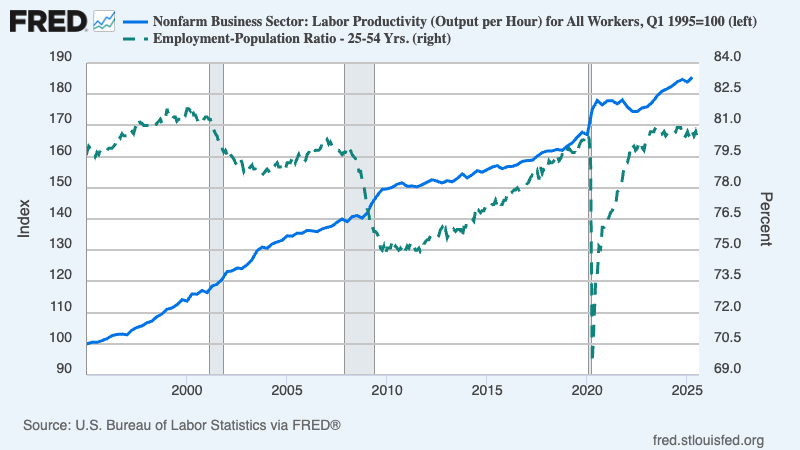
This is just a thought experiment. But events since that exchange have, I believe, refuted Greider’s alarmism and supported my complacency. In the chart below, you can see that overall labor productivity (the blue line) has risen 80 percent over the past 30 years, yet this has not led to mass unemployment. One common measure of job market performance is the percentage of adults in their prime working years with jobs (the green dashed line, right scale.) That percentage, after some fluctuations due to the global financial crisis and then Covid, was about the same in 2024 as it had been in the late 1990s.

Yet many of the warnings about AI and jobs amount to saying that AI will allow us to produce the same amount of stuff with many fewer workers, so where will the jobs come from? Well, in the past we’ve always created new jobs by producing more (and to some extent different) stuff. And so far we have never reached a point at which people don’t want more stuff.
As I’ve noted, manufacturing used to employ 30 percent of the U.S. work force. That number is now down to 8 percent. What replaced those jobs? Well, jobs in manufacturing have mostly been replaced by jobs in two sectors. First, the share of employment in health care and private education has risen from 4 to 16 percent. Second, the share of employment in leisure and hospitality has risen from 6 to 11 percent. There were other, smaller growth sectors. But I hope you can see my point. We can satisfy the demand for manufactured goods with fewer workers, but that frees up money to spend on things like eating out in restaurants. So far we’ve never run out of things people want to consume, and the result is that sectoral job losses from technology have always been offset by gains in other sectors.

So does this mean that we don’t have to worry about the effects of AI on employment? No. For one thing, large job losses in a given sector can cause dislocation and hardship even if they’re matched by job gains elsewhere when that sector is localized in a particular place — that’s the moral of the decline of coal mining.
Beyond that, as Ricardo realized two centuries ago, it is indeed possible for technological progress to depress wages and possibly employment for workers as a group. But the issue isn’t technological progress in and of itself. It’s whether the new technology is biased against labor and towards capital.
Will AI be biased against labor and towards capital?
The distribution of income in the United States is much more unequal now than it was before 1980. For a while, many economists attributed widening inequality to “skill-biased technological change” — technological change that increased the demand for highly educated workers while reducing it for less educated workers. The claim was that this bias in technology was pushing wages for college graduates up but pushing real wages for non-graduate workers down.
These days there is a lot of skepticism about whether that was really the story. I personally think that the decline of unions and the dominance of Wall Street through the financialization of the economy were much bigger factors in rising inequality. But that’s a topic for another day. The point for now is that economists generally accepted the proposition that technological progress could be so biased against a large segment of the work force — in this example, less educated workers — that their real wages would fall despite overall rising productivity.
Could the same thing happen to all, or at least most, workers? Yes, it could, if technological change were biased towards capital, and against workers in general.
That, in effect, was the essence of David Ricardo’s claim about the effects of the Industrial Revolution on British labor (although he didn’t use modern terminology or economic models). His argument was that new technologies made it profitable for businesses to employ more capital by investing heavily in machinery, while employing fewer workers. Workers could keep their jobs only by accepting lower wages – possibly much lower wages. And if for some reason wages couldn’t or wouldn’t fall sufficiently, there would be large job losses.
Was Ricardo right about what was happening in his own era? Technology certainly had a devastating effect on British handloom weavers in the early 19th century. It was probably their experience that caused Ricardo to change his mind about the effects of technology. What about other workers? There has been intense debate among economic historians about whether average real wages rose, stagnated, or fell in early 19th-century Britain, with much of the uncertainty involving how to calculate the relevant cost of living. But Acemoglu and Johnson (2024), summarizing the evidence, conclude that “economy-wide real wages \[in Britain\] stagnated through the early nineteenth century.”
So Ricardo had a point. At least during the initial decades of the Industrial Revolution, the benefits of technological progress accrued to the owners of capital and weren’t shared with workers. Thus, it was likely that in this case technology made workers worse off for a period of time.
Again, the issue wasn’t rising labor productivity per se. It was, instead, the fact that the new technologies were capital-biased: They required large investments in machinery while reducing the demand for labor.
So how does AI compare? Although we are still figuring out what this technology is capable of, it seems clear that AI will be strongly capital-biased. Other things equal, businesses will pursue profits by making massive investments in data centers and in the power plants to power them. At the same time, jobs will be cut in areas such as coding, customer service, graphics and data entry. Moreover, the huge demand for investment in AI will compete for resources – principally capital and, as I’ll discuss below, energy — with sectors less affected by the new technologies. To give an example of how this could happen: although AI will probably not displace carpenters, the enormous capital demands of AI could send mortgage rates higher, thus potentially reducing new home construction and thus the demand for carpenters.
If this scenario plays out, there will be overall downward pressure on wages. And if that pressure is extreme, we could see potential workers leaving the labor force and overall employment falling.
So there is a possible scenario in which AI increases GDP while reducing wages and employment. Although we don’t know that this will happen, it’s important to be aware of the possibility. What we can say is that (1) the more capital biased AI is; and (2) the more it starves other sectors of capital, then the more likely that it would put overall downward pressure on wages and employment.
Even if this scenario should come to pass, it’s also important to be aware that workers benefited from the Industrial Revolution in the long run, although it is likely to have hurt them in the short run. Yet, as Keynes famously observed — and policymakers as well as politicians should remember — in the long run we are all dead.
AI and Energy: A Fork in the Road
While much of the discussion of AI has focused on its impact on jobs, and this primer reflects that focus, this is arguably the wrong question. The main negative impact AI is having on our society right now is its voracious demand for energy, which is already causing electricity prices to soar. And the long run impact of AI will depend a lot on whether and how this energy demand is met.
I see three possibilities.
First, we could simply fail to develop the new generation capacity AI needs, in which case the industry’s growth will be strangled by lack of a crucial resource (unless the industry changes to a much less energy-intensive approach, such as using special-purpose models trained on limited data sets.)
Second, we could meet the energy demand with fossil fuels. In that case AI may push us into environmental catastrophe, which will overshadow any effects on the job market.
Finally, AI could supercharge the growth of clean energy, which would be a very good thing. Only in that case will questions about its effect on jobs — important and, may I say, intellectually interesting as they are — become central.
So by all means let’s talk about the potential negative impact of AI on workers. But we’ll have to deal with the energy issue first.
Write a comment