Have Some Free AI Documentation Software
Source: Have Some Free AI Documentation Software Publisher: Medium | Author: Nathan Hillen Published: April 5, 2026 | Archived: April 7, 2026
[
I, like most of the world, have drunk deep of the well of AI coding. I’ve gone through the 7 stages of grief, though I did it quickly, and landed on the final stage: A $200 Claude Max Subscription
As I experimented with Ralph Loops and became enthralled with the ideas in swarm agents like Gas Town, I found myself thinking about Vibe Coding. We know now (I think, for the time being at least) that Plan Mode is incredibly powerful. Thinking through before we build is good. Even in the pre-AI age, measure twice cut once was a thing.
Now though, vibe coding makes it incredibly easy to go back and rearchitect everything from the ground up. I’ve noticed though that in the same way that Context Rot is a thing, even if you aggressively tell Claude or Codex to update documentation, it will hallucinate over time with how that should be structured
I would have “To Do” lists with implementation details in them and PRDs with conflicting statements in them, which was fine in general but hugely problematic when on a random Thursday, my agents picked the wrong PRD to chase after.
Worse, the file architecture made it hard for me to understand what was truly real. When the AI is writing your documentation too, the amount of time I’m willing to dedicate to reading it is incredibly low. Anyways, enough life story.
The core problem is that AI coding agents are ravenous context consumers, and if the docs they’re eating are inconsistent, duplicated or incoherent they build the wrong thing. Worse when you’re vibe coding and moving between a mountain of projects it can be a nightmare figuring out source of truth when you come back to the project. You need opinionated structure for your docs the same way you need opinionated structure for your code.
The first version of my Blueprint said “I want to do for Documentation what Gas Town promises to do for Code”. How do we inject NOS into the documentation layer so the code layer doesn’t run out of go.
Enter Abulafia
Book nerds will hopefully appreciate my Umberto Eco nod, to everyone else don’t sweat it, not important. But maybe go read Foucault’s Pendulum anyways.
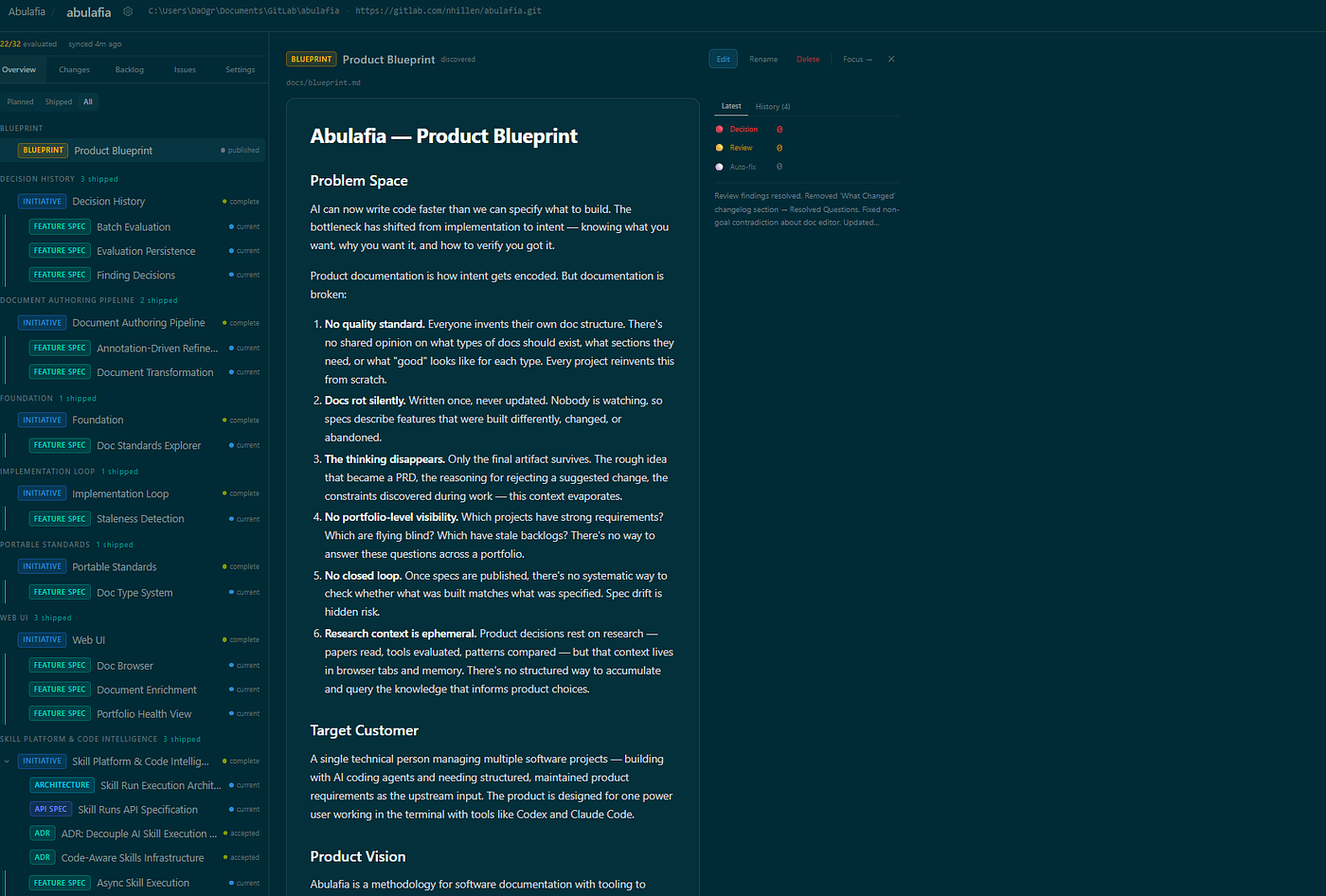 A Picture of A Doc Describing a Software About Docs
For the rest of you, the repo is on GitLab at https://gitlab.com/nhillen/abulafia
Get Nathan Hillen’s stories in your inbox
Join Medium for free to get updates from this writer.
Remember me for faster sign in
It’s probably the thing I’ve built with AI that I feel best delivers on the promise for what I set out to do. Which is give personal project documentation the kick in the pants that AI Tools gave to the typing part of the SDLC
So what does it actually do?
Abulafia is an opinionated document methodology, a taxonomy of document types with per-type quality standards, anti-patterns, required sections and templates. This in turn makes it extendible and predictable, either as a centralized template, or because you clone it LOCALLY into the repo, you can maintain those standards in whatever way is locally important. There’s also built in hierarchy and some additional ancillary doc types like ADRs, architecture docs, runbooks, etc.
The evaluation system makes findings rather than scores. When an agent evaluates a doc, it generates specific, actionable findings like “This is missing acceptance criteria”. They also have severity and fixes so you can just slam the accept button. It also all gets persisted so you can see the decision history over time.
There are also some agent workflows built in, one is Bootstrap which finds and classifies existing docs, since ultimately it’s unlikely you’ve magically picked the exact same standards and opinons of the new doc structure. And Doctor which you can run as an audit at any time to just health check and fix up any of your missing docs.
The most important thing about Abulafia is it’s all handled locally, you dont need a server. It’s got a thin local webserver to help with some visualization, but in order to make use of Abulafia you just copy the doc-standards/ folder into your repro and a small snippet into your CLAUDE.md or AGENTS.md and you’re done. The standards are portable YAML and Markdown.
A few key notes on Abulafia:
- It is opinionated. You are welcome to make changes to these standards in how you use them and how they work, but there are some specific setup pieces around how documentation is supposed to be organized and written. It’s also somewhat arbitrary and able to be edited but I found it to be a good mix of enough detail to convey to humans and agents what needs to be built without going too far
- It’s meant to be run from the command line/in Claude Code or Codex. There’s a thin web client to help with some visibility/doc reading but I unwound all the web app stuff because it was just getting in the way. When you install it in now to a repo it just becomes the way that repo handles docs
- It gives up at the bug/task level. While I have some VERY light roadmapping and bug tracking in here, this is intended to get your thoughts together around what you’re going to build and track that at a very high level across your project portfolio. The intent of this documentation is to feed the ravenous beast (by this I mean your AI coding agents)
- Last minute I added 2 other modules, one that’s for creating work breakdowns and auding what’s implemented in code, but this is ancillary to the core product, and one that rolls in Karpathy’s sick Wiki stuff
- You can modify the doc standards, fork away and please do, make them work the way you want. If I fucked something up deeply please let me know.