The Ecommerce Website Brief: What a Dubai Business Should Write Down Before Asking for Quotes
- Why a brief matters more for ecommerce than for a normal website
- Section 1: The business and the goal
- Section 2: The catalogue
- Section 3: Platform preferences and constraints
- Section 4: Payments and checkout
- Section 5: Delivery, couriers and returns
- Section 6: Integrations and operations
- Section 7: Language, content and brand
- Section 8: Search, speed and growth
- Section 9: Ownership, budget and timeline
- A one-page brief template
- Common mistakes to avoid
- Frequently asked questions
- Talk to Oxedge about your store
Ask three agencies in Dubai to quote for “an online store” and you will usually get three numbers that cannot be compared. One assumes 40 products and a ready-made theme. Another assumes a custom checkout, an ERP link and a marketplace feed. The third quietly leaves out Arabic. None of them is wrong. They are simply answering different questions, because nobody wrote the question down properly.
A short, honest brief fixes most of that. It does not need to be a 40-page tender document. It needs to describe what you sell, who buys it, how they pay, how it reaches them and who will run the store on a normal Tuesday afternoon. With that on paper, quotes start to line up, timelines become realistic, and the conversation moves from “how much for a website?” to “what will it take to sell well in the UAE?”
This guide walks through what to put in an ecommerce brief, section by section, with the questions that matter most for stores selling in Dubai and the wider UAE. It draws on how Oxedge scopes ecommerce projects, and the prices and timelines mentioned come from the published Oxedge ecommerce website development page, where every project is still scoped line by line before anyone signs.
Why a brief matters more for ecommerce than for a normal website
A brochure website has a handful of pages, a contact form and perhaps a blog. An online store is closer to a small operating system for the business. It holds a catalogue, prices, stock, customer accounts, payments, invoices, delivery rules and returns. Each of those has local details in the UAE that change the build:
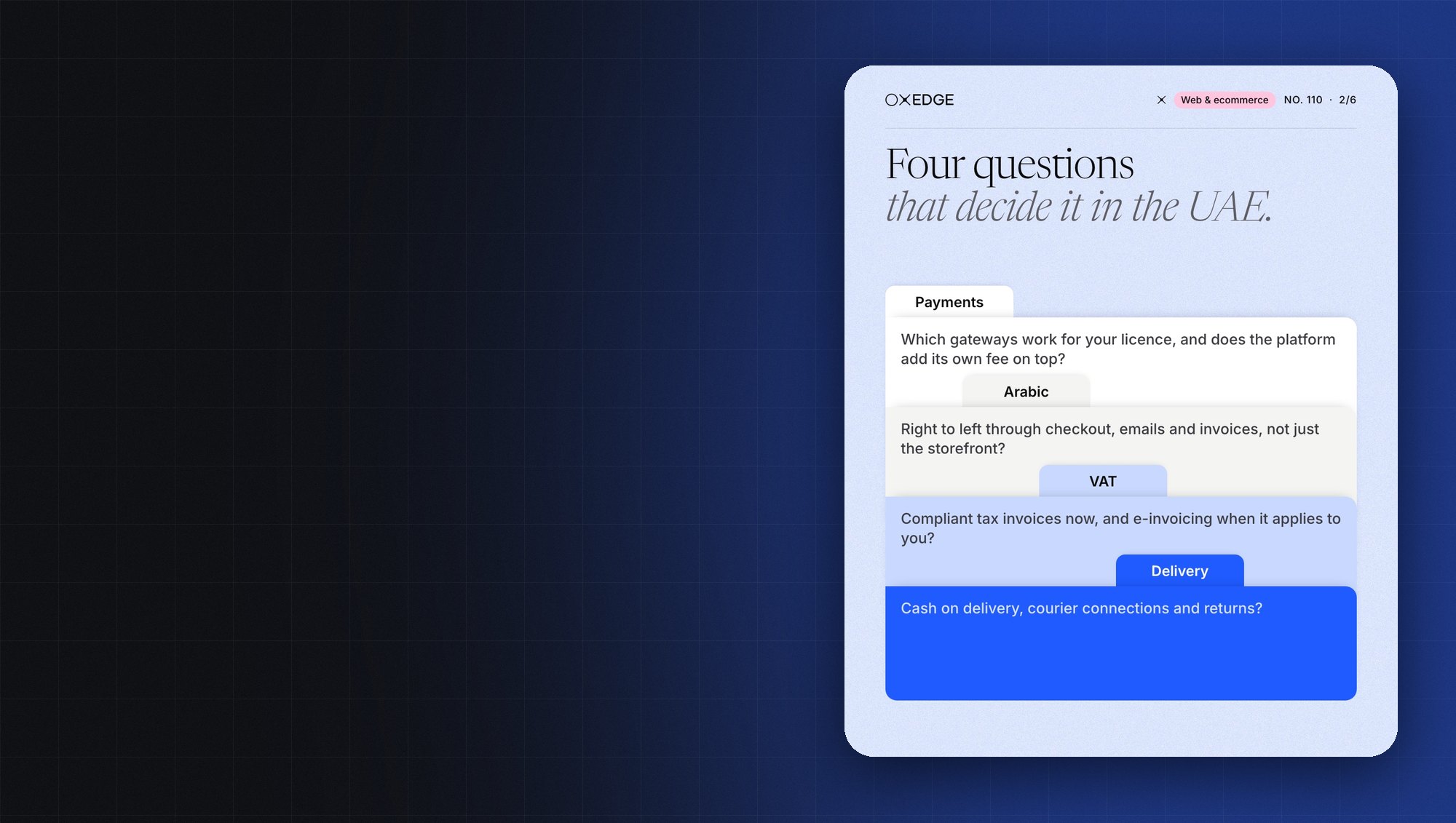
- Payments are not only cards. Shoppers expect Apple Pay, instalment options such as Tabby and Tamara, and in many categories cash on delivery.
- Invoices have to carry the details the Federal Tax Authority requires, and stores should be ready for the UAE e-invoicing rollout.
- Delivery depends on address capture that works without postcodes, courier integrations and clear delivery slots.
- Language means a real Arabic version, not a plugin that translates half the checkout.
- Mobile is where most buying happens. Oxedge cites Mordor Intelligence (2025) that 78.7% of UAE ecommerce transactions are made on a smartphone.
If the brief is silent on these points, each agency fills the gaps with its own assumptions, and that is where the price differences come from. A clear brief makes the assumptions visible.
Section 1: The business and the goal
Start with a few plain sentences about the business. What do you sell, to whom, and where? Are you a new brand launching online for the first time, a shop with a physical store that wants to sell online, or an existing online store that has outgrown its platform?
Then write down the goal in measurable terms where you can. Useful examples:
- Launch a first store in English and Arabic before a specific season, such as Ramadan, White Friday or Dubai Shopping Festival.
- Move an existing store to a new platform without losing search rankings or order history.
- Reduce failed cash-on-delivery orders and refused parcels.
- Connect the store to stock in an ERP so the warehouse stops overselling.
A goal tells the agency what to optimise for. A launch date drives scope choices. A replatform puts migration and redirects at the centre of the plan. A COD problem points to checkout rules and delivery operations rather than design.
Section 2: The catalogue
The catalogue is the single biggest driver of effort, so describe it carefully:
- How many products you have today and how many you expect in a year.
- Variants, such as sizes, colours or bundles, and whether each variant has its own stock and price.
- Product data: who writes descriptions, in which languages, and whether photography already exists.
- Special cases: made-to-order items, gift cards, subscriptions, wholesale pricing, or products that need age checks or special handling.
As a guide to scale, Oxedge describes its starter store (Shopify or WooCommerce) as a customised theme with up to about 50 products, English and Arabic, card and instalment payments, and one courier, from AED 9,999 in roughly 3 to 5 weeks. A large catalogue with complex variants, or one that needs to sync with an ERP, moves a project into custom territory.
If you can, attach a spreadsheet export of your products, even a messy one. It answers dozens of questions at once.
Section 3: Platform preferences and constraints
You do not need to pick the platform yourself, but you should say what you know. Do you already have a Shopify or WooCommerce store? Do you sell in Saudi Arabia, where Arabic-first platforms like Salla and Zid are common? Does your team already know WordPress? Is there an internal IT policy about hosting or data?
Oxedge compares Shopify, WooCommerce, Salla, Zid and custom builds on real numbers, including fees, apps, Arabic support and the people who will run the store. A brief that explains who will manage products day to day, and how comfortable they are with technology, makes that comparison far more useful. The Oxedge article on how much an ecommerce website costs in Dubai is a helpful read before this step, because platform choice affects running costs for years, not just the launch budget.
Section 4: Payments and checkout
This is the section most briefs leave too thin. Write down:
- Which payment methods you want at launch and later: cards, Apple Pay, instalments (Tabby, Tamara), cash on delivery, bank transfer for B2B orders.
- Whether you already have a payment gateway account, or still need one. UAE gateways and banks typically ask for a trade licence that covers e-commerce, a UAE bank account in the company name and the owner’s Emirates ID before they approve a merchant.
- COD rules you want, for example limits on order value, confirmation by WhatsApp, or blocking repeat refusers.
- Currency and VAT display: AED only, or multiple currencies; prices shown VAT-inclusive.
A store can be built and tested while the licence and gateway are being approved, so do not hold the brief back for that. Just say where you are in the process.
Checkout details worth naming
Small details decide whether people finish paying. Mention guest checkout, address forms without postcodes, map pins for delivery locations, delivery date estimates shown before payment, and clear totals including VAT and delivery fees. Oxedge has written separately about why UAE shoppers abandon checkout, and the same list makes a good set of brief requirements.
Section 5: Delivery, couriers and returns
Describe how orders physically leave your business today, or how you expect them to:
- Which couriers you use or are considering, and whether you need more than one.
- Delivery areas: Dubai only, all emirates, GCC, or international.
- Delivery options: same-day, next-day, scheduled slots, click and collect.
- How you want customers updated, for example WhatsApp order updates.
- Your returns and exchange policy, and who handles it.
Failed deliveries are one of the biggest hidden costs in UAE ecommerce. Better address capture, delivery slots and proactive updates reduce them, but only if the brief asks for them.
Section 6: Integrations and operations
List every system the store needs to talk to. Common ones include an ERP or accounting tool, a CRM, a warehouse or fulfilment partner, marketplaces such as Amazon.ae and noon, email marketing, and analytics. For each, note whether the connection is a must-have at launch or a phase-two item.
Integrations are where timelines stretch. Oxedge describes marketplace or ERP-linked stores as custom quotes with longer timelines set in the quote, compared with 8 to 14 weeks for a custom store at AED 35,000 to 120,000. Being clear about what can wait is one of the best ways to control cost.
Section 7: Language, content and brand
State whether the store needs English and Arabic at launch, and who will write or check the Arabic. Machine translation is fine as a first draft, but product names, size guides and checkout messages deserve a human review by someone who writes Arabic for UAE customers.
Also list what already exists: logo files, brand colours, fonts, photography, lifestyle images, size charts, policy pages. Missing content is the most common reason a finished store sits unlaunched for weeks.
Section 8: Search, speed and growth
If the store will rely on organic search, say so in the brief. Category structure, product schema, Arabic URLs and internal linking are much easier to get right during the build than after it. The Oxedge guide to ecommerce SEO in Dubai covers category pages, product schema and Arabic in detail.
Speed belongs here too. Oxedge sets a target of mobile PageSpeed 90+ at launch, and before big seasons it tunes and load-tests stores so the busiest weeks stay online. If you know your peak periods, name them in the brief with dates.

Section 9: Ownership, budget and timeline
Three short paragraphs finish the brief.
Ownership. Say that you expect the domain, platform accounts, code and data to be registered in the company’s name. Oxedge states this as standard for its stores, and it is a good test question for any agency.
Budget. Give a range, even a wide one. A range does not weaken your position; it stops agencies proposing a custom build when a starter store would do, or the reverse. Remember that domain, hosting, platform subscriptions and payment-gateway fees usually come on top of the build price.
Timeline. Give the date you need to be live and the reason, then let the agency say whether it is realistic. A starter store can launch in about 3 to 5 weeks, a custom store usually takes 8 to 14 weeks, and large catalogues or ERP projects take longer.
A one-page brief template
If you want a starting point, copy these headings into a document and answer each in a few lines:
- Business summary and what we sell
- Main goal for the store and the launch date we are aiming for
- Catalogue size, variants and who owns product content
- Current platform, if any, and team skills
- Payment methods, gateway status and COD rules
- Delivery areas, couriers, delivery options and returns policy
- Systems to integrate now and later
- Languages and who checks the Arabic
- Brand assets and photography available
- Search, speed and peak seasons
- Ownership expectations, budget range and decision date
Send the same brief to every agency you speak to. You will get quotes you can actually compare, and you will learn a lot from the questions each team asks back. The Oxedge list of 30 questions to ask an ecommerce agency in the UAE is a useful companion for those conversations.
Common mistakes to avoid
- Describing the design and forgetting the operations. Colours and layout matter, but payments, delivery and stock decide whether the store makes money.
- Leaving Arabic as “phase two”. Retrofitting Arabic into a live store is slower and more expensive than building bilingual from day one.
- Hiding the budget. Agencies then guess, and guesses are rarely useful.
- Ignoring post-launch support. Ask what happens in the first month. Oxedge, for example, includes 30 days of free bug fixes after launch.
- Underestimating content. Product descriptions, photos and policy pages take longer than most owners expect.
Frequently asked questions
How long should an ecommerce brief be?
One to three pages is enough for most stores. The aim is clarity, not length. A product spreadsheet and a few screenshots of stores you like add more value than extra paragraphs.
Do I need to choose Shopify, WooCommerce, Salla, Zid or custom before writing the brief?
No. Describe your catalogue, team, markets and budget, and let the agency recommend a platform with reasons. If you already have a preference, say why.
What does an online store cost in Dubai?
According to Oxedge’s published pricing, a starter Shopify or WooCommerce store costs from AED 9,999 and a custom store with UAE payment gateways, instalments, courier integration and VAT-correct invoices typically costs AED 35,000 to 120,000. Platform and payment-gateway fees come on top, and every project is scoped line by line.
Do I need a trade licence before the store is built?
You need a trade licence that covers e-commerce to trade and take payments, and gateways will ask for it. The store itself can be designed, built and tested while the licence and gateway approval are in progress.
Can the store be ready for White Friday or Ramadan?
Often yes, if the brief arrives early enough. Name the season and the date in the brief so the plan includes speed tuning and load testing before the peak.
Talk to Oxedge about your store
If you are planning a new online store or a replatform in the UAE, Oxedge builds bilingual stores on Shopify, WooCommerce, Salla, Zid and custom stacks, with local payments, cash on delivery, VAT-ready invoices and courier integrations. Start with the service page at https://oxedge.com/ecommerce-development-dubai/ the Arabic version at https://oxedge.com/ar/ecommerce-development-dubai/, or the main site at https://oxedge.com/.
Contact Oxedge on +971 50 815 3521 or info@oxedge.com. Office hours are Monday to Saturday, 9am to 5pm, and Sunday closed.
Write a comment