Haitians rally for Bukele's anti-gang operation
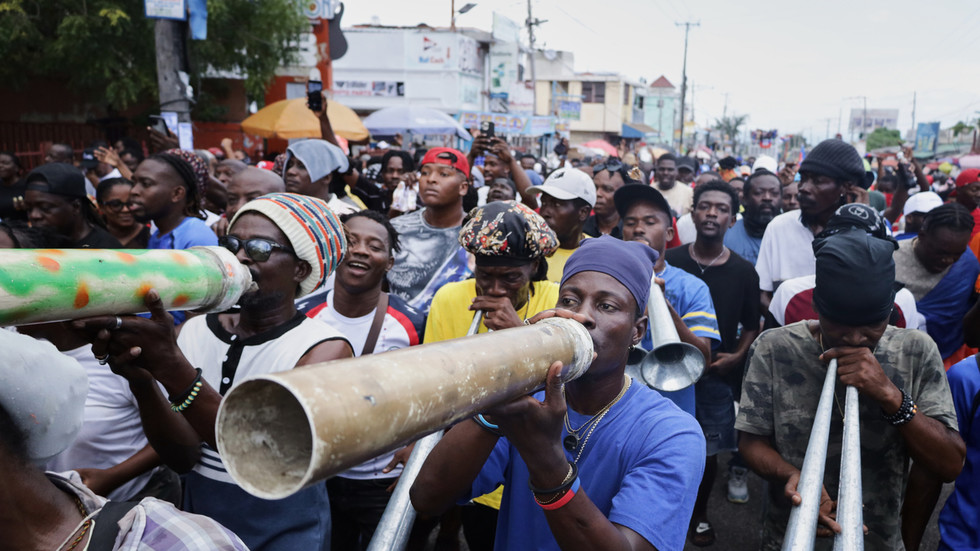
Haitians rally for Bukele’s anti-gang operation
El Salvador’s President Nayib Bukele has announced that Salvadoran troops deployed in Haiti destroyed the mansion of prominent gang leader Jeff Canaan and other gang properties as part of an offensive against armed groups. Both Brazil Left and Brazil Right sources agree that these operations occur under a bilateral security cooperation agreement recently approved by Haitian authorities, that Salvadoran forces have retaken strategic sites such as the Sylvio Cator Stadium and turned them into operational bases, and that Haitians have held large rallies in Port-au-Prince and other cities to express support and gratitude for the Salvadoran mission. They also concur that the immediate trigger for El Salvador’s deployment was the disappearance of four Salvadoran aviation technicians in Haiti, and that Haiti’s government is publicly asking for the troops to stay, even as the initial Salvadoran plan emphasized rescuing their citizens and then withdrawing.
Coverage from both sides also agrees that the demonstrations feature thousands of Haitians waving flags, holding Bukele posters, and calling him a kind of liberator from gang domination, in a context of severe, long-running gang violence and institutional collapse in Haiti. Outlets on both sides describe Haiti’s security crisis as having overwhelmed local police and state institutions, making external assistance appear attractive to many Haitians who feel abandoned by both their own authorities and previous international missions. There is shared acknowledgment that the Haitian government sees the Salvadoran contingent as complementary to broader international stabilization efforts, potentially extending at least until scheduled elections in 2027. Both sides thus frame the operation as occurring at the intersection of Haiti’s chronic insecurity, weak governance, and the search for new security models that can quickly reclaim territory from gangs.
Areas of disagreement
Legitimacy of Bukele’s model. Brazil Left coverage tends to treat Bukele’s anti-gang strategy as controversial and potentially exporting a punitive security model, stressing that international organizations like Amnesty International have raised human rights concerns about his methods in El Salvador. Brazil Right outlets largely present Bukele’s approach as effective, popular, and even exemplary for other countries, foregrounding images of Haitians calling him a liberator and highlighting successes such as the retaking of the stadium. Where the left-leaning press warns that Haiti may be importing a militarized model with a record of abuses, right-leaning coverage portrays the same model as a rare instance of decisive leadership delivering tangible security gains.
Human rights and legal safeguards. Brazil Left sources emphasize the risk of extrajudicial practices, lack of judicial oversight, and possible civilian harm, linking Bukele’s operation in Haiti to a broader pattern of mass arrests and due-process violations reported in El Salvador. They often frame the destruction of gang leaders’ houses as symbolically powerful but legally ambiguous, questioning standards of evidence and accountability. Brazil Right sources instead downplay or omit these concerns, treating the demolitions as justified acts against criminal infrastructure and giving little attention to potential abuses, which they imply are secondary to the urgent need to dismantle entrenched gangs.
Motives and duration of the mission. Brazil Left coverage highlights that El Salvador’s declared priority is rescuing the four missing aviation technicians and suggests that any prolonged stay risks entangling Salvadoran troops in an open-ended intervention with unclear exit criteria. It underscores that even as Haitian officials request a long-term presence, Bukele’s original mandate was narrow, raising questions about mission creep and political uses of the deployment at home and abroad. Brazil Right outlets, by contrast, stress that the Haitian government has ratified a cooperation agreement and explicitly wants Salvadoran forces to remain at least until elections in 2027, framing a longer deployment as both legitimate and responsive to popular demand on the streets.
Portrayal of Haitian agency and popular support. Brazil Left sources acknowledge the pro-Bukele rallies but are more cautious, presenting them alongside references to Haiti’s desperation and history of foreign interventions, implying that popular support may be shaped by lack of alternatives and weak institutions. They tend to question how representative these demonstrations are of Haitian society as a whole and whether communities are fully informed about the costs of militarized security. Brazil Right outlets spotlight the marches as clear, organic endorsements of Bukele’s intervention, repeatedly emphasizing the size of the crowds, the praise-filled slogans, and calls for Salvadoran troops to stay, using these images as validation of both Bukele’s leadership and the mission’s legitimacy.
In summary, Brazil Left coverage tends to view the Haitian rallies for Bukele’s anti-gang operation through a critical lens that foregrounds human rights risks, mission creep, and Haiti’s fraught history with foreign security interventions, while Brazil Right coverage tends to cast the same events as powerful proof that Bukele’s hard-line security model is both effective and eagerly embraced by Haitians seeking relief from gang rule.
https://brazil-test-hub.syndichain.com Brazil News Hub brazil-test-hub brazil-test-hub
Write a comment