If People Would Know The True Cost Of Credit Cards, There Would Be A Revolution Before Tomorrow
The trillion-dollar promise of “tap and go” has a quiet price tag, and it’s embedded in almost everything we buy.
From a $4 latte to a $40,000 kitchen remodel, the fees that flow through the card rails are largely invisible to consumers but unavoidable for merchants—and therefore priced into retail.
Follow the money and a simple story emerges: every swipe sets off a chain of transfers among banks, processors, and card networks that collectively drain billions from merchants’ margins each year. The true cost of convenience is higher than most people think, and the profits are among the richest in modern finance.
Table of Contents
- How the four-party system extracts value, every time you pay
- The networks’ evolution—from cooperative rails to high-margin toll roads
- The global fee map: 0.05%-8%
- What consumers don’t see—and why they still pay
- Not just cards, payments in general are costing us
- Why cash and bitcoin is king—for merchants’ margins
- What a $100 sale looks like to a small merchant
- The road ahead and how to reduce credit card fees
How the four-party system extracts value, every time you pay
The mechanics reveal a sophisticated toll system. In the four-party model, the cardholder’s issuing bank authorizes a transaction over a network (Visa or Mastercard), while the merchant’s acquiring bank accepts and settles it. The “merchant discount rate” (MDR) the merchant pays includes interchange (paid by the acquirer to the issuer), network “assessment” or scheme fees (paid to Visa/Mastercard), and processing/acquiring markups.
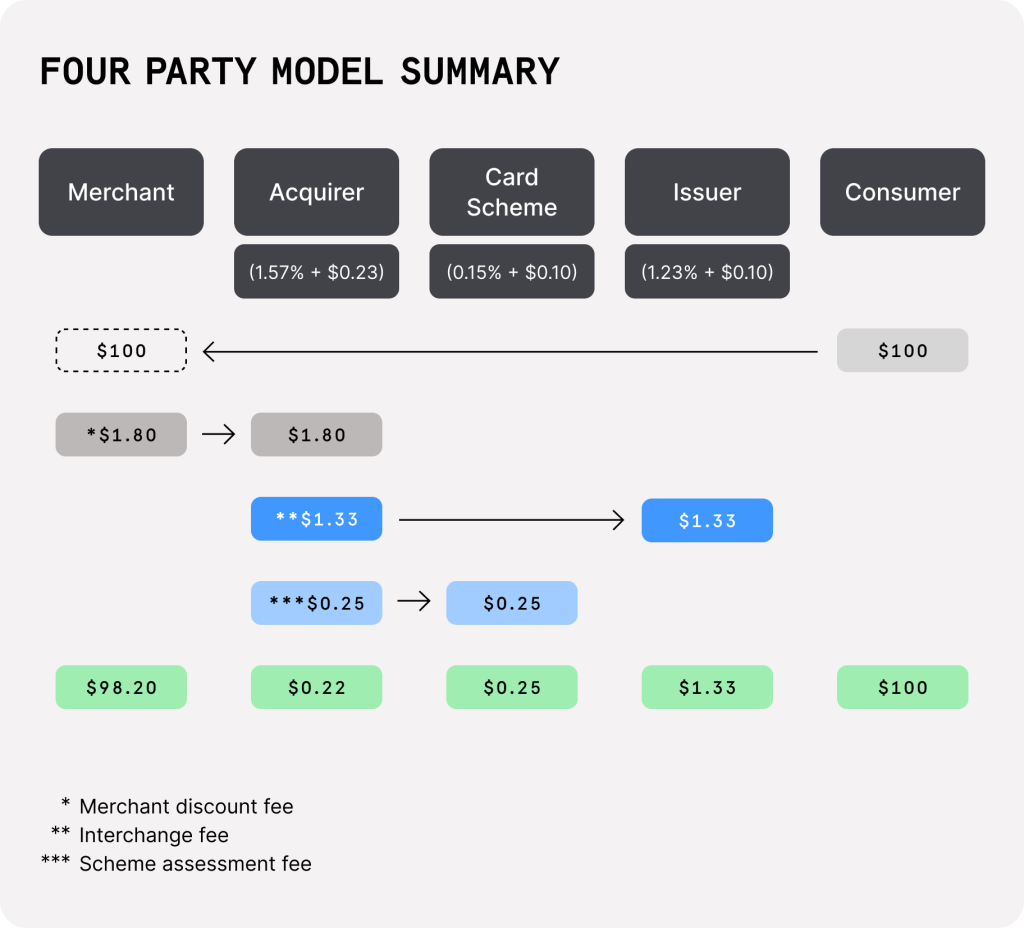
Interchange dominates the cost structure—averaging roughly 2% on credit in the U.S. The total U.S. merchant processing bill reached $172.05 billion in 2023, up 7.1% year over year. Visa’s assessment schedule alone includes a 0.14% assessment on credit volume plus per-transaction and international add-ons—an overlay before any acquirer markup is applied.
Visa and Mastercard don’t issue cards or lend money—they sell access to rules and roads. But in most markets, they are the only roads that reach everyone. Visa’s roughly two-thirds operating margin tells you what a global, two-sided tollbooth looks like when regulation is absent.
The networks’ evolution—from cooperative rails to high-margin toll roads
Their transformation shows in the numbers. Visa reported fiscal 2024 net revenue of $35.9 billion and operating income of $23.6 billion—an operating margin of roughly 66%, off a base of 233.8 billion processed transactions and almost $13 trillion in payments volume. Few businesses on earth scale this large with that kind of profitability on what is essentially a transport layer for value.
Visa began in 1958 as BankAmericard and grew into a global network by the 1970s before consolidating into Visa Inc. in 2007, crystallizing the economics of the tollbooth it operates. Mastercard’s roots trace to 1966 as the Interbank Card Association, maturing from a member-governed utility into a profit engine that sells access to its rails and rulebook.
Mastercard posted 2024 revenue of $28.2 billion and $9.8 trillion in gross dollar volume, with 159.4 billion switched transactions—again signaling a network business that grows with global commerce yet collects tolls at each hop.
American Express runs a different model: a “closed loop” where the company is the network, issuer, and often the acquirer. In 2024, Amex set records with $66 billion in revenue and more than $10 billion in net income.
But where are these profits coming from? Unlike commercial banks, card processing doesn’t come with a “license to print money“. And yet it’s extracting billions of dollars of value from the economy each year.

The global fee map: 0.05%-8%
Card processing fees vary between regions. North America has some of the highest average credit card processing fees (around 1.5% to 3.5% or more), especially with rewards and premium cards. Latin America also experiences high fees (about 2% to 4%) with additional costs from currency conversions and local taxes. Other regions generally have lower fees due to regulation and localized payment systems
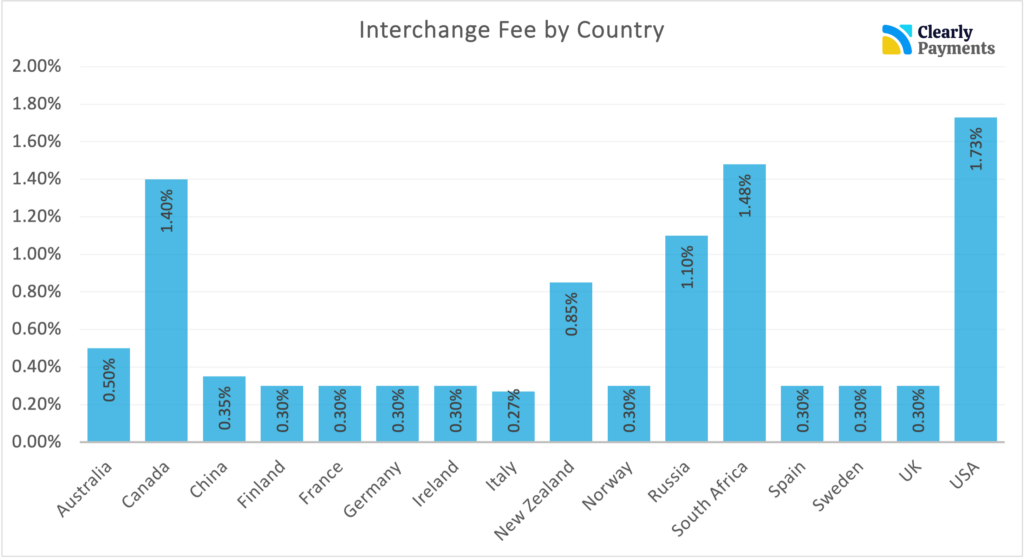
United States: Credit cards average above 2% in total merchant fees. Debit is regulated under the Durbin Amendment, capped at $0.21 plus 0.05% for large issuers, a lot lower than credit.
Canada: Ottawa struck agreements with networks to cut in-store domestic credit interchange for qualifying small businesses to a weighted average 0.95%. Government estimates forecast about C$1 billion in savings over five years for eligible small firms.
Europe: The Interchange Fee Regulation caps consumer debit at 0.2% and credit at 0.3%—demonstrating that hard caps can work market-wide. However, post-Brexit, networks raised UK-EEA cross-border fees fivefold—debit to 1.15% and credit to 1.5% for online transactions, costing UK businesses £150-200 million annually. Ultimately central planning is just patching the issue, the root problem has to be addressed on a deeper level.
Latin America:
-
The average payment processing fee in LATAM is around 2% to 4% of the transaction amount.
-
Interchange fees can range from 0.5% to 2.5% depending on card type and transaction nature.
-
Assessment fees by card networks are about 0.13% to 0.15%.
-
Processor fees vary from 0.2% to 1%, covering authorization, fraud prevention, and settlement.
-
Smaller merchants typically pay higher fees (2.5% to 3.5%), while larger enterprises may negotiate lower rates (1.5% to 2%).
-
Credit card transactions have higher fees than debit cards or alternative payment methods.
-
Brazil capped debit at 0.5% while launching PIX, the instant-payment system that pressures card pricing
-
Mexico publishes interchange schedules with debit capped at 1.15% or 13.50 pesos
-
Chile implemented caps at 0.8% for credit and 0.35% for debit
What consumers don’t see—and why they still pay
Every fee a merchant absorbs finds its way into retail prices. Academic research shows that card fees create regressive wealth transfers: higher-income consumers using premium rewards cards capture benefits funded by fees built into prices paid by all shoppers, including cash users.
The “true cost of convenience” is visible in macro numbers. U.S. merchants’ card processing costs eclipsed $172 billion in 2023 and continue rising. That burden doesn’t disappear in competitive retail—it gets priced in quietly because few sellers can steer or surcharge without friction.
Not just cards, payments in general are costing us
A recent report from Lightning News revealed that freelancers worldwide are squeezed out by payment providers. Platforms like PayPal, Pateron or Stripe charge up to 12% in fees. In some countries even higher. The estimated annuall toll exceeds $3,69 trillion.
[Freelancers Globally Could Save $3.69 Trillion a Year in Fees, Study Finds](https://lightning.news/freelancers-save-3-69-trillion-a-year-study-f
Write a comment