Nostr Fixed Identity. The Web Layer Is Still Captured
- 1. DNS and the CA Cartel Are Weak Links in the Trust Chain
- 2. Shared Gateways Break the Same-Origin Security Model
- 3. Mobile Signing UX Actively Encourages Key Compromise
- 4. Encrypted State Shouldn’t Live on Big Tech Servers
- Build on Sovereign Primitives
We built Nostr to eliminate central points of failure from social communication. No platform can revoke your npub, and no single server holds your social graph hostage.
Yet look at the transport and presentation layer sitting right on top of it. Almost every Nostr web client, relay admin panel, and nsite still relies on the exact legacy cartels we claim to be routing around: ICANN, DNS registrars, centralized Certificate Authorities, and Big Tech browser ecosystems.
If your app can be killed by a domain registrar freeze or a revoked TLS cert, it isn’t sovereign. It’s just a decentralized backend wearing a centralized leash.
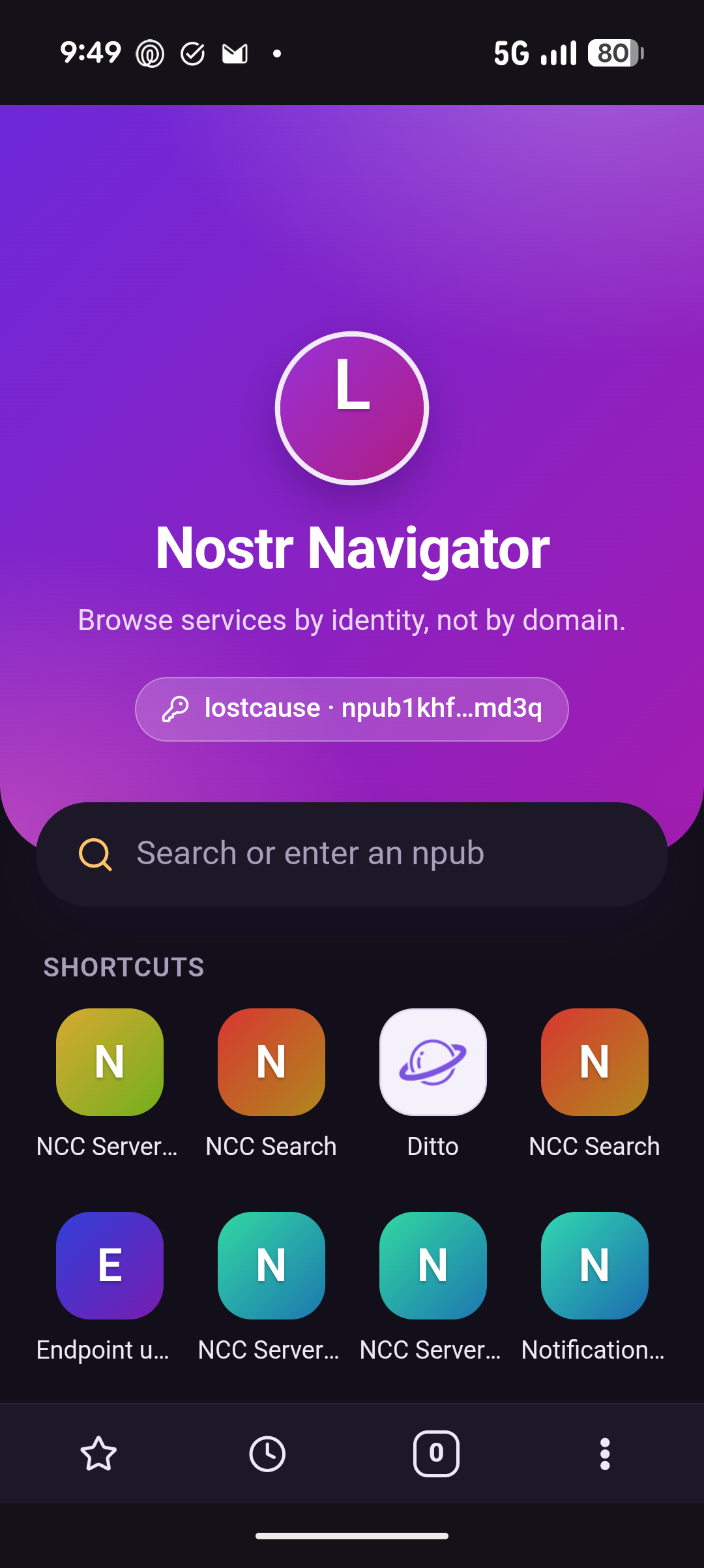
I’m building Nostr Navigator (ncc-browser) to cut that leash. The goal isn’t to ship another Chromium skin with a purple logo—it’s to make your Nostr keypair the actual root of trust for discovering, verifying, and isolating web applications.
Here are the architectural failures in the current stack that ncc-browser is built to fix.
1. DNS and the CA Cartel Are Weak Links in the Trust Chain
Right now, resolving a Nostr web app requires outsourcing truth to two third parties: DNS to tell you where the service lives, and a Certificate Authority to tell you who owns it. Both are legally coercible, censorable, and completely decoupled from Nostr’s cryptographic primitives.
The Architecture:
Bind service discovery and transport verification directly to the creator’s npub.
-
NCC-05 Resolution: Instead of querying A/AAAA records, Nostr Navigator queries relays for signed NCC-05 service locator events published by the target
npub. If an operator migrates infrastructure, they sign a new locator event. No registrar permission required. -
SPKI Pinning: Rather than blindly trusting the root CA store shipped by an OS vendor, the browser pins the Subject Public Key Info (SPKI) of the endpoint directly against the Nostr identity. If the cryptographic chain doesn’t trace back to the expected key, the connection dies.
2. Shared Gateways Break the Same-Origin Security Model
The naive workaround to DNS censorship is serving decentralized content (nsite://, Blossom blobs, local bundles) through a single public web gateway or shared local path. Doing so destroys browser security guarantees.
Browsers enforce sandboxing via the Same-Origin Policy (SOP). When multiple untrusted web apps load under the same gateway domain, they share an origin—meaning a single malicious script can exfiltrate localStorage, IndexedDB, and session tokens from every other app hosted on that gateway.
The Architecture:
True origin isolation without central DNS.
-
Nostr Navigator dynamically spins up a dedicated local loopback proxy per resolved identity, mapping each service to its own isolated
*.localhostorigin. -
Every Nostr service gets strict, browser-enforced SOP sandboxing—isolated storage, isolated cookies, isolated permissions—with zero reliance on external domain infrastructure.
3. Mobile Signing UX Actively Encourages Key Compromise
On desktop, extensions like nos2x and Alby isolate keys from the DOM via window\.nostr (NIP-07). On mobile, platform restrictions break that model.
Users are routinely forced to choose between pasting raw nsec strings directly into untrusted web forms—which is catastrophic opsec—or enduring broken app-switching loops that drop web state. Furthermore, standard browsers leak identity across contexts: using one global keypair across every tab links your activity across every app you touch.
The Architecture:
Move the signer into the browser engine as a core primitive.
-
Native NIP-07 & NIP-46:
window\.nostris injected natively across bothnsite://and standardhttps://origins, gated by explicit, per-origin capability prompts. Yournsecnever touches the page context. -
Ephemeral Identities: Opening a Private or Tor tab generates a disposable, in-memory keypair on the fly. You can authenticate with Nostr apps, test relays, or browse hostile front-ends without exposing your primary
npub.
4. Encrypted State Shouldn’t Live on Big Tech Servers
If you rely on Chrome Sync, Firefox Accounts, or iCloud Keychain to move passwords and bookmarks between devices, you are feeding your browsing graph and encrypted vaults to centralized infrastructure.
The Architecture:
You already run a decentralized, authenticated storage layer: your NIP-65 relay list.
- Nostr Navigator encrypts credentials, bookmarks, and browser state locally using your keys and syncs them directly across your configured relays. No accounts, no proprietary cloud APIs, no metadata leakage to browser vendors.
Build on Sovereign Primitives
We don’t need to ask ICANN, DigiCert, or Google for permission to publish and run software on the open web. Nostr already gave us the primitives for identity, signing, and relay-based data distribution—we just haven’t wired them deep enough into the client stack yet.
Inspect the code, break things, or submit PRs:
- Source & Releases: https://
github.com/imattau/ncc-browser
- Zapstore: Nostr Navigator
Write a comment