Ukraine. The war. Transformation.

- The Beginning
- Faith. Hope. Reconstruction. Culture.
- Grieving. Guilt. Fatigue. And the first feelings that something is going wrong
- The Draft
- Libertarian lense as a way of intelectual escape or way to get a breath of sanity?
- Now
I didn’t meet the war at home. Two weeks before the invasion, me with family went to visit her relatives a bit south of Kyiv. Danger was in the air, even though every TV screen blared, “Don’t worry, these are just training maneuvers, and Putin won’t attack.” Then a news flash slipped through that the Russians were stockpiling blood bags for transfusions for the wounded. That’s when I realized the war was coming.
Initially, we planned to fly out to another country. My wife had just finished breastfeeding and had health issues, so at the last minute, we decided to stay. I remember looking at a yellow travel suitcase and thinking, “maybe our staying behind will be the decisive moment.” A week later, the war started, and a week after that, the borders were closed to men of conscription age.
The Beginning
We woke up to an explosion at 5 AM. They were bombing the local airport. Before that, I had dreamed a couple of times about planes bombing the city. The nightmare came true.
Then everything began to take on a surreal tinge. Adrenaline was through the roof. The perception of time and space changed.
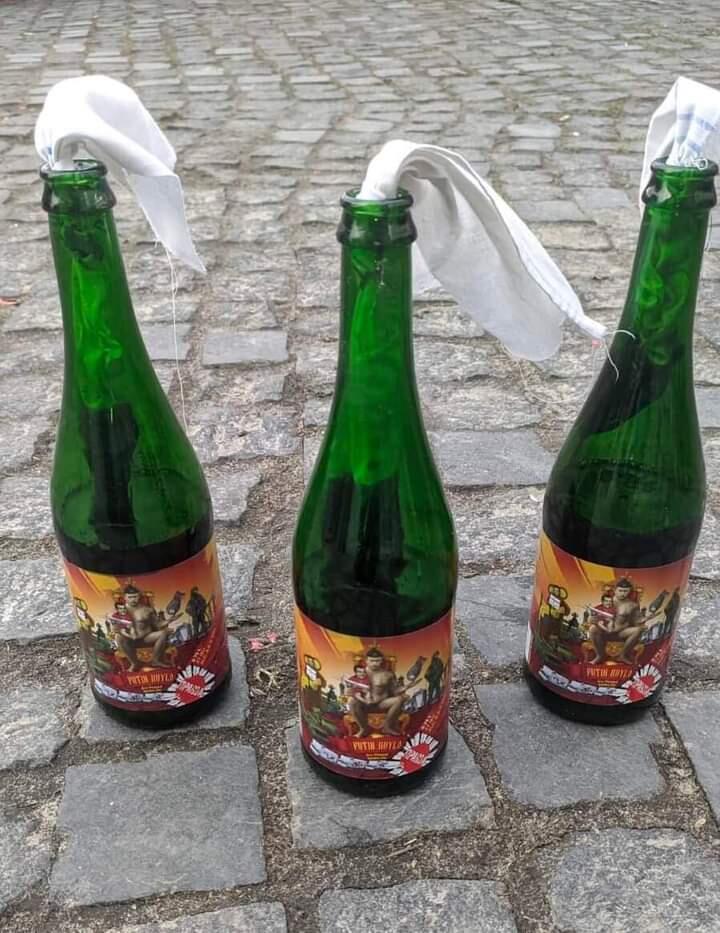
We woke up, started surviving, and defending ourselves. Everyone did what they could. Back then, nobody forced anyone. Everyone understood their place and role without any coordination from officials. I remember driving fuel to the local Territorial Defense for Molotov cocktails. The atmosphere was electric, but there was no panicked fear. On the contrary, there was pride and joy that we weren’t scared and were defending what’s ours. Our homes, our streets, and the shop where we buy bread. We really were like a single organism. The Russians felt it quickly. The world felt it. The support was insane.
A month later, couple mortar shells hit my 5-story apartment building in Irpin. The entire attic floor and all utilities burned down completely. I remember one of the neighbors posting a video of our burning building in the community chat. I looked at it and felt nothing. “Well, a building is burning. It looks like ours, but it’s as if it isn’t.” The pain started later.
https://www.youtube.com/shorts/c4wnLJMt8_c
I was only able to return to Irpin after de-occupation. I saw only two people on the street. I will never forget those bizarre sensations. A ghost town, even though just three months prior it was full of life. Then people slowly started returning, and the city began coming back to life. Irpin took a severe beating. Many damaged buildings. I listened to a ton of stories about the occupation from the locals. About murders, torture, and dogs eating corpses. In reality, everything is more prosaic and, in a way, coldly crueler than what they show in movies.
Faith. Hope. Reconstruction. Culture.
The first six months flew by very quickly. A sort of healthy, “defiant” mood prevailed. Rage, drive, and pride. For the first time, Ukraine managed to fight off great Russia. David fought off Goliath. People volunteered for the front line. There were plenty of people willing to defend. I was also part of this merging with the general flow. I felt that if my team didn’t win, it wouldn’t lose either. Ukrainian troops de-occupied Kharkiv Oblast and Kherson. There was faith that it would continue this way.
Back then, I hesitated whether to go to the front or not. Two sides of me were fighting. On one side of the scale was a general rejection of drilling and army BS—an army that was post-Soviet in fact but Soviet in essence, with its contempt for the individual—my humanistic and individualistic wiring, chronic pancreatitis, the fear of dying, and leaving my family without support. On the other side was a male sense of solidarity, the desire to defend, and the understanding that we were fighting for a righteous cause and were on the side of light. Ultimately, I decided not to mobilize. I was working at a fintech startup at the time and began helping the military financially. I completely immersed myself in working on our startup projects. This allowed me to financially support my family and the army, and to mentally detach somewhat from the war and everything happening around us.
I also took on an active role in rebuilding our apartment building. Myself and two other activists from the building initiated a fundraiser. We had to convince people not to rely on the state but to pool resources and repair the roof ourselves, because without a roof, the building wouldn’t survive the winter. It was a really cool experience. For the first time in my life, I took on such managerial functions. My experience in IT and psychology helped coordinate people to achieve the goal, and we managed to replace the roof before winter, essentially saving the building. It was a small victory and a wonderful experience of solidarity and grassroots self-organization. I look back on that time with warmth, though I was thoroughly exhausted and spent back then, and it took me a long time to recover my strength.
https://www.youtube.com/watch?v=p6-G8tHvXWU
In parallel, I started reading history and watching many videos on historical and cultural topics. Although my wife and I had been gradually switching to the Ukrainian language since 2019, 2022 catalyzed the process, and I switched to Ukrainian completely. Then the question of identity arose. Who am I? I stopped reading in Russian and mostly surrounded myself with Ukrainian-language content. The idea that “Russian culture” enters first to prepare the ground, followed by the boot of the Russian soldier, became close to me back then. Culture and language became a mental weapon and a friend-or-foe identification. I embraced this idea. We were a besieged fortress and formed the corresponding psychology. Friend or foe, no third option, no nuances or complex pictures. There was no energy for a complex picture. When you are attacked, there is no time to sort through nuances. “Russian warship, go fuck yourself”—that was our answer.
Grieving. Guilt. Fatigue. And the first feelings that something is going wrong
In the winter of 2023, as a client, I joined a Gestalt therapy group where I was able to validate the experiences that had settled inside and get support. Mostly it was grief that had frozen and had no chance to get out. It was scary, painful, shameful, and I wanted to cry. And I cried. It got a little easier. But then it would wash over me again. I was also supported by family and work. The little one was growing, and I was grateful to fate that I could see her grow. I felt sad and guilty that right now many men don’t have the opportunity to see their children.
I have a neighbor on the floor above, a bit younger than me, who mobilized. His daughter is the same age as mine. Before the war, I thought they would grow up and maybe play together in the yard. But he mobilized, and his wife and child went to live with her parents. And I looked after his home. I had the keys to his apartment. In the winter, I turned on the heating to warm up the rooms. His apartment was also damaged and stood unrepaired. I would turn on the heating and warm up his empty apartment. And I lowered my eyes when he came home on leave once every six months. He was at the front, and I was here. I felt guilt and sadness.
In the spring of 2023, the relatively voluntary influx into the army began to run dry. The counteroffensive failed, the stupidity of butcher-commanders, mistakes, inefficiency, heaps of funeral notices, constant corruption scandals, constant lies, manipulation, and gaslighting. Everyone saw that loyalty, window-dressing, and the desire to flatter superiors outweighed results and efficiency among the bureaucrats. And most importantly, the lack of a normal answer to the question: “How long will all this last, and does the state have any sane strategic plan?”
There is a saying in Ukraine: “Russian lice are not as terrifying as Ukrainian nits.” And a whole lot of nits bred during the war. It was noticeable how the bureaucrats began to stretch their shoulders, feeling that the war was not so much a threat as a brilliant chance to strengthen their power and wealth. They are exempt from mobilization. Their children do not fight. They don’t depend on the economy because the US and EU flood the government with money. The war transformed from a war of Ukrainian society against the state of Russia into a war by the society of the state of Ukraine against the state of Russia. Even though it was still “our” war, signs of engineering from offices in Kyiv, Brussels, and Washington were becoming increasingly visible.
People were stripped of their right to choose and given only one path: to fight. The only path was the state monopoly army and complete subordination to the “Prussian-Soviet” vertical. For some, this was fine, and many accepted it as the only way to defend themselves. For me, it caused absolute resistance and rejection. I could not sacrifice freedom and dignity for a dubious venture. I felt responsible for my family. I saw that this was a suicidal path for soul and body. I often asked myself, “Maybe I just got scared and built an intellectual defense and justification for myself while others do their job?” I don’t even know… This war raised questions to which I found no answers.
The Draft
In Ukraine, I am used to the crap the state produces and somehow learned to ignore it. But during the war, the state gained a level it never had before. The draft. Every man aged 25 to 60 had to show up at the military enlistment offices and update their data. Unless he was a bureaucrat, a civil servant, or managed to buy his way out, he was almost 100% destined for the front. There was also poor health. But nobody paid attention to health. You needed a truly weighty reason, connections, and luck to get an exemption or a deferment. When you see injustice on TV or in books, you think it won’t happen to you. Mobilization affected me directly. I am not a bureaucrat, I don’t work for a state institution, and I didn’t want to look for ways to pay bribes. I felt coercion, and I did not accept this coercion. I saw how this topic paralyzed me, my acquaintances, and my friends. I avoided thinking about it in every possible way. Initially, the narrative was “Either you are in the military or you are for the military.” I chose to be “for the military.” Then the rhetoric changed: “Everyone will fight, and no one will escape this fate,” so “Choose a decent unit for yourself before it’s too late.” I felt the room for maneuver shrinking and good options vanishing. All that was left was a choice between bad and very bad.
Videos began to appear online showing pixel-clad recruiters rolling up in minibuses, grabbing men, and throwing them inside. More and more videos of beatings and clashes. When 4-5 well-fed recruiters drag a person into a bus. In society, this process was dubbed “buscification” (forced mobilization via minibuses). The state gave the “attack” command against its own population. And this was probably the point of no return and the flashpoint of a split in society. It was increasingly felt how this process was being engineered. Telegram channels are full of videos of “buscification,” but all state or state-aligned media remain silent about it. More news emerged about people being tortured, killed, or throwing themselves out of TCK (enlistment office) windows. In parallel, a wave of shaming men unfolded. Online, they are called “mama’s flowers,” “bubochkas” (little darlings), “men without balls,” “cherries,” “those not born for war.” Around 3-4 million men are hiding in their homes, afraid to go out into the street. An atmosphere of contempt is created toward them. The system creates a colossally toxic space that begins to squeeze people out. I understand that I am also in this cohort of 3-4 million men.
https://t.me/gnapinfo/4448 - one of thousands of “busification” videos
I was very angry about what was happening. The environment created an ultimatum situation: either you go to the army, or it’s “ostracism and stigma.” Fuck off. This is very hard to endure morally. I am used to seeing reality as more nuanced, but here they are trying to split me.
Libertarian lense as a way of intelectual escape or way to get a breath of sanity?
Until 2025, I was probably a moderate center-left progressive. It never crossed my mind that things could be any different. I thought the state was something useful by design, but in different countries, it just had a different number of bugs. Debug it, fix it, and it will work for the benefit of society like in Switzerland or Sweden. That was my approach. But I began to doubt. I asked myself, maybe it was created to be a bug? Maybe what I call a bug is its feature, and it just masks it very successfully? A kind of Dawkinsian cultural meme that parasitizes our primitive instincts.
In 2025, I increasingly began to feel a mismatch between what I saw and what the media was pouring into my ears. I saw the beginning of the war. When the state of Ukraine practically didn’t exist, and people somehow managed. They organized the defense themselves, caught looters, and duct-taped them to poles so others would learn their lesson. There was no crime and chaos that everyone scares you with. Yes, there were state units of the Armed Forces of Ukraine, but they weren’t coordinated from the center. They relied on common sense and grassroots initiative. There was an incredible sense of freedom and responsibility. Then I saw the state return, creating fuck-up after fuck-up with its inept management, splitting society, creating artificial conflicts where people would have reached an agreement much faster otherwise.
In the winter of 2025, I was introduced to Hayek’s book The Road to Serfdom and How to Fix What Wasn’t Broken by our local ancap. Then it took off. Rothbard, Mises, Hoppe, Block. I was struck by their intellectual courage and honesty. This helped me structure into more or less settled thoughts what I felt intuitively and saw with my own eyes but couldn’t formulate correctly. Gestalt therapy helped me at the emotional level, and these respected gentlemen provided the intellectual foundation. I won’t say it became easier for me. On the contrary, it became harder. I shed my illusions and continue to shed them. I don’t even know if this is a blessing or a curse.
Now
This is probably the most difficult stage in my life. Especially when I see my country sliding into an abyss and becoming the very dragon it is fighting against. Right now, I am trying to understand what that was, what I went through, and where to go next?
This is a very strange war. Tangled, cynical, bloody, absurd. What began as a grassroots protest and a desire to protect one’s home has turned into a cynical geopolitical clusterfuck. Ukraine and Russia systematically knock out each other’s infrastructure with drones, and at the exact same time, oil flows to the EU through Ukraine via the ‘Druzhba’ (Friendship) pipeline-oil that Europeans buy, and with that money, Putin continues the war. Likewise, the EU and the US, as externalities for gas and oil, flood Zelenskyy with money, paralyzing and distorting our economy and breaking the remaining feedback loop between the government and society. It’s a very sad story.
These circumstances are bigger than me, and perhaps one just needs to accept what cannot be changed and try to change what is within one’s power. What is within my power is simply to share one small story among thousands of similar ones. Right now, I am focusing on family, health, and building healthy relationships with those around me. I have a calmer attitude toward questions of language and culture now. I understand that it was my protective adaptation, which is no longer needed. I realize that universal human values sound the same in every language. I want this war to end as quickly as possible. And I truly want to preserve my humanity and not become embittered against the world after everything that has happened and is happening.
Write a comment