a postrationalist syllabus
IntroductionPostrationalism does not, has not, and never will exist. Nevertheless I offer to posterity this set of postrationalist cultural influences. My syllabus is incomplete, but may serve two purposes. One end is archaeological. These materials map a culture that never existed. What can we imagine that postrationalists thought about when they should have been working or studying? What problems (if they had existed) might they have seen in the way people thought? What resolutions might they have sought, or offered? What, can we tentatively conclude, was their damage? The second objective of this document is to make it possible for aspiring acolytes to imitate, in their own manner, the ways of this imaginary people, and thereby begin to depart from the realm of the real themselves. In Regards to Its ContentsThe selection of cultural touchstones is in neither complete, nor perfectly representative. My selection represents my own view and understanding of what matters, and not everyone necessarily agrees about this. It represents a single minor postrationalist’s perspective of what postrationalism might have been for a period, not the entirety, of its nonexistence. Inclusion in this list was influenced both by the popularity of each work among postrationalists; by whether the author themselves was, explicitly or spiritually, a postrationalist; and by the extent to which a work seemed to capture some aspect or essence of postrationalist thought or concern. As postrationalism is purely chimerical it may seem odd that I would take time to defend my selection of materials related to it; but I believe we our duty to fidelity extends beyond the immanent to the ethereal and further. Of Its Division by TopicThe contents of this syllabus are divided into labeled categories. Although this classification system is in a sense correct, there exist arbitrarily many valid ontologies that might be so employed. I hope this one, in particular, sparks joy. The Annotated Syllabus ItselfPostrationalism can wrongly be said to have originated, in a local sense, as an inevitable response to Yudkowskian rationalism. Reductively, rationalism was the youth of a generation of autists: their embrace of autism and the exploration of its frontiers. Just how far can we push this way of understanding the world? Inevitably, this lead to excesses, and failures, and absurdities. Postrationalism was an attempt to keep the best fruits of rationalism, to abandon the worst, and to return home to the normies and see them for the first time. A Core CanonI begin with a set of persistent essays and blogs comprising the heartwood of postrationalist culture.
• What is Ritual? (https://www.ribbonfarm.com/2015/02/11/what-is-ritual/) (archive (https://archive.ph/D9cgd))
Sarah Perry is the most important postrationalist writer, and this piece is chosen as representative of her interests, thought process, and writing style, which many of us have imitated.
The standard rationalist mode is to apply correct principles of “rationality” to new domains or tear down gods. What is Ritual? draws on anthropological studies of apparently irrational behavior to develop a theory of how those behaviors may nevertheless be useful in a sort of “meta-rational” sense.
A leitmotif of postrationality is not the rejection of rationality, but rather broadening one’s understanding of what rationality might mean and rendering it more subtle.
Perry wrote extensively in this vein at her old blog, The View from Hell (http://theviewfromhell.blogspot.com/), which has its own syllabus (http://theviewfromhell.blogspot.com/2015/01/books.html). Her writing continued at The View from Hell Yes (https://theviewfromhellyes.wordpress.com/)1 (#footnote-1) and also continued at Ribbonfarm (https://www.ribbonfarm.com/author/sarahperry/) until early 2019, when she disappeared under mysterious circumstances.
• A bridge to meta-rationality vs civilizational collapse (https://metarationality.com/stem-fluidity-bridge) (archive (https://archive.ph/sxI0u))
David Chapman’s influence among postrationalists is second only to Perry’s. Although he’s written extensively on a variety of topics (see below), this piece lays out
• his vision of society and its relationship to ideas;
• a model of intellectual development;
• the relationship of development to institutions; and
• the history and failure of such institutions in the 20th century.
The specific framework is hard to summarize in a blurb, but it relates to the relationship between a systemic mode of representation and and a sort of flexible approach to grappling with the world that moves between and across systems. Although the essay is relentless its diagnosis, it did not offer any particular prescriptions; the nature and means of summoning the hoped-for “bridge” is left as an exercise for the reader.
Of all Chapman’s writing, this essay had the most influence on postrationalist thought, and its nomenclature permeated their discourse.
• Politics isn’t about Policy (https://www.overcomingbias.com/p/politics-isnt-ahtml) (archive (https://archive.ph/LrDk0))
Rationalism is an outgrowth of earlier internet communities like the Extropians2 (#footnote-2) but Yudkowsky, in his current incarnation, got his start blogging with Robin Hanson at Overcoming Bias (https://www.overcomingbias.com/). Robin Hanson was neither Rationalist nor postrationalist; he is of an older generation, and an early GMU Economics blogger.3 (#footnote-3)
In this short post, Hanson lays out his analytic worldview that he describes as “contrarian” but which might be alternatively viewed as anthropological. His approach is straightforward: using rational tools, he speculates on how a social phenomenon might look if it really served its supposed purpose. In finding that the actual phenomenon looks very different, he examines the phenomenon more closely, and attempts to deduce what “true” purpose it might serve—if one supposes it were rationalized optimized for that purpose.
In a common Rationalist mode, by contrast, one might view the divergence between an “optimal” phenomenon and its realized form—given its stated aim—as demanding a solution to make the phenomenon optimal.
Hanson is not abandoning rationality; rather, here rationality is employed instrumentally for furthering understanding and for solving a puzzle. It is a rationalism of perception rather than a rationalism of judgment.
• Slate Star Codex (https://slatestarcodex.com/) (now Astral Codex Ten (https://www.astralcodexten.com/))
To the best of my knowledge Scott Alexander does not see himself as a postrationalist; culturally, he grew up firmly enmeshed in the Rationalist tradition. Nevertheless, he was the most influential blogger in the era of postrationalism’s genesis, and (as much as he may hate being identified as such) a key moderate commentator during the early to mid culture war era when the world seemed to be disintegrating.
Scott’s discourse norms were especially influential for me specifically, and we owe him a great debt for defending our tribe’s independence during the darkest years of the culture war.
His posts range from drug studies to cultural commentary to book reviews to fiction and it’s impossible to give full coverage of what’s worth reading. In lieu of that, here is a list of some of his best-known posts.
• Meditations on Moloch (https://slatestarcodex.com/2014/07/30/meditations-on-moloch/) (archive (https://archive.ph/REWu4))
• I Can Tolerate Anything Except the Outgroup (https://slatestarcodex.com/2014/09/30/i-can-tolerate-anything-except-the-outgroup/) (archive (https://archive.ph/o6h5v))
• The Categories Were Made for Man, Not Man for the Categories (https://slatestarcodex.com/2014/11/21/the-categories-were-made-for-man-not-man-for-the-categories/) (archive (https://archive.ph/C8kyj))
• Guided by the Beauty of Our Weapons (https://slatestarcodex.com/2017/03/24/guided-by-the-beauty-of-our-weapons/) (archive (https://archive.ph/5pooC))
• Gay Rites are Civil Rites (https://slatestarcodex.com/2019/07/08/gay-rites-are-civil-rites/) (archive (https://archive.ph/LlC3h))
• The Ideology is Not the Movement (https://slatestarcodex.com/2016/04/04/the-ideology-is-not-the-movement/) (archive (https://archive.ph/A9Z2k))
• The Goddess of Everything Else (https://slatestarcodex.com/2015/08/17/the-goddess-of-everything-else-2/) (archive (https://archive.ph/65Ltv))
• Untitled (https://slatestarcodex.com/2015/01/01/untitled/) (archive (https://archive.ph/CnBOf))
• All in All, Another Brick in the Motte (https://slatestarcodex.com/2014/11/03/all-in-all-another-brick-in-the-motte/) (archive (https://archive.ph/6u9mO))
• Unsong (https://unsongbook.com/)
• literalbanana (https://twitter.com/literalbanana)
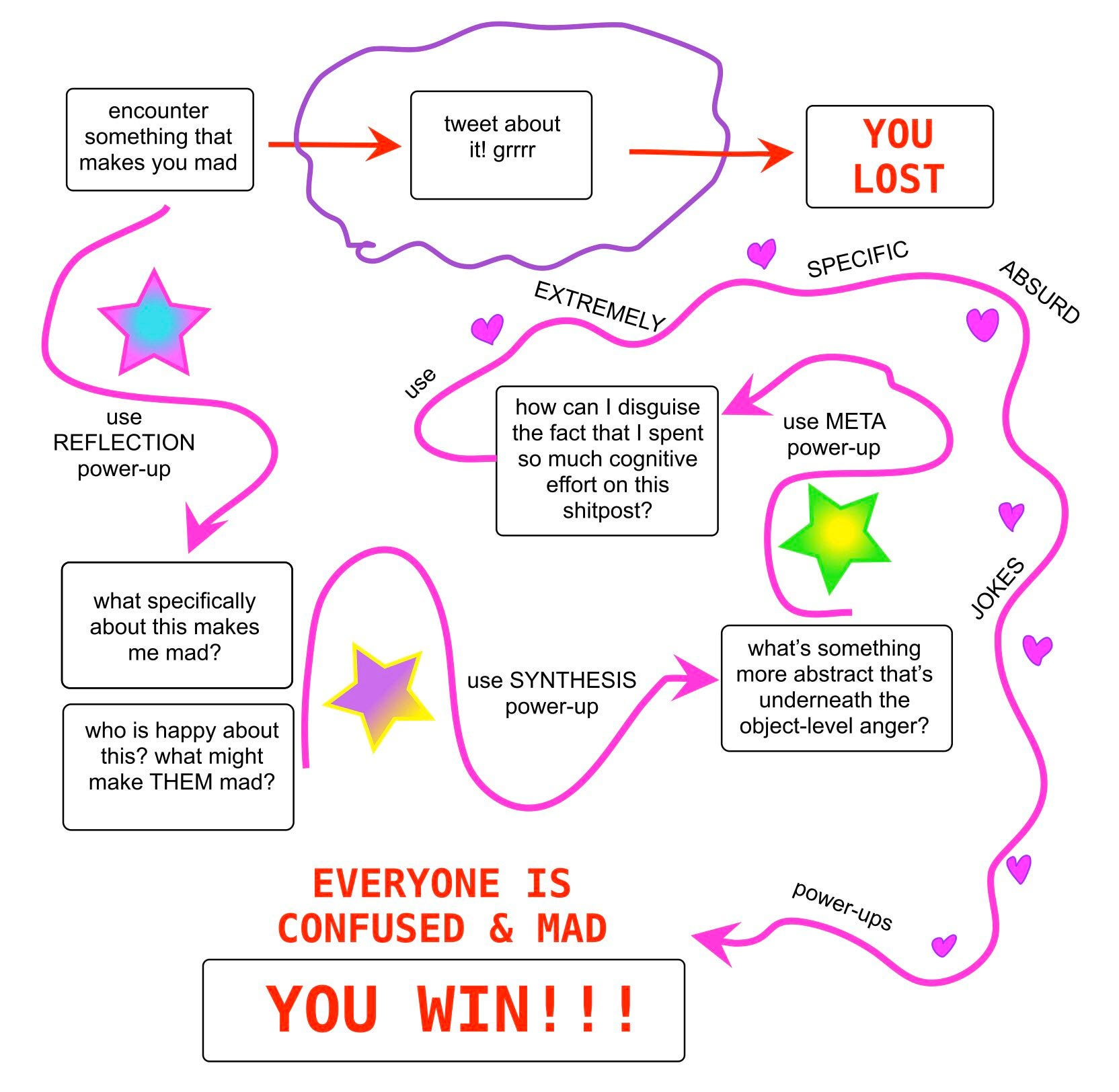
Banana is a mysterious figure who operates in the shadows. The Banana’s works occasionally take the form of blog posts, and some are linked elsewhere in this syllabus, but their sublimest output comes in the form of image macros. Here is one such revelation. • •
Those Categories Whose Population and Annotation Remains an Unfinished ExerciseApplied SorceryEthnographyAlbion’s Seed (https://amzn.to/45Rx3Mm)
• Albion’s Seed has already been reviewed in detail at the object level, and at length, by at his old site (https://slatestarcodex.com/2016/04/27/book-review-albions-seed/) (archive (https://archive.ph/nNE39)).
• Directly, the book is a detailed cultural study of four primary subcultures in the colonial era of the United States. You will immediately recognize their contemporary descendants. While straight-faced throughout its illustrations of each culture are hysterical.
• Aside from its engaging prose and cultural salience, Albion’s Seed is valuable as an elaboration of the specific practices—”folkways”—that distinguish shared cultures at large and small scales. You will not have been aware they exist before reading this book and afterward you will not be able to stop seeing them.
• In summary, by reading one develops a heightened awareness of the breadth of Cultures; their diversity and their hierarchy; and their durability over time.
Geeks, MOPs, and sociopaths in subcultural evolution (https://meaningness.com/geeks-mops-sociopaths) (archive (https://archive.ph/WqZp8))
• This essay by the eminent David Chapman is another staple of Grey Tribe cultural knowledge.
• It describes a process by which any subculture is likely to be exploited and overwhelmed by broader social forces.
• It also identifies eternal archetypes in every subculture: the tortured genius-kings, their loyal retainers and true friends, their wicked counselors, and the peasants who know a good party when they see it.
• Geeks, MOPs, and Sociopaths is essential reading if you belong to a subculture; are seeing a subculture grow around you; or if you hope to understand the lives of the eddies that form, whirl, and disappear in our sea of memeplices.
Class (https://amzn.to/462aO6o)
• Paul Fussell was a curmudgeon. An old-stock California, he arrived in the East Coast and, like Tom Wolfe, lived as something of an outsider in its highest literary institutions. Like Wolfe, he developed a taste for its blood, but Fussell’s violence was more ranging than Wolfe’s.
• Class was allegedly conceived as a sendup of the ethnographic writing style, but in fact this formal parody is simply the vehicle which allows Fussell to get to work at his true purpose, which is mercilessly lampooning every subcultural or class group in his contemporary United States that he can identify.
• In doing this he does in fact accurately describe the folkways of the many classes of America in the early Reagan Era and I unironically believe that Class will be an invaluable source for cultural historians for centuries to come.
• By reading Class one will develop awareness of specific markers of discrete classes in America; consider the ways in which each class has changed over the fifty years since, and the mores each has maintained. In combination with Albion’s Seed one may develop a stronger appreciation, upon reflection, of the extent to which class is more function of culture than of wealth.
The Two Cultures (pdf) (https://apps.weber.edu/wsuimages/michaelwutz/6510.Trio/Rede-lecture-2-cultures.pdf)4 (#footnote-4)
• CP Snow—that’s Baron Snow, Kt CBE to you—started life as a chemist. He pioneered the practice of publishing bad research in Nature by a 1930s paper on the synthesis of Vitamin A that was quickly found not to work. Retiring from scientific work, he turned to writing and accepting posts in His Majesty’s Civil Service presumably offered by his compatriot toffs.
• The Two Cultures portrays a moment when the Western tradition was broken and the two peoples, the wordcels and the shape rotators,5 (#footnote-5) were cleft apart.
• This is not the first literary notice of a schism. C. S. Lewis had depicted it years earlier in his under-appreciated Space Trilogy (https://amzn.to/3t4R17O), whose opening portion portrays the predation of a pleasant peregrine philologist by deranged, atheistic, and grasping natural scientists.
• Snow took the opposite side of the war, disavowing his wordcel peers as “Luddites” and practical illerate snobs pretending at knowledge. Beyond this broadside, in he opened a charge for the deplatforming of Greek and Latin education in Britain
• Snow, and Lewis, are worth reading because they capture a key moment in a millennia-old tradition when the men of learning were well and truly divided by their faculties. Both sides became poorer for it and we are still living in the resulting impoverished intellectual world where brother fights brother, each armed with his own variety of retard strength, yielding ample heat but no light of which to speak.
Parable of the Orangutan (archive) (https://archive.ph/AtOAL)
• We do not talk about this.
• Broadly, it is a study of the formation of norms of tolerance from a cauldron of internecine violence.
Ritual and MagicThe Ancient City (https://amzn.to/45R6A1p) The Golden Bough (https://amzn.to/3EDFrmQ) Religion and the Decline of Magic (https://amzn.to/3PAJrKX) AnthropologyFacing Violence (https://amzn.to/3PEaG7I) Practical AestheticsThe Timeless Way of Building (https://amzn.to/3Lre6YL) / A Pattern Language (https://amzn.to/3rdrWak) Language and StoriesThe Story of Human Language (https://amzn.to/3EB2Q8e) The Great War and Modern Memory (https://amzn.to/3LlYLZs) When They Severed Earth from Sky (https://amzn.to/3PEaRQq) Sandman (I (https://amzn.to/3sPONcp), II (https://amzn.to/3ZwMp6V), III (https://amzn.to/46anms9)) The Man in the High Castle (https://amzn.to/3Ze7qTz) / The Lathe of Heaven (https://amzn.to/3ZiSXWu) AntiplatonismAgainst Method (https://amzn.to/486cCNg) Ignorance, a Skilled Practice (https://carcinisation.com/2020/01/27/ignorance-a-skilled-practice/) (archive (https://archive.ph/IrVgF)) Reality has a surprising amount of detail (http://johnsalvatier.org/blog/2017/reality-has-a-surprising-amount-of-detail) (archive (https://archive.ph/Qiu4s)) Synthetic History and Information EconomicsThe Story of Civilization (I (https://amzn.to/3r48Rrf), II (https://amzn.to/3r5NXYK), III (https://amzn.to/3RkS9P1), IV (https://amzn.to/3rbJRhA), V (https://amzn.to/46eLPgd), VI (https://amzn.to/3Lik0v5), VII (https://amzn.to/3P9UOs0), VIII (https://amzn.to/3r499yl), IX (https://amzn.to/3r30NXK), X (https://amzn.to/3PAe2Zh), XI (https://amzn.to/3RiNEEs)) The Passions and the Interests (https://amzn.to/3Pl6mIW) Private Truths, Public Lies (https://amzn.to/44Q9bro) Seeing Like a State (https://amzn.to/3EEaZce) Evolutionary Game Theory (https://amzn.to/44VTu1I) The Use of Knowledge in Society (pdf) (https://statisticaleconomics.files.wordpress.com/2013/03/the_use_of_knowledge_in_society_-_hayek.pdf) MetacognitionThis Book Needs No Title (https://amzn.to/3EDGaEA) Ficciones (https://amzn.to/467wLAO) A first lesson in meta-rationality (https://metarationality.com/bongard-meta-rationality) (archive (https://archive.ph/yrFnu)) Doxa, Episteme, and Gnosis Revisited (https://www.lesswrong.com/posts/QKyvibvccetFyBqtp/doxa-episteme-and-gnosis-revisited) (archive (https://archive.ph/61BoP)) The Master and his Emissary (https://amzn.to/46tmyz1) Gödel, Escher, Bach (https://amzn.to/45UW7Cf) Ways to LiveComprehensiveEssays (https://amzn.to/44RBzt7), Montaigne PlayFinite and Infinite Games (https://amzn.to/3LhXD9q) Impro (https://amzn.to/3EEbbIu) WisdomEcclesiastes (https://www.biblegateway.com/passage/?search=Ecclesiastes%201&version=KJV) and Havamal (https://www.ragweedforge.com/havamal.html) MysticismCharnel ground (https://vividness.live/charnel-ground) (archive (https://archive.ph/15But)) / Pure land (https://vividness.live/pure-land) (archive (https://archive.ph/gn8zP)) Null Call (https://arcove.substack.com/p/null-call) (archive (https://archive.ph/1XQDZ)) PolitesseHow to Be Polite (https://medium.com/s/story/how-to-be-polite-9bf1e69e888c) (archive (https://archive.ph/gMeBU)) Rules of Civility (https://amzn.to/3PD5HUz) The Silent Suffering of the Non-Neurotic (https://www.econlib.org/archives/2016/11/the_neurotic_he.html) (archive (https://archive.ph/UCysD)) How to Win Friends and Influence People (https://amzn.to/45W7nhW) Egregore StudiesBrain Worms, Their Character, and How to Avoid ThemThe True Believer (https://amzn.to/3PCdFxh) Keep Your Identity Small (http://www.paulgraham.com/identity.html) (archive (https://archive.ph/e6k2d)) Things People Would Like to ForgetRadical Chic and Mau-Mauing the Flak-Catchers (https://amzn.to/3P9VkpW) Days of Rage (https://amzn.to/3PhTd3x) Illiberal Reformers (https://amzn.to/467x0fa) Who We Are and How We Got Here (https://amzn.to/48c3ZRr) Industrial Society and Its Future (https://amzn.to/45PPRM8) Things People Have ForgottenThe Final Pagan Generation (https://amzn.to/45RyaM2) Those Belonging to This CategoryFragnemt (https://amzn.to/3ZjZSyQ) Writings, 1997-2003 (https://amzn.to/3ZiGQbL)6 (#footnote-6) Twitteron egregores (https://twitter.com/chaosprime/status/1150259062719811584) Those Which I Need to Think About a Little More, or Which I Need to Actually Read-Recommended GroupThe Metaphysical Roots of Modern Science (https://amzn.to/45Oo26Y) The Secret of Our Success (https://amzn.to/3PBBZ2d) Personal Knowledge (https://amzn.to/3sUgbWZ) Priests and Programmers (https://amzn.to/3LlwPoC) The Mythical Man-Month (https://amzn.to/3PkG9KI) When Prophecy Fails (https://amzn.to/3PkPMsy) Foucault’s Pendulum (https://amzn.to/3ZfnkNk) Metaphors We Live By (https://amzn.to/3PfQh7h) Legal Systems Very Different From Ours (https://amzn.to/3rlFrol) Net of Magic (https://amzn.to/3EEVe4W) Violence and the Sacred (https://amzn.to/3ECNX5t) Crowds and Power (https://amzn.to/3Pet7yh) Ontological Uncertainty GroupSexual Personae (https://amzn.to/3RiOfWI) The White Goddess (https://amzn.to/3Lmy0Ec) Plutarch — Lives7 (#footnote-7) Tao Te Ching (https://amzn.to/45UWTz9) The Story of Philosophy (https://amzn.to/3LmGfQW) Haven’t Read Yet GroupAncient Law (https://amzn.to/3sNSEGR) The Treason of the Intellectuals (https://amzn.to/3r4a6GV) Ancient and Modern Imperialism (https://amzn.to/46coZFK) On Deep History and the Brain (https://amzn.to/48grvfU) Empires of the Word (https://amzn.to/48bnucS) The Unheavenly City (https://amzn.to/48eikfZ) Homo Sacer (https://amzn.to/3rgtKiP) The Idea of a University (https://amzn.to/3ECOeFx) Human Universals (https://amzn.to/3Pk2EiI) Manhood in the Making (https://amzn.to/3P9vm5K) A Secular Age (https://amzn.to/3ZjhfzN) The Death of an American Jewish Community (https://amzn.to/467xy4K) 1 (#footnote-anchor-1)Thanks to @paul__is__here (https://twitter.com/paul__is__here) for flagging this (https://twitter.com/paul__is__here/status/1701664712847409497). 2 (#footnote-anchor-2)JD Pressman is an intellectual historian of Rationalism; he discusses Eliezer Yudkowsky’s intellectual background and influences, and participation in the Extropians, in a podcast with me (https://soundcloud.com/user-557955426/episode-22-eigenrobot-vs-extropy?si=f5c2c74411224d08b69582f4e631bfbd&utm_source=clipboard&utm_medium=text&utm_campaign=social_sharing). 3 (#footnote-anchor-3)The influence of the GMU Economics Department on discourse and the intellectual development of weird late GenX / early Millenial kids is underappreciated. Tyler Cowen and Alex Tabarrok at Marginal Revolution (https://marginalrevolution.com/) are the best-known, but Bryan Caplan, Garret Jones, and others were also core influences that came out of their early pro-blog actions in the aughts. 4 (#footnote-anchor-4)Thanks to for flagging this. 5 (#footnote-anchor-5)An old postrationalist nomenclature described and set out in ’s contemporary retelling (https://roonscape.ai/p/a-song-of-shapes-and-words) of the Two Cultures. 6 (#footnote-anchor-6)Thanks to @sadiqstik (https://twitter.com/sadiqstic) for flagging this (https://twitter.com/sadiqstic/status/1701736860437840145). 7 (#footnote-anchor-7)Good luck finding a nice unabridged copy. The one I finally stumbled upon in a rare books store was published contemporaneously with the First World War.
Write a comment