How Long Should a Blog Post Be in 2026? Every Study, Dated and Sourced
Every study on blog post length with its date, sample and finding, re-opened on November 19, 2026, plus word counts of nine pages Google shows.
- Studies of Google rankings, traffic and links
- Studies of AI answers
- What Google’s John Mueller said about word count, by date
- Nine pages Google showed for the question, and the words on each
- Ranges people publish, by post type
- Other figures in the post
Every study on blog post length with its date, sample and finding, re-opened on November 19, 2026, plus word counts of nine pages Google shows.
Where the data comes from: the study pages behind each row, re-opened on November 19, 2026 (the date printed on each page is in its own column), a pull of Google’s results for “how long should a blog post be” through DataForSEO on November 19, 2026 (14:44 UTC; US, English, desktop), and my word counts of nine pages from that pull.
- Post: How Long Should a Blog Post Be in 2026? Every Study, Dated and Sourced
- RankControl, an AI SEO and AEO platform
- Google Doc: Is Word Count a Google Ranking Factor? Google’s Own Statements
Studies of Google rankings, traffic and links
| Study | Date on its page | Sample | What it measured | What it found |
|---|---|---|---|---|
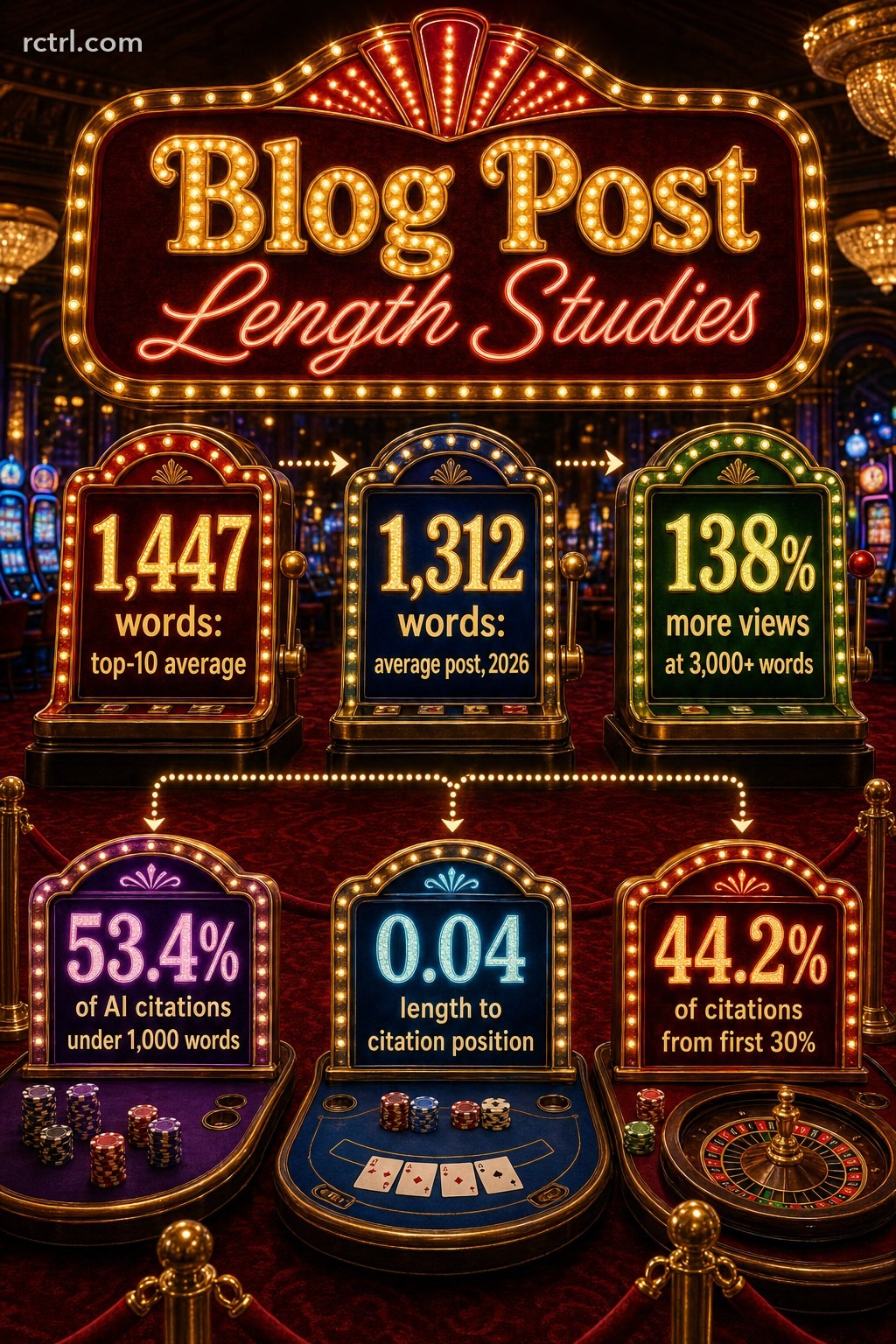
| Backlinko, search ranking study | Page last updated April 14, 2025 | 11.8 million Google results | Word count against rank | Top-10 average of 1,447 words and no direct relationship between word count and rank |
| Backlinko with BuzzSumo, content study | February 19, 2019 | 912 million blog posts | Length against referring domains and social shares | Posts over 3,000 words had 77.2% more referring domains than posts under 1,000; posts of 1,000 to 2,000 words had 56.1% more social shares than posts under 1,000, with diminishing returns after 2,000 |
| HubSpot, shareable and linkable post study | Page updated June 5, 2025; organic visits counted May 1 to July 31, 2015 | 6,192 posts on HubSpot’s own marketing blog | Length against organic traffic, shares and links | 2,250 to 2,500 words earned the most organic traffic; posts over 2,500 words got the most shares and the most links; HubSpot calls it a correlation study |
| Semrush, data-driven length guide | September 28, 2022 | Not stated on the page; it cites Semrush’s State of Content Marketing Global Report 2022 | Length against page views | Posts of 3,000+ words got 138% more page views than posts under 500 words |
| Semrush, blogging statistics | Page dated May 6, 2024; figures labeled 2023 | Not stated on the page | Length of top-performing against low-performing posts | Top-performing posts averaged 1,152 words and low-performing posts 668; over 30% of marketers called short articles their best-performing content and 24% said long-form posts |
| Orbit Media, 2026 blogging survey | September 8, 2026 | 1,042 content marketers, 13th year of the survey | Self-reported post length and results | Average post of 1,312 words, down from a 2023 peak of 1,427; 6+ hours on 2,000-word posts roughly doubled the odds of strong results; 13.9% said their blog delivers strong results, an all-time low |
| SerpIQ, “How Important is Content Length?” (archived copy) | April 26, 2012 | Not stated in the text; “all of the SERPs we’ve analyzed” | Average length by result position | Tenth-position pages carried about 400 fewer words than first-position pages; at least 1,500 words called a good target for most results |
Studies of AI answers
| Study | Date on its page | Sample | What it measured | What it found |
|---|---|---|---|---|
| Ahrefs, AI Overviews length study | December 3, 2025 | 560,346 AI Overviews, 1,677,876 cited URLs, 174,048 pages with readable text | Page length against being cited and citation position | Cited pages averaged 1,282 words; 53.4% were under 1,000 words; the correlation with citation position was 0.04 |
| Kevin Indig, reported by Search Engine Land | February 18, 2026 | 1.2 million AI answers, 18,012 verified ChatGPT citations | Where on a page ChatGPT cites | 44.2% of citations came from the first 30% of a page, 31.1% from the middle and 24.7% from the last third |
| Chen and Koudas, University of Toronto | October 10, 2026 | 158,099 AI answers with 468,037 citations; the page-level model covers 12,038 pages on 1,120 websites | Page features, including word count, against citations | Word count went with 0.9% more citations per standard deviation of length, and the paper says length shows no effect |
| DEJAN AI, “How big are Google’s grounding chunks?” | December 20, 2025 | 7,060 queries, 2,275 pages, 883,262 snippets | How much of a page Google’s AI uses | A fixed budget of about 2,000 words per query and a plateau at about 540 words per page; the share of a page selected was 61% for pages under 1,000 words and 13% for pages over 3,000 |
What Google’s John Mueller said about word count, by date
| Date | Where | What Mueller said |
|---|---|---|
| August 5, 2019 | A Reddit thread, reported by Search Engine Roundtable | “Word count is not a ranking factor.” |
| February 27, 2021 | A video answer, reported by Search Engine Journal | Word count is neither a quality factor nor a ranking factor, and adding text blindly does not make a page better |
| January 21, 2025 | Bluesky, reported by Search Engine Roundtable | “word-count itself makes so little sense” |
Nine pages Google showed for the question, and the words on each
| Page | Where it showed | Words counted | Figure it recommends | What backs the figure | Source and date |
|---|---|---|---|---|---|
| Wix Blog, “How long should a blog post be for maximum impact?” | AI Overview source | 3,619 | 1,500 to 2,500, with a sweet spot at 2,450 | Wix Blog’s own results around 2,450 words, no sample given | Google results (DataForSEO, US, English, desktop), Nov 19, 2026; words counted by the post author, Nov 19, 2026 |
| Lovable guide, “Data-Backed Guide 2026” | AI Overview source | 1,734 | 1,500 to 2,500 | Links to Backlinko (11.8 million results, 912 million posts), Orbit, Semrush and Ahrefs (174,000 pages) | Google results (DataForSEO, US, English, desktop), Nov 19, 2026; words counted by the post author, Nov 19, 2026 |
| The Write Practice, “A Writer’s Guide” | AI Overview source | 1,905 | 2,450+ for Google traffic | A link labeled “the data” to a Quick Sprout article | Google results (DataForSEO, US, English, desktop), Nov 19, 2026; words counted by the post author, Nov 19, 2026 |
| 11content, “In 2024? (Backed By Research)” | AI Overview source | 1,561 | 2,566 to 2,736 | Its own count of the top 10 blogs in each of five niches | Google results (DataForSEO, US, English, desktop), Nov 19, 2026; words counted by the post author, Nov 19, 2026 |
| Capsicum Mediaworks, updated April 1, 2026 | Regular result | 9,242 | 2,000 to 2,500+ | A chart of top-10 positions (2,400+ first, 2,300+ fifth, 2,000+ tenth) with no study named | Google results (DataForSEO, US, English, desktop), Nov 19, 2026; words counted by the post author, Nov 19, 2026 |
| AwardSpace, snippet dated September 29, 2025 | Regular result | 1,419 | 1,200 to 1,800 for how-tos, about 2,000 for pillar posts | Cites WG Content and Elementor, which gives a 1,890-word sweet spot | Google results (DataForSEO, US, English, desktop), Nov 19, 2026; words counted by the post author, Nov 19, 2026 |
| Social Media Today, April 6, 2015 | Regular result | 1,852 | No target of its own; quotes 1,500 to 1,600 from older sources | Medium’s December 2013 finding on seven-minute posts (1,600 words), SerpIQ’s April 2012 post and Buffer’s 1,600-word guideline | Google results (DataForSEO, US, English, desktop), Nov 19, 2026; words counted by the post author, Nov 19, 2026 |
| Page One Power, snippet dated August 18, 2023 | Regular result | 1,244 | 1,000 to 2,500 | Numbered links to Search Engine Journal, Semrush and HubSpot pages, no dated study in the text | Google results (DataForSEO, US, English, desktop), Nov 19, 2026; words counted by the post author, Nov 19, 2026 |
| Optuno, November 16, 2026 | Regular result | 1,648 | A few hundred words for narrow questions, 1,000 to 1,500 for how-tos, 2,000+ for broad guides | Names DEJAN AI’s December 2025 analysis of 7,060 queries and 2,275 pages | Google results (DataForSEO, US, English, desktop), Nov 19, 2026; words counted by the post author, Nov 19, 2026 |
Ranges people publish, by post type
| Post type | Semrush guide, September 28, 2022 | Mailchimp guide, undated page | Google AI Overview, November 19, 2026 |
|---|---|---|---|
| Any post, general rule | About 1,500 to 2,500 | 1,500 to 2,000 | 1,500 to 2,500 |
| Announcement or news | 400 to 600 for announcements, 600 to 1,000 for news | 400 to 700 for simple press releases and announcements | 300 to 600 for quick answers and news updates, 600 to 1,000 for standard posts |
| Informational or “what is” post | 1,000 to 1,500 | 1,000 to 2,500 for informational posts and how-tos together | 1,300 to 1,700 |
| Guide, how-to or listicle | 1,500 to 2,500 | 1,000 to 2,500 for informational posts and how-tos together | 1,700 to 2,500 |
| Pillar page | 3,000+ | Over 3,000 | 3,000+ |
Other figures in the post
| Figure | What the post reports | Source | Date |
|---|---|---|---|
| 1,500 to 2,500 words, 8 sources | Google’s AI Overview for “how long should a blog post be” said 1,500 to 2,500 words and listed eight sources; its ranges by type were 300 to 600 for quick answers, 1,700 to 2,500 for how-tos and 3,000+ for pillar posts | DataForSEO Google results, US, English, desktop, top 10 plus the AI Overview | Nov 19, 2026 (14:44 UTC) |
| 3 of 9 | Pages (Lovable, 11content and Optuno) that state how many pages, posts or queries at least one of their numbers rests on | The post author’s reading of the nine pages | Nov 19, 2026 |
| 1,734 median, 2,692 average | Median word count of the nine pages; Wix (3,619) and Capsicum Mediaworks (9,242) raise the average; seven of the nine run 1,244 to 1,905 | The post author’s word counts | Nov 19, 2026 |
| Up to 584 words | Difference between two passes over the same saved pages; Optuno came out at 2,232 words and then 1,648, AwardSpace at 1,830 and then 1,419, once the sidebar and related posts were removed | The post author’s counts | Nov 19, 2026 |
| “(No, we don’t.)” | Google’s page on helpful, people-first content asks whether you are writing to a particular word count because you heard Google has a preferred one, and prints this answer | Google Search Central, page last updated Oct 5, 2026 | Read Nov 19, 2026 |
| 2,416 and 2,032 words | First and tenth result, as a commenter quoted SerpIQ; the archived SerpIQ post says tenth-position pages carry about 400 fewer words, and the two figures are not in its text | r/Blogging thread, and the Internet Archive copy of SerpIQ’s post | Oct 27, 2025; Apr 26, 2012; read Nov 19, 2026 |
| 37 upvotes, 49 comments | r/Blogging: a poster said forcing 2,000-word posts because long form ranks better was “killing my soul” and that half of each post was filler | r/Blogging thread, read through AgntData’s Reddit API | Posted Oct 27, 2025; read Nov 19, 2026 |
| 7 upvotes, 16 comments | r/b2bmarketing: a poster asked whether 3,000-word posts are dead; replies said clarity took over as the advantage, and that fluffy posts are dead and not long ones | r/b2bmarketing thread, read through AgntData’s Reddit API | Posted Apr 29, 2026; read Nov 19, 2026 |
| 77% and 56% against 77.2% and 56.1% | Wix’s guide merges two findings into one band; Backlinko gives 77.2% for posts over 3,000 words (referring domains) and 56.1% for posts of 1,000 to 2,000 words (shares) | Wix Blog guide; Backlinko content study | Read Nov 19, 2026 |
| 1,427 against 1,312 | Lovable’s guide says Orbit’s survey landed “around 1,427 words”; 1,427 is Orbit’s 2023 peak and the 2026 page gives 1,312 | Lovable guide; Orbit Media survey page | Read Nov 19, 2026 |
| 2,140 words, 0.18 | Visionary, a UK SEO agency: a crawl of 100000 pages ranking for 5000 keywords, average #1 page 2140 words, raw word count correlation 0.18 with ranking; full data only on email request, so it is not in the tables | Visionary page, not checked | Published Apr 2026 |
| 21,000+ citations | Kevin Indig’s Growth Memo “The science of how AI picks its sources” analysed more than 21,000 citations for content length, depth and focus; the results are paywalled and were not checked | Growth Memo | Mar 23, 2026 |
- Reference: https://rankcontrol.github.io/2026/11/how-long-should-a-blog-post-be/
- Reference: https://rctrl.com
- Reference: https://docs.google.com/document/d/1vnTc5pJ0T3VtxN5g0beqwJtgXDnKpZGPHNVM-s7jHK0/edit?usp=sharing
- Reference: https://rankcontrol.github.io/images/gh-026-how-long-should-a-blog-post-be-info-t1-wm.jpg
- Reference: https://www.orbitmedia.com/blog/blogging-statistics/
- Reference: https://searchengineland.com/chatgpt-citations-content-study-469483
- Reference: https://arxiv.org/abs/2610.15033
- Reference: https://www.seroundtable.com/google-word-count-is-not-a-ranking-factor-27994.html
- Reference: https://www.searchenginejournal.com/word-count-not-a-quality-factor/397288/
- Reference: https://www.seroundtable.com/google-word-count-itself-makes-so-little-sense-38767.html
Write a comment