AI Workflows vs Autonomous Agents: Why Enterprise Chooses Workflows in 2026
- The Great AI Architecture Debate: Workflows vs Agents
- Why Enterprise Reality Contradicts the Hype
- Workflow Orchestration Tools: What Actually Works in 2026
- Enterprise Decision Framework: When to Use What
- The Hidden Cost of Agents: Why 80% See No ROI
- Building Your First Agentic Workflow: Practical Playbook
- The 2026 Workflow Architecture Stack
- What Changes in 2027: Predictions
- FAQ
- Conclusion: The Workflow-Agent Synthesis
The AI industry’s dirty secret: autonomous agents promised to revolutionize work, but in 2026, structured workflows are winning in production. While tech media obsesses over “AGI agents,” 78% of enterprises quietly run MLOps teams managing deterministic AI pipelines—and they’re seeing better ROI.
Here’s the uncomfortable truth: fewer than 5% of enterprise applications have genuine autonomous agents. The rest? Glorified chatbots and structured workflows doing the real work. Yet one global industrial firm cut audit reporting by 92% using agent-centric workflows. The difference isn’t agents vs. workflows—it’s how you architect them.
The Great AI Architecture Debate: Workflows vs Agents
AI Workflows (Pipelines):
-
Structured, deterministic task orchestration
-
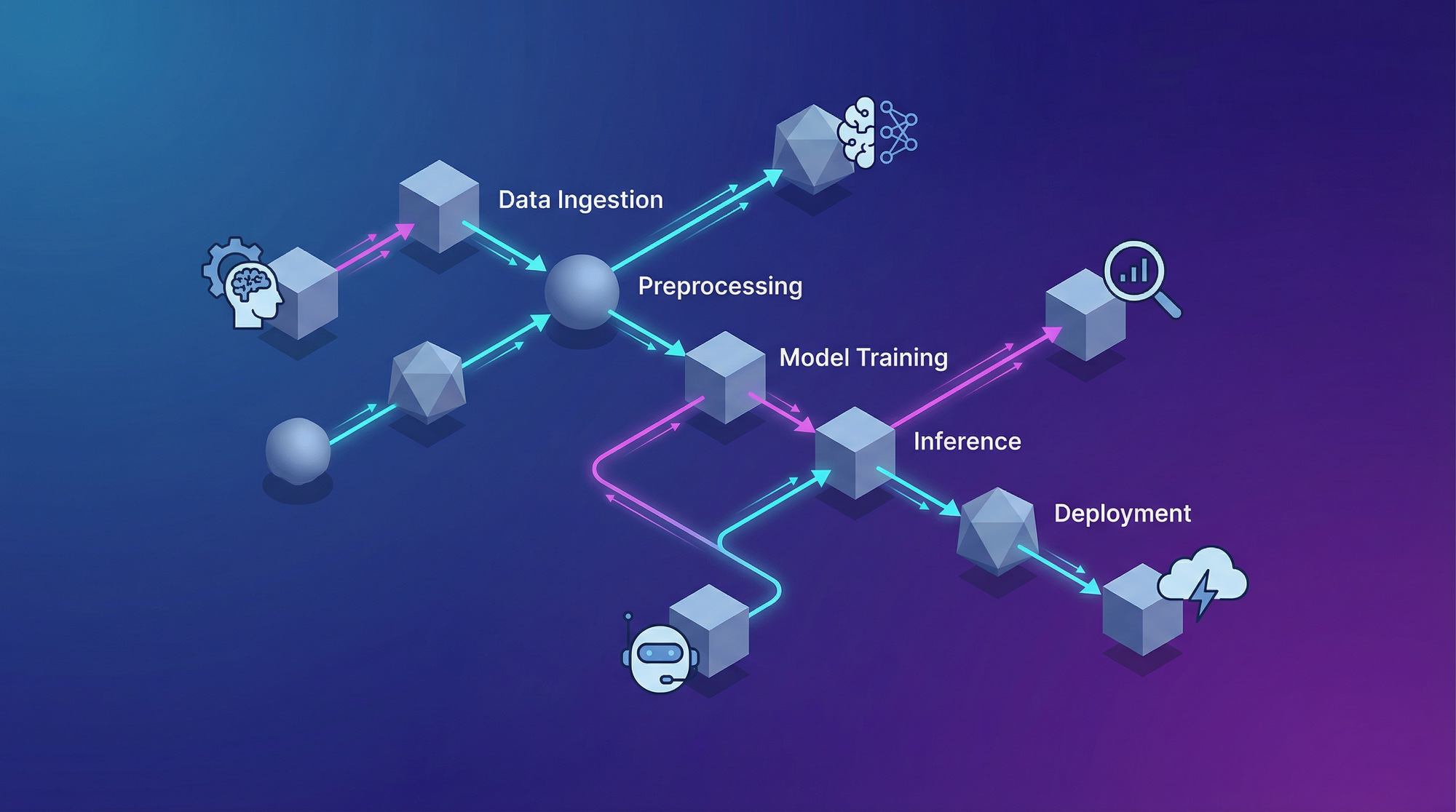
Fixed sequences: data collection → preprocessing → model training → deployment
-
Predictable, testable, governable
-
Excel at repeatable, well-defined work
Autonomous Agents:
-
Goal-directed software that perceives, decides, acts
-
Adaptive, dynamic decision-making
-
Minimal human guidance required
-
Handle ambiguous, multi-step tasks
The critical distinction: workflows optimize for reliability; agents optimize for adaptability.
Why Enterprise Reality Contradicts the Hype
The Numbers Don’t Lie
Current State (2026):
-
78% of enterprises have dedicated MLOps teams for workflows
Pattern Description Best For
ReAct Reasoning + Acting in loops Research, problem-solving
Plan-and-Execute Upfront planning, then execution Complex multi-step tasks
Reflection Self-critique and iteration Content creation, coding
Tool Use Agent calls external APIs/tools Data retrieval, calculations
Planning Break goals into sub-goals Project management
Multi-Agent Specialized agents collaborate Enterprise workflows
Planner-Critic-Executor Planning → Review → Action High-stakes decisions
Self-Discovery Agent learns optimal patterns Adaptive processes
Tree of Thoughts Explore multiple reasoning paths Strategic planning
Key Insight: These patterns reduce cycle time, clarify human-agent responsibilities, and improve repeatability under load.
Workflow Orchestration Tools: What Actually Works in 2026
The market has clarified into distinct categories:
n8n: Visual Workflow Automation
Strengths:
-
350+ native integrations (Slack, Salesforce, databases)
-
Drag-and-drop visual interface
-
Execution-based pricing (cheaper for complex loops)
-
Self-hosted or cloud
-
Native LangChain integration for AI
Best For:
-
IT operations and production automation
-
Teams without Python expertise
-
Enterprises requiring self-hosting
-
General-purpose workflow automation
Limitations:
-
Less control over agent reasoning
-
Limited state management for complex AI flows
LangGraph: Code-First Agent Orchestration
Strengths:
-
Python-based state machines for complex AI logic
-
Dynamic branching, loops, conditional routing
-
Built specifically for LLM-powered agents
-
Time-travel debugging (LangGraph Studio)
-
v1.0 introduces Agent Protocol for cross-framework communication
Best For:
-
Python developers
-
Multi-agent reasoning systems
-
Human-in-the-loop AI workflows
-
Applications requiring fine-grained control
Limitations:
-
Steeper learning curve
-
No visual interface
-
Requires code deployment infrastructure
Temporal: Durable Execution Standard
Why It Matters:
Temporal has become the de facto standard for “durable agent execution” in mission-critical workflows. When an AI workflow must survive server crashes, network failures, or extended delays, Temporal ensures state persistence and automatic recovery.
Use Cases:
-
Financial transaction processing with AI
-
Healthcare workflows with compliance requirements
-
Long-running research pipelines
The Observability Requirement
2026’s Killer Feature: Production AI workflows require time-travel debugging and end-to-end tracing.
-
LangGraph Studio: Rewind agent decisions, inspect state at any point
-
n8n + LangSmith: Track LLM calls, token usage, error patterns
-
Without observability: Debugging agents is nearly impossible
Enterprise Decision Framework: When to Use What
Choose Pure Workflows If:
✅ Tasks have well-defined, repeatable steps
✅ Compliance requires deterministic outputs
✅ Budget constraints favor execution-based pricing
✅ Team lacks AI/ML expertise
✅ Reliability > adaptability
Example: ETL pipelines, report generation, data synchronization
Choose Agentic Workflows If:
✅ Tasks involve ambiguity or require reasoning
✅ Steps can’t be fully specified upfront
✅ Value comes from adaptation, not just execution
✅ You have Python/AI expertise
✅ ROI justifies complexity investment
Example: Customer support routing, research synthesis, code generation
Choose Pure Autonomous Agents If:
⚠️ Almost never in production (as of 2026)
⚠️ Only for research or non-critical applications
⚠️ Requires extensive guardrails and human oversight
Reality Check: “Pure” autonomous agents remain aspirational. Even advanced systems operate within workflow constraints.
The Hidden Cost of Agents: Why 80% See No ROI
Problem 1: Retrofit vs. Redesign
What Fails:
-
Take existing human workflow
-
Replace human steps with AI
-
Expect productivity gains
Why It Fails:
Human workflows optimize for human cognition. AI agents have different strengths (parallel processing, instant recall) and weaknesses (context limits, reasoning gaps). Retrofitting guarantees suboptimal performance.
What Works:
-
Identify business outcomes (not tasks)
-
Design workflows with agents as primary actors
-
Place humans where judgment matters, agents where scale matters
Problem 2: Underestimating Governance Overhead
Autonomous agents require:
-
Continuous monitoring for drift
-
Guardrails for safety and compliance
-
Version control for prompt engineering
-
A/B testing for performance optimization
-
Audit trails for regulated industries
TCO Reality:
Building the agent: 20% of cost
Operating and governing the agent: 80% of cost
Problem 3: Measurement Myopia
Organizations measure agent performance on task completion but fail to measure:
-
Reduction in cycle time across full workflow
-
Decrease in human context-switching
-
Improvement in decision quality
-
Impact on customer/employee satisfaction
Example:
An AI agent handles 70% of support tickets (task success), but response time increases because remaining 30% require extensive context from agent interactions. Net outcome: worse customer satisfaction.
Building Your First Agentic Workflow: Practical Playbook
Step 1: Map Current State (1 week)
-
Document end-to-end workflow
-
Identify bottlenecks and high-volume steps
-
Measure baseline metrics (time, cost, quality)
Step 2: Design Agent-Centric Future State (1 week)
-
Redesign workflow with agents as primary actors
-
Define human-agent handoffs
-
Specify governance checkpoints
-
Choose orchestration tool (n8n for visual, LangGraph for code)
Step 3: Build MVP Workflow (2-4 weeks)
-
Implement core path with one agent
-
Add observability (logging, tracing)
-
Test with production-like data
-
Measure against baseline
Step 4: Iterate and Scale (ongoing)
-
Add guardrails based on failure modes
-
Optimize prompts and model selection
-
Expand to additional workflow branches
-
Monitor ROI and adjust
Anti-Pattern: Building a complex multi-agent system upfront. Start simple, add complexity only when justified by data.
The 2026 Workflow Architecture Stack
Modern agentic workflows require layers:
┌─────────────────────────────────────┐
│   Business Layer                    │
│   (Task definitions, metrics)       │
└─────────────────────────────────────┘
           ↓
┌─────────────────────────────────────┐
│   Orchestration Layer               │
│   (n8n, LangGraph, Temporal)        │
└─────────────────────────────────────┘
           ↓
┌─────────────────────────────────────┐
│   Agent Layer                       │
│   (LLM calls, reasoning, tools)     │
└─────────────────────────────────────┘
           ↓
┌─────────────────────────────────────┐
│   Infrastructure Layer              │
│   (LLM APIs, vector DBs, caching)   │
└─────────────────────────────────────┘
           ↓
┌─────────────────────────────────────┐
│   Observability Layer               │
│   (LangSmith, custom tracing)       │
└─────────────────────────────────────┘
Critical: Observability isn’t optional. Without it, debugging production failures becomes impossible.
What Changes in 2027: Predictions
Consolidation Around Standards
-
Agent Protocol (introduced by LangGraph v1.0) enables cross-framework agent communication
-
Expect workflow tools to converge on this standard
-
Multi-vendor agent ecosystems become feasible
Workflow Marketplaces
Like GitHub for code, expect marketplaces for proven agentic workflow patterns:
-
“Customer onboarding workflow” (finance vertical)
-
“Contract review workflow” (legal)
-
“Bug triage workflow” (software engineering)
Regulatory Pressure
EU AI Act and similar regulations will mandate:
-
Audit trails for agent decisions
-
Human-in-the-loop for high-risk applications
-
Explainability requirements
This favors structured workflows over pure autonomous agents.
Economic Shift: Workflows as Competitive Moats
Organizations with superior workflow architecture will outcompete those with better models. Why? Models commoditize, workflows compound.
FAQ
Q: Are autonomous agents dead?
A: No, but standalone agents are rare in production. The future is agentic workflows—agents operating within structured orchestration.
Q: Should I learn n8n or LangGraph?
A: Depends on your role. If you’re a product manager, data analyst, or ops engineer, start with n8n. If you’re a developer or AI engineer, learn LangGraph. Both have valid use cases.
Q: How do I justify ROI for agentic workflows?
A: Measure full-cycle time reduction, not just task automation. Calculate cost of human context-switching and errors. Include compliance risk reduction. ROI hides in places traditional metrics miss.
Q: What’s the biggest mistake companies make?
A: Retrofitting AI into human workflows instead of redesigning workflows around agent capabilities. It’s like putting a jet engine on a bicycle—technically possible, fundamentally suboptimal.
Q: Do I need a specialized orchestration tool, or can I build custom?
A: For prototypes, custom code works. For production, orchestration tools provide essential features (monitoring, error handling, retries) that take months to build well. Use Temporal for durable execution, n8n for visual workflows, LangGraph for complex agent logic.
Q: How long until we have truly autonomous agents?
A: Define “autonomous.” Current agents handle narrow tasks well within workflows. General-purpose agents that operate independently across domains remain 5-10 years away (and may require architectural breakthroughs, not just scaling).
Conclusion: The Workflow-Agent Synthesis
The debate “workflows vs. agents” presents a false dichotomy. The real innovation is agentic workflows: structured systems where agents execute tasks, humans provide judgment, and orchestration ensures reliability.
Key Takeaways:
-
Workflows aren’t legacy—they’re infrastructure. Just as microservices need orchestration (Kubernetes), agents need workflows.
-
ROI requires redesign, not retrofit. Inserting AI into human processes yields marginal gains. Redesigning workflows around agent capabilities yields 10x.
-
Observability determines success. Without time-travel debugging and tracing, production agents fail unpredictably. LangGraph Studio and LangSmith-style tools are non-negotiable.
-
Start simple, scale deliberately. The 92% audit time reduction came from methodical workflow redesign, not a complex multi-agent system on day one.
-
2026 winners combine structure and autonomy. Pure workflows lack adaptability. Pure agents lack governance. Agentic workflows balance both.
The organizations thriving in 2026 aren’t those with the most advanced models—they’re those with the best workflow architectures. Build your competitive moat in orchestration, not just automation.
Related Reading:
-
[best ai Models 2026: GPT-5 vs Claude vs Gemini](#)
Originally published at humai.blog
#AI #HumAI #Technology
Write a comment