The new Sanders-Casar Ban Artificial Superintelligence Act – and why I oppose it
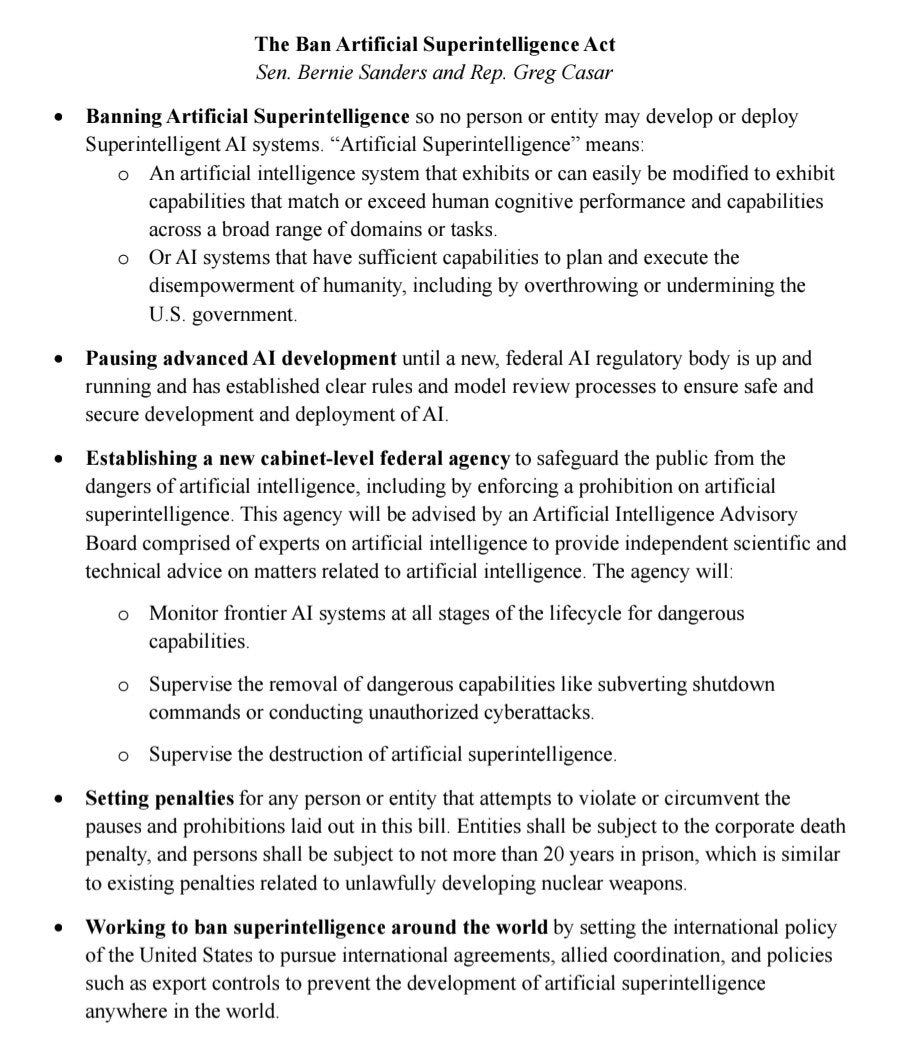
Breaking news, and why I oppose it.
Sanders’ own tweet focuses on a defensible subset of the bill:
I am OK with the tweet, and I can see arguments (both pro and con) for a pause.
But the proposal itself goes too far. As I just wrote on X,
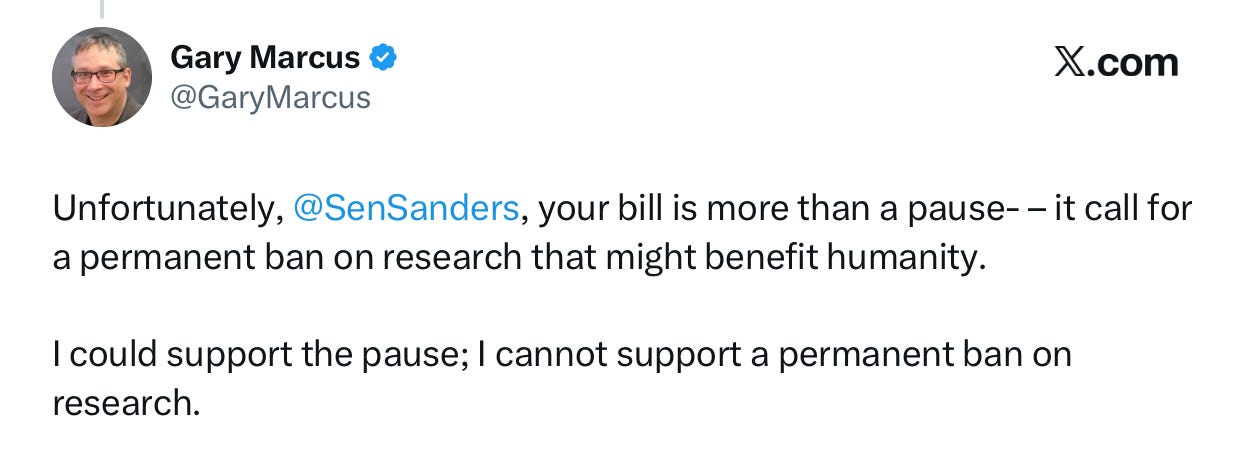
We may need a_temporary_pause, maybe even one that lasts for a number of years, until such time as we have much better ideas about regulation and alignment.
And we certainly need an AI agency—as I myself told the U.S. Senate in 2023—but a permanent, unilateral ban on all research into superhuman AI is too broad, a guarantee of leaving the US behind, and not the right approach.
It’s also naive about the complexities in benchmarking, and would unfortunately leave room for authoritarians to play games with the rules.
Furthermore, it focuses too much on hypothetical future risks (such as AI that “plan\[s\] … to disempower humanity) to the exclusion of current risks, aswrites:
§
We should all want to get to a good AI future, not a backward AI future. But this is not the way.
I salute the Sanders-Casar effort to get something down on paper for discussion, but let’s figure out a better approach.
(In my postscript below I give one hint; my book_Taming Silicon Valley_gives many more. An upcoming article with Cal Newport will give still more.)
P.S. On the pausing point—separate from regulating other aspects of the more immediate risks of AI—I like the language here (boldface added), fromAnthony Aguirre. Perhaps Sanders and Casar might borrow it in a revised proposal:
“Development of narrowly-scoped AI tools, and those that can be reasonably expected to be significantly below the current frontier in software development, cyber, and autonomous capabilities, may continue.Systems of greater combined intelligence, generality, and autonomy may be developed only if and when their developers can demonstrate with high assurance to a capable independent authority that sufficient alignment, control, and oversight exist.”
Rather than calling for permanent ban that could be undone only by an act of Congress, this framing sets an important high bar – and hence an incentive — for the companies to meet. That’s a good model for a better, less overbearing approach that stills leaves room for future discovery, while encouraging critical research.
Share
https://bender.layer3.press/articles/11873dbc-12f1-4283-a05d-841b3528522d
Write a comment