Context, Harness, Loop, Graph: How AI Engineers Stopped Prompting and Started Building Systems
Masterclass on how to move from prompting AI by hand to building systems that work, check themselves, and finish the job.
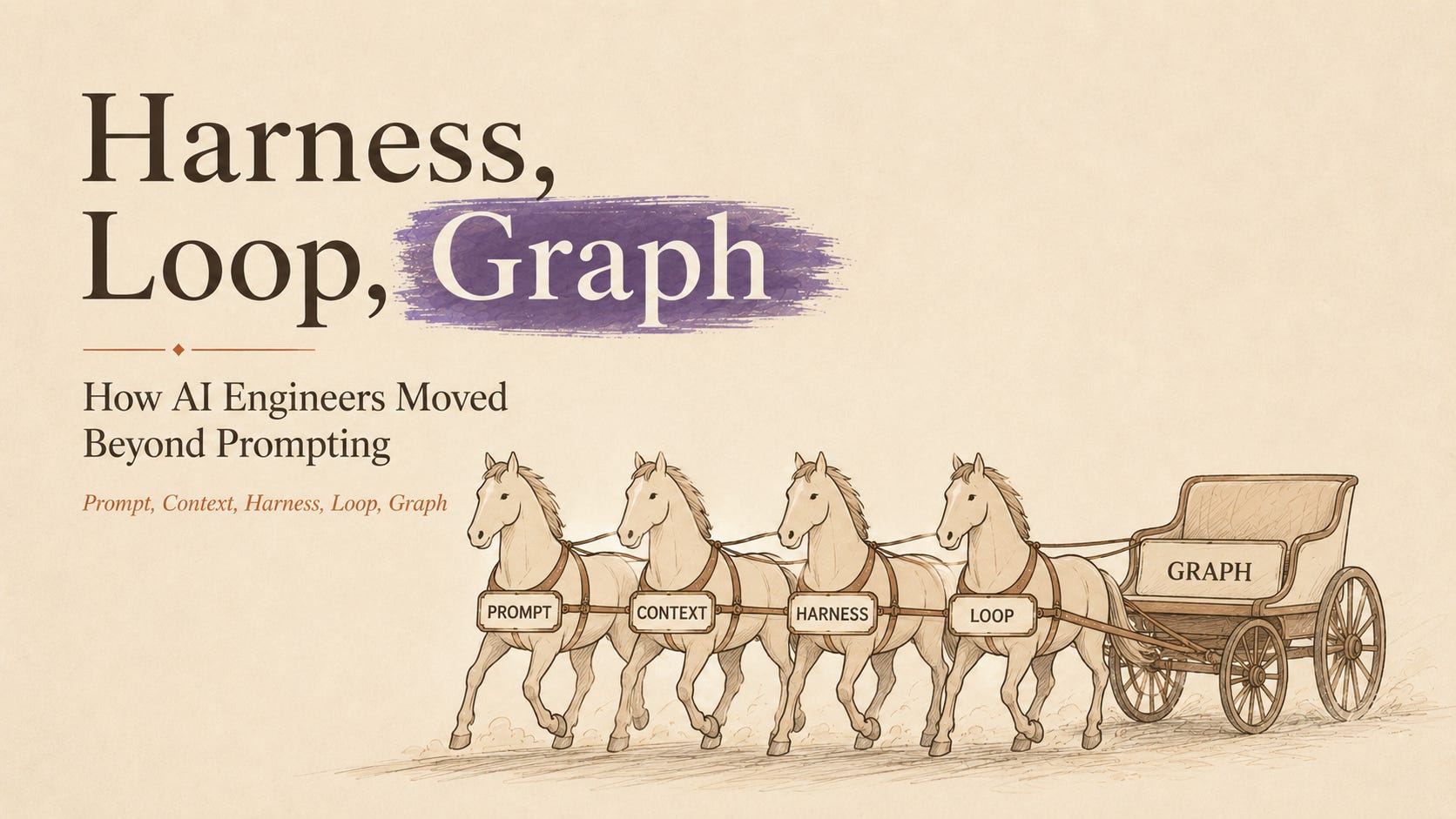
Significant AI improvements are now coming from the systems built around AI models rather than just the models themselves. By implementing components like retained reasoning, context compaction, verification, and bounded loops, AI performance can drastically increase. The focus has shifted from prompt engineering to harness, context, loop, and graph engineering, creating comprehensive AI operations.
- A powerful AI model inside a weak setup performs poorly, forgetting decisions, repeating work, and failing to complete tasks effectively.
- A strong ‘harness’ system around the same model, including verifiers, bounded loops, and graph coordination, dramatically improves performance.
- AI engineers have shifted leverage from manual prompting to building systems that automate decision-making for AI agents.
- Key layers of AI system development include prompt engineering, context engineering, harness engineering, loop engineering, and graph engineering.
- These layers are not replacements but build upon each other: prompts are within context, harnesses assemble context and tools, loops run harnesses repeatedly, and graphs coordinate multiple loops.
https://bender.layer3.press/articles/e57f63c6-7284-4779-a0bc-83c958ff9b8f
Write a comment