Gibraltar Joins the Schengen Travel Area: What Has Changed?
- What has changed?
- Before the treaty
- After the treaty
- What hasn’t changed?
- What about Gibraltar residents?
- What about other non-Schengen countries?
- What does this mean for non-British travellers?
- The bottom line
For decades, Gibraltar occupied a unique position. Although it is a British Overseas Territory located at the southern tip of Spain, it was outside both the European Union’s Schengen Area and the UK’s Common Travel Area with Ireland. For British travellers, this created a travel arrangement unlike anywhere else in Europe.
With the new UK–EU Gibraltar treaty now in force, that has changed significantly.
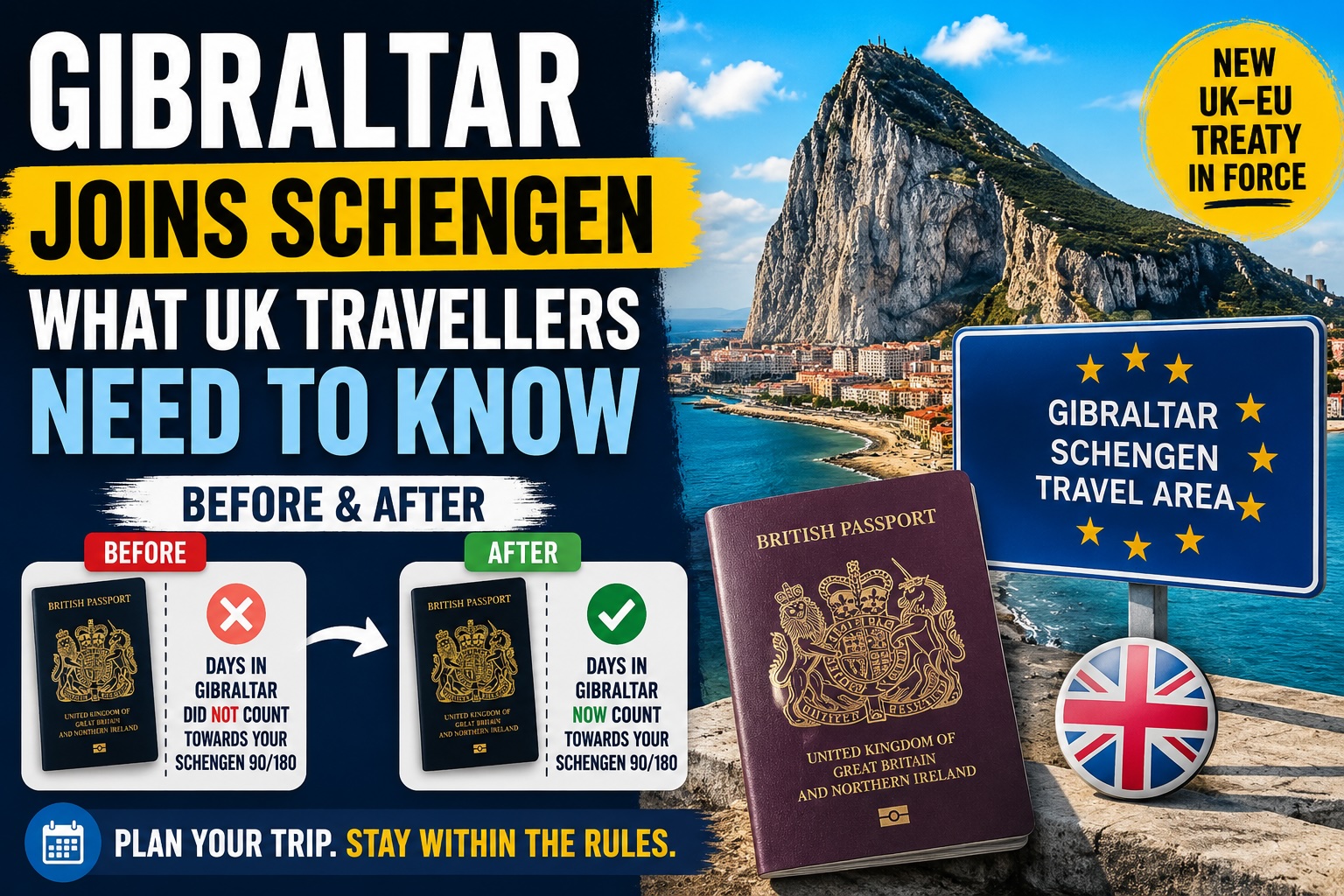
While Gibraltar has not become a Schengen member state, it has effectively become part of the Schengen travel area for border control purposes. This is one of the biggest changes to travel between the UK, Gibraltar and mainland Europe since Brexit.
What has changed?
Under the new agreement:
- Passport checks at the land border between Gibraltar and Spain have been removed for routine travel.
- Schengen immigration controls are now carried out at Gibraltar’s airport and port.
- Travellers arriving from the UK enter the Schengen travel area when they arrive in Gibraltar.
- Gibraltar now operates as a Schengen external border, despite not formally joining the Schengen Agreement.
For most British tourists, the practical effect is that time spent in Gibraltar now counts towards the Schengen 90 days in any 180-day allowance.
Before the treaty
For a British passport holder visiting Gibraltar:
- Flights from the UK arrived in Gibraltar without entering Schengen.
- Crossing into Spain involved entering the Schengen Area.
- Days spent only in Gibraltar did not count towards the Schengen 90-day limit.
- Someone could spend six months living in Gibraltar and then still have their full 90-day Schengen allowance available.
Example
A UK tourist spends:
- 60 days in Gibraltar
- 30 days in Spain
Only the 30 days in Spain counted towards the Schengen limit.
After the treaty
Now:
- Flying into Gibraltar involves entering the Schengen travel area.
- Days spent in Gibraltar are generally treated as Schengen days for ordinary visitors.
- Travelling into Spain no longer involves a separate immigration check.
Example
A UK tourist spends:
- 60 days in Gibraltar
- 30 days in Spain
The total is now 90 Schengen days.
Before and after comparison
| Situation | Before | After |
|---|---|---|
| Fly UK → Gibraltar | Outside Schengen | Enter Schengen on arrival |
| Gibraltar stay counts towards 90/180 rule | No | Yes (for most visitors) |
| Cross Gibraltar → Spain | Enter Schengen at land border | No routine border checks |
| Return to Gibraltar from Spain | Leave Schengen | Remain within Schengen travel area |
| Passport stamping | At Spain border | At Gibraltar airport/port (where applicable) |
What hasn’t changed?
Several important points remain the same.
- Gibraltar remains a British Overseas Territory.
- It has not become a Schengen country.
- British citizens still do not need a visa for short tourist visits.
- UK sovereignty over Gibraltar is unchanged.
The agreement changes how borders are managed—not who owns Gibraltar.
What about Gibraltar residents?
This is where the agreement becomes more complex.
People who are legally resident in Gibraltar have special arrangements designed to preserve the daily movement of thousands of frontier workers who cross between Gibraltar and Spain every day.
Those residents are not treated exactly the same as ordinary UK tourists. However, questions remain over how the Schengen 90-day rule will be monitored in practice for Gibraltar residents, particularly those who commute into Spain every working day. Detailed operational guidance is still emerging.
What about other non-Schengen countries?
Many British travellers assume that every country outside Schengen has its own separate allowance. That is not always true.
- Ireland remains outside Schengen and British citizens continue to enjoy unrestricted travel under the Common Travel Area.
- Cyprus is outside Schengen and has its own separate 90-day visitor rules.
- Andorra, Monaco, San Marino, and Vatican City are not Schengen members but are effectively accessed through the Schengen Area, so time spent there generally counts as Schengen time in practice.
- Gibraltar now joins this group of territories that are not formally in Schengen but are integrated into the Schengen travel area for practical border purposes.
What does this mean for non-British travellers?
The changes are not limited to UK passport holders. Travellers from visa-exempt countries such as the United States, Canada, Australia, New Zealand, Japan and Singapore should also be aware that Gibraltar is now treated as part of the Schengen travel area for border purposes. For these visitors, time spent in Gibraltar will generally count towards the Schengen 90 days in any rolling 180-day period, just as if they were staying in Spain or another Schengen destination. Anyone planning an extended European itinerary should therefore include Gibraltar when calculating their remaining Schengen allowance to avoid accidentally overstaying.
The bottom line
For British passport holders, Gibraltar has moved from being a destination that sat outside the Schengen travel clock to one that is effectively inside it for immigration purposes.
Before the treaty, time spent in Gibraltar did not reduce a traveller’s Schengen allowance.
After the treaty, for most visitors, it does.
Anyone planning extended stays in Gibraltar alongside travel elsewhere in Europe should now include Gibraltar when calculating their available Schengen days.
Source: https://apnews.com/article/spain-gibraltar-uk-brexit-9113dd58dc8220826038022e84e3b662
Write a comment