The Age of Single-Day Bank Failures

- The emergence of single-day bank failures
- Bank run speed: from physical to digital queues
- Fractional reserve fragility
- Bank run protection
- From “bank runs” to “bank taps”
Disney’s 1964 classic Mary Poppins teaches kids about imagination, family… and bank runs.
Near the end of the film, Jane and Michael follow their father to the bank. The grumpy old bankers try to convince little Michael to deposit his money into an account, but at the last minute he backs out. Michael wrestles his coins out of the hands of the reluctant banker, shouting:
“Give me back my money!”
Bank customers overhear the commotion and word of mouth spreads like wildfire. Within seconds, panic ensues as crowds of people run to the bank tellers demanding to withdraw their cash. The bankers are overwhelmed, leading to the tellers shutting their windows, and stopping all withdrawals. Bank run.
Although it’s a kid’s movie, the sequence is basically right: confidence breaks, fear spreads, people rush to withdraw, and the bank fails. The funny thing about this bank run is its speed: 28 seconds.
Surely bank runs can’t actually happen that fast.
Surely.
The emergence of single-day bank failures
Three of the four largest bank failures in U.S. history happened in 2023. Two of them—Silicon Valley Bank and Signature Bank—collapsed on the same weekend, with each failure essentially triggered in a single day.
Is this an anomaly, or the new standard?
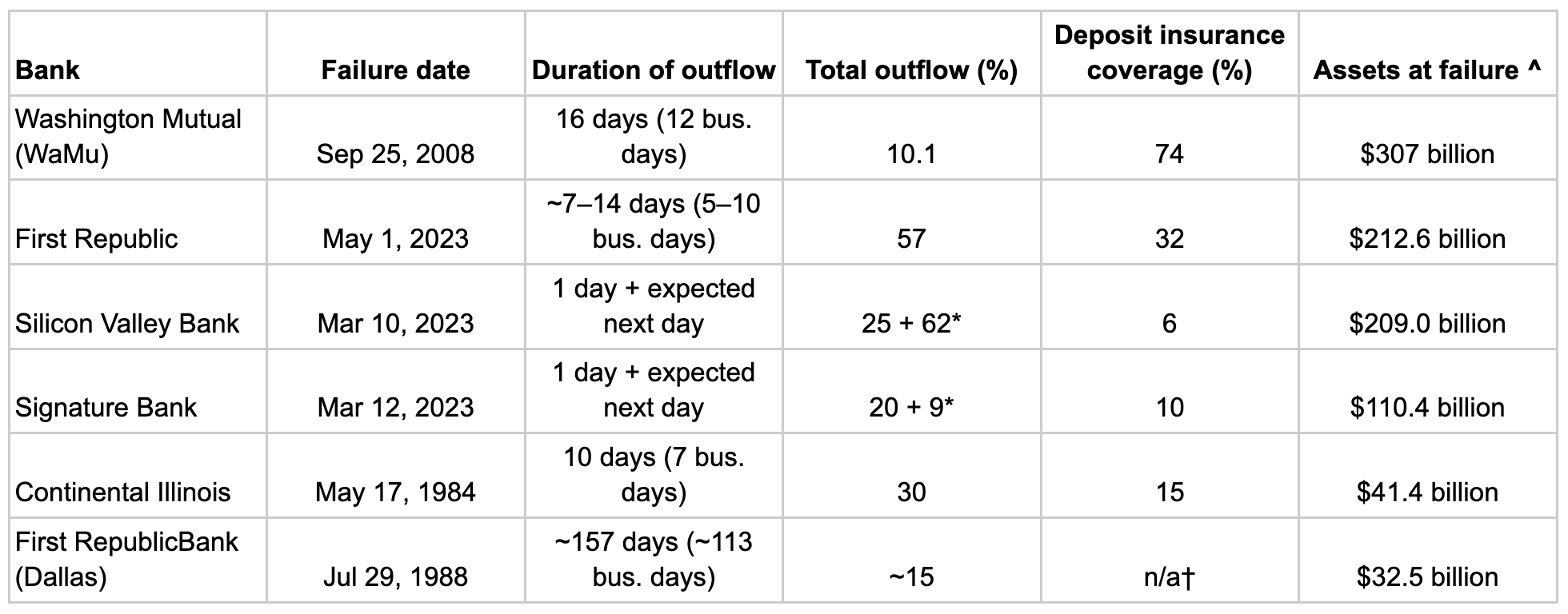
*Expected next day. † FDIC insurance limit was $100k per depositor per bank (since 1980). A precise insured-deposit percentage for the Dallas bank wasn’t publicly broken out; uninsured share was large across the First Republic system.
How could multi-billion-dollar banks unravel so quickly? SVB stands out as both bigger and faster. With $209 billion in assets—twice the size of Signature—it was the third-largest bank failure ever.
In simple terms: interest-rate risk + concentrated, uninsured, highly networked depositors. During the low-rate era, SVB parked a big chunk of deposits in longer-duration Treasuries and agency MBS. When rates rose quickly, the market value of those bonds fell. To rebuild confidence, SVB sold ~$21 billion of securities at a loss and tried to raise capital, moves that instead spotlighted its vulnerabilities and triggered fear among a depositor base that talks to itself in real time.
What stands out about SVB’s failure is its unprecedented speed.
- Wed, Mar 8: SVB discloses the sale of ~$21B of “available-for-sale” securities at a loss and announces a capital raise.
- Thu, Mar 9: Depositors pull ~$42B in 8 hours (~25% of deposits) and ~\(100B more is queued to leave the next day ([an additional 62% of deposits](https://www.stlouisfed.org/on-the-economy/2023/may/understanding-the-speed-and-size-of-bank-runs-in-historical-comparison)). * **Fri, Mar 10:** California’s regulator closes SVB and appoints the FDIC as receiver, creating [Deposit Insurance National Bank](https://www.fdic.gov/news/press-releases/2023/pr23016.html) to handle insured deposits. * **Sun, Mar 12:** Treasury, the Fed, and FDIC invoke a Systemic Risk Exception to cover all deposits and launch the [Bank Term Funding Program (BTFP)](https://www.federalreserve.gov/publications/2023-ar-record-of-policy-actions-of-the-board-of-governors.htm) for all eligible banks to lend against Treasuries and agency debt at par. * **Mon, Mar 13:** The FDIC moves deposits and assets to [Silicon Valley Bridge Bank, N.A.](https://www.fdic.gov/news/press-releases/2023/pr23019.html) to keep operations running, which is ultimately sold to [First-Citizens](https://www.fdic.gov/news/press-releases/2023/pr23023.html) bank on March 27th. The failure played out over a weekend, but in reality the bank run actually took place within one business day: March 9th. Single-day bank runs are now a thing. s_!A3Kh!,w_1456,c_limit,f_webp,q_auto:good,fl_progressive:steep/https%3A%2F%2Fsubstack-post-media.s3.amazonaws.com%2Fpublic%2Fimages%2Fb37325a6-df99-45cd-a9c5-ce22890e9307_1000x625.jpeg)
Bank run speed: from physical to digital queues
The SVB collapse wasn’t a Mary Poppins–style line out the door. It was a massive digital queue.
On March 9, 2023, depositors pulled 25% of deposits during business hours, with another 62% queued after hours for the next day. In effect, nearly nine out of ten dollars at the bank were gone—or about to be gone—within a single business day.
The Federal Reserve’s St. Louis branch later described the 2023 failures as “extraordinary” and “unprecedented” in their speed. However, that language frames them as outliers, but it misses the deeper point: this isn’t an anomaly—it’s a trend.
Why? Because the drivers are structural and accelerating:
- Social media virality: Information doesn’t spread by whispers—it trends. Tweets, Slack threads, and group chats synchronize thousands of depositors in real time.
- Mobile and web banking: Withdrawals aren’t tied to teller hours. Every depositor has a 24/7 withdrawal button in their pocket.
- Uninsured, concentrated deposits: At SVB, corporate accounts backed by the same venture networks acted in lockstep. When one account moves, they all move.
It’s like every depositor is in the bank’s lobby, within earshot of hearing rumours and ready to withdraw their balance at once.
In Mary Poppins, the bank run unfolds in a comical 28-second cascade of shouting and stampeding customers. Today, the shouting happens on social feeds, and the stampede happens on banking apps. The difference is that now billions can be withdrawn in minutes.
The old era of slow-motion bank runs is over. What took weeks in the 1980’s or days in 2008 now happens in hours. And as information speeds up, so can loss of confidence and withdrawals. If SVB can lose 87% of its deposits in one day, why not in half a day? or an hour?
The question isn’t whether bank runs can get faster.
It’s why they wouldn’t.

Fractional reserve fragility
The fragility of of modern banking can be summed up in two words: fractional reserves. Banks never hold all deposits in cash. They keep a fraction on hand for withdrawals and lend or invest the rest. That isn’t a flaw, it’s the business model.
The problem is that no bank, no matter how conservatively run, can survive an SVB-style 87% withdrawal in a single day. And in the age of social media and mobile banking, that kind of run is potentially a trend or tweet away.
SVB’s depositor base was unusually concentrated and uninsured, but its vulnerabilities weren’t unique. As of early 2025, U.S. banks still carried about $413 billion in unrealized securities losses—bonds worth far less than they were purchased for, thanks to the Fed’s rapid rate hikes.
On top of that:
- Total insured deposits (<$250,000): about $10.7 trillion
- Total uninsured deposits (>$250,000): about $7.8 trillion
- FDIC Deposit Insurance Fund balance: about $145.3 billion, equal to only 1.36% of insured deposits.
The FDIC’s playbook works when one bank stumbles: seize it, set up a bridge bank, and find a buyer. That resolved SVB, Signature, and First Republic. But if multiple banks fail in rapid succession, or if no buyer emerges, the FDIC’s fund is far too small.
That’s why, three days after SVB’s March 9th bank run, the Fed rolled out the Bank Term Funding Program (BTFP), allowing banks to borrow against their Treasuries and agency bonds at par rather than market value. On paper, this gave banks breathing room. In reality, it was a form of money creation.
The BTFP:
“Under the BTFP, U.S. federally regulated depository institutions and U.S. branches and agencies of foreign banks eligible for primary credit are able to obtain advances of up to one year by pledging any collateral eligible for purchase by the Federal Reserve in open market operations, such as U.S. Treasuries, U.S. agency securities, and U.S. agency mortgage-backed securities, provided that such collateral was owned by the borrower as of March 12, 2023. Collateral was valued at par, and the interest rate on the advances, which is fixed for the term of the advance on the day the advance was made, was set to the one-year overnight index swap rate plus 10 basis points.” – Federal Reserve
It’s like owning a home once worth $400,000, that’s fallen to $300,000. Normally, you could only borrow against it at the market value, but thanks to a special government program you can now borrow as if it’s still worth $400,000. The extra $100,000 in liquidity isn’t real—it’s conjured by pretending the loss doesn’t exist.
That’s what the BTFP did. It wasn’t billed as “printing money,” but that’s effectively what it was: new liquidity conjured to stabilize the system when the real market value of assets couldn’t.
The takeaway is simple: the ultimate backstop for fractional reserve banking isn’t prudent management or a well-funded FDIC. It’s the Fed’s ability to create money on demand. And expanding the money supply to rescue banks is, by definition, inflationary—new dollars issued to cover obligations that otherwise couldn’t be met.
Bank run protection
In Mary Poppins, once panic spreads, the bankers slam their windows shut and depositors are left with nothing. That’s the harsh reality of a run: once withdrawals stop, customers are simply out of luck.
When a run hits, what happens next isn’t mechanical—it’s political. Regulators can choose to intervene, make all depositors whole, and roll out new liquidity programs—or they can let a Lehman-style collapse play out. At SVB, both insured and uninsured depositors were made whole, but only because policymakers feared contagion. That outcome isn’t guaranteed.
By law, only deposits under $250,000 are insured, and that amount hasn’t changed since 2008 to keep up with inflation. And even those depend on the government’s willingness to create new money if the FDIC’s limited fund runs dry. You’ll probably get paid—but in freshly printed, more inflationary dollars.
So if the rules of the game have changed, how should individuals and businesses respond?
In the U.S., there is no such thing as a full-reserve bank. The system is fractional by design. Custodia Bank, which proposed a 100% reserve model, was denied a Fed master account and blocked from operating as intended. Even if you’re willing to pay a fee for safe custody with no lending, that option doesn’t exist. It’s fractional reserve or nothing.
If you want bank run protection, there’s only one path: outside money. As strategist Zoltan Pozsar describes, outside money is an asset that doesn’t depend on a bank or counterparty. Gold has filled that role for thousands of years. But gold is slow: heavy to move, clunky to scale, and hard to verify instantly.
Bitcoin is outside money that scales. It’s digital, verifiable, and transferable worldwide in minutes. Unlike bank deposits, it isn’t a promise—it’s full-reserve by design.
When the bankers slam their windows shut, outside money means you don’t need their permission.
From “bank runs” to “bank taps”
Mary Poppins gave us a cartoonish 28-second bank run: panic, shouting, and a stampede to the teller windows. That was Disney fantasy.
In 2023, Silicon Valley Bank showed us the real thing. $142 billion was withdrawn or queued in a single business day. That works out to:
- $17.8 billion per hour
- $295 million per minute
- $4.9 million per second
Speeds and scales like that are impossible in a physical branch. Nobody lines up anymore—they tap their phones. The “bank run” has become the “bank tap.”
A 28-second bank run is looking less like fantasy.
In the digital era, confidence is more fragile than ever. Banks are backstopped not by reserves but by money creation—political decisions to print liquidity when trust evaporates. That safety net isn’t guaranteed, and it comes with a cost: inflation.
Which leaves individuals with a choice. Gold offers outside money that’s slow but proven. Bitcoin offers outside money that’s digital, global, and instantly transferable.
The rules have changed.
Write a comment