Blaze Media

News, opinion, and entertainment for people who love the American way of life.

Even Washington state has had enough: Americans push back on the left’s culture war agenda

The left may not be as far gone as Blaze Media co-founder Glenn Beck previously believed, as it's no longer just traditionally red states actively pushing back on some of the more insane proposals being offered to Americans this year. “Idaho just defeated one of the most aggressive abortion laws ever,” Glenn explains. “It was like, ‘You know what? If your son’s 43 and you’ve changed your mind, you could go ahead and kill him.’ I mean, it was a crazy law. They voted that down,” he continues. And not only that, he says, but “voter ID laws have passed in [five] states: Alaska, Arkansas, Kansas, South Dakota, and West Virginia.” Even Washington state is standing up to some of the crazier positions the left has previously held, including “forcing women’s nude spas to admit men.” “They’re crazy. ... But here’s good news — not as crazy as we thought,” Glenn says. “Isn’t that amazing?” “If I said to you, ‘Yeah, they want men in women’s nude spas,’ you’d be like, ‘Of course, it’s Washington state.’ Even Washington state said, ‘Nah, we can’t go that far,’” he adds. “There were several left-leaning states that passed bills to protect women's sports,” Rikki Ratliff-Fellman chimes in. “And what’s so fascinating about this is that this is one culture war issue where conservatives are winning over left minds,” she says. “And it’s actually like the new social justice issue, if you will,” she continues. “I love that they have taken this once-divisive debate where the left was owning it and now they’re saying, ‘Actually no, you’re a freak, and there’s something wrong with you if you think a boy should be in the [girls’] locker room.’” Want more from Glenn Beck? To enjoy more of Glenn’s masterful storytelling, thought-provoking analysis, and uncanny ability to make sense of the chaos, subscribe to BlazeTV — the largest multi-platform network of voices who love America, defend the Constitution, and live the American dream.

Cover image for Even Washington state has had enough: Americans push back on the left’s culture war agenda

Stephen Miller Has the Keys. Now What About the Deportations?

Republicans suffered a rout on Tuesday. There is one sliver of good news, however. The remaining congressional GOP may be less divided on the issue Trump rode back into office on: mass deportation.Even amid the carnage, voters gave Republicans a narrow edge over Democrats on immigration. In the NBC exit poll, 44% said Republicans would handle the issue better, against 41% for Democrats. That is not proof that every voter favors mass deportation. It is a rebuke to those who spent two years insisting that immigration enforcement itself had become a political loser.Somehow Americans were expected to endure war abroad but not inconvenience at home.I spent much of that time arguing with reporters, activists, members of Congress, and their staffers about a manufactured consensus. The people who wanted to abandon enforcement were often the people who stood to benefit from cheap, illegal labor. I said so, loudly. It cost me invitations that somehow never arrived. Fine.The voters who sent Trump to Washington expected him to carry out the largest deportation operation in American history. Instead, they got a war with Iran. Even Vice President JD Vance says plainly that the war cost Republicans the midterms.The Iran campaign was defended on the grounds that short-term economic pain was worth a long-term strategic gain. The lobbyists who oppose worksite enforcement invoke the same economic pain as a veto over sovereignty. Beef could cost more. DoorDash might take longer. You might have to mow your own lawn. Somehow Americans were expected to endure war abroad but not inconvenience at home.We could still make that choice.ICE does not need a new check from the incoming Democrat Congress. The One Big Beautiful Bill Act appropriated roughly $75 billion for ICE enforcement and detention, above annual funding, available through September 2029. The money is there. The missing ingredient is a serious commitment to enforcing immigration law at worksites — where employers who profit from illegal labor have so far enjoyed far too much deference.RELATED: The day after tomorrow: A new GOP Tom Brenner/Getty ImagesAnd the deportation totals are not where they need to be. The Migration Policy Institute estimates that through July 2026, formal removals under Trump averaged about 380,000 a year, below the Obama-era annual peak of more than 432,000. The unauthorized immigrant population, meanwhile, grew from roughly 11 million during the Obama years to an estimated 15.8 million by mid-2024. Measured against the size of that population, this is not the promised operation at scale.My organization, the Oversight Project, has sued the Department of Homeland Security for detailed deportation records. The government should release the numbers and let Americans judge the results for themselves. We intend to keep pressing until it does.Vance seems to recognize what is at stake. In his post-election assessment Wednesday, he wrote: “I’m open to the idea that we should change enforcement — by focusing more on businesses that hire illegal labor, for instance. But anyone pushing amnesty is lying to you.”That is more than a throwaway line. It acknowledges a fight over whether the administration will confront employers who want the border secured but their illegal workforce untouched. Vance has now publicly put worksite enforcement on the table.So has the personnel shift at the White House, or at least it should. Trump on Friday named Stephen Miller to replace Susie Wiles as chief of staff, effective Monday. Few people have done more to move the political debate on immigration than Miller. He will occupy the most powerful staff position in the administration. If Washington cannot move from promises to mass deportation now, when will it?RELATED: Trump conquered the Republican Party. What a waste of a victory. Brendan SMIALOWSKI/AFP/Getty ImagesThe midterms also cleared out many lawmakers whom immigration hawks judged weak on enforcement. According to the Immigration Accountability Project’s post-election tally, 18 losing lawmakers ranked in its bottom quartile, compared with just two in its top quartile. The group also counted eight defeated co-sponsors of Rep. María Salazar’s (R-Fla.) “Dignity Act.” Those rankings do not tell us what caused each defeat. But they give the new Congress a different complexion.Consider Sen. Roger Marshall (R-Kan.). When ICE stepped up activity in southwest Kansas’ meatpacking country in September, Marshall complained that agents had not coordinated with local law enforcement and had caused “mass disruptions to local communities and businesses.” He then lost to Democrat Adam Hamilton by nearly five points, becoming the first Kansas Republican to lose a Senate race since 1932. His defeat had many causes. It also illustrates the political pressure that arrives when enforcement reaches the employers who depend on illegal labor.Republicans were punished over the Iran war, the cost of living, and promises left unfulfilled. The answer is not to give up on the issue on which voters still trusted Republicans more than Democrats. It is to keep the promise that helped bring their coalition together.Trump has the funding. He has a vice president talking about worksite enforcement and Stephen Miller about to run the White House staff. The special interests are weaker than they were a week ago. A large contingent of pro-amnesty Republicans lost. There is no shortage of excuses left to invent. There is less reason than ever to accept them.Now do the job.

Cover image for Stephen Miller Has the Keys. Now What About the Deportations?

Why does God allow the wicked to win elections?

The midterm elections have left many Christians asking a troubling question: Why would God allow this to happen?In Texas, Democrat James Talarico, who has invoked Scripture in defense of abortion rights and transgender policies, won a Senate seat. He once declared that “God is nonbinary”, a remark he later acknowledged was deliberately provocative.The question is not simply why God permitted our candidates to lose. It is what He may intend to teach us through the loss.In Michigan, Abdul El-Sayed became the first Muslim elected to the U.S. Senate, thanking Allah in his victory speech.Meanwhile, Christians who wanted biblical principles honored in public life suffered significant political defeats. Why does God permit such outcomes? Why do those who reject His truth sometimes prosper while those who profess His name suffer?The question is ancient. Psalm 73 offers a better way to approach it than election-night recriminations.The problem of Psalm 73The psalmist Asaph watched the arrogant prosper. They boasted against heaven while he suffered, and he wondered whether he had cleansed his heart in vain. Then he entered the sanctuary of God and considered their end.Their prosperity was temporary, their security an illusion. But Asaph discovered something more important than their eventual judgment: He had envied the wrong treasure.“Whom have I in heaven but thee? And there is none upon earth that I desire beside thee” (Psalm 73:25).The wicked may possess political power, wealth, and public admiration. But they do not possess the greatest good: fellowship with the living God. Unlike political victories, that blessing lasts forever.RELATED: Why Christians lose elections Liveslow/Getty ImagesLearning to read providenceChristians too often reason simplistically: Victory means God’s blessing; defeat means His judgment. The Puritan writers Jeremiah Burroughs and Thomas Watson, along with the Scottish theologian Thomas Boston, understood that God may have many purposes in permitting His people to suffer.We cannot claim to know His precise purpose in a particular election. But their writings suggest five lessons worth considering.1. To reveal whether we love God more than successIn “The Rare Jewel of Christian Contentment,” Jeremiah Burroughs teaches that contentment rests in God rather than changing circumstances.Do we love Christ because He gives us political victories or because He is worthy of our love? Defeat tests whether our confidence rests in God or in the benefits we hope to receive from Him.2. To expose sins among God’s own peopleThomas Watson, in “All Things for Good,” explains that affliction can expose and mortify remaining sin. Christians may denounce wickedness in the culture while tolerating it in themselves. Asaph had to confront his own envy.Do we defend biblical morality publicly while compromising privately? Have we exchanged reverence for entertainment? Perhaps the response to defeat is less political calculation and more fasting, prayer, and repentance.3. To teach humility and dependence upon GodIn “The Crook in the Lot,” Thomas Boston describes how God uses adversity to humble His people.Political success can tempt Christians to imagine that the future of the church depends on the right candidate, party, or strategy. Defeat reminds us that Christ builds His church. No election can replace God’s sovereign power.4. To strengthen faith through adversityWatson also teaches that God uses affliction to strengthen the graces of His people. Faith untested remains immature.Political defeat offers a chance to practice patience, courage, perseverance, and confidence in God’s promises. It is easy to proclaim His sovereignty when your candidate wins. The test comes when your candidate loses — and when political opposition becomes more than an inconvenience.RELATED: The champagne communists who sold Millennials a bill of goods BRO Vector/Getty Images5. To redirect our hope toward eternal thingsBurroughs reminds us that the believer possesses a treasure greater than anything this world can offer. God may remove earthly comforts to remind us they were never our ultimate good.Political victories are temporary. Governments rise and fall. Nations flourish and decline. Communion with God endures. Do you seek Him daily in His Word?The victory that cannot be taken awayNone of this means Christians should abandon politics. Government is ordained by God, and Christians should labor for justice and righteousness. But electoral outcomes do not reveal the whole purpose of divine providence.Those celebrating victory have not thereby demonstrated God’s approval. Christians mourning defeat have not demonstrated His displeasure. Psalm 73 calls us to judge earthly events in the light of eternity.The question is not simply why God permitted our candidates to lose. It is what He may intend to teach us through the loss.Perhaps the greatest victory He is preparing for His people is a deeper knowledge of Himself.

Cover image for Why does God allow the wicked to win elections?

'Your church is a target': Glenn Beck warns woke ideology is infiltrating Christianity

America's religious divide is becoming harder to ignore, but Glenn Beck believes something even more troubling is happening beneath the surface.Election data reveals a stark difference between ballots cast by religious and nonreligious voters — but also proves that Marxist ideology is even infiltrating Christianity itself.“Protestant was 21% of the vote: 39% of the Protestant voted for the Democrats; 60% voted for the Republicans,” Glenn explains, noting that the closest result was between Catholics.“21% of the vote: 48% voted for the Democrats; 50% voted for the Republicans. So almost evenly split,” he says. “The LDS church: 29% voted for Democrats; 69% voted for Republicans. That’s going to make them an even bigger target. They’re the farthest that skew to the right. Other Christians were 17% of the vote. That’s 38% Democrat, 60% Republican,” he says.Of the Jewish vote, he says, 67% voted Democrat, while only 32% voted Republican.“That’s changing, and that is way down from where it used to be,” Glenn comments, noting that it gets worse.The “opposite of the scale,” he says, is the Muslim vote. 85% of Muslims voted Democrat, he says, while only 12% voted Republican.“The more nebulous you get, the harder it leans to the left,” Glenn says. “Listen to this ... the largest religious group, with 26%, is none. No religion. 77% who say, ‘I don’t recognize God. I have no religion,’ 77% went to the Democrats; 21% went to the Republicans,” he explains, adding that shockingly, famous podcaster Joe Rogan has already sounded the alarm on this.“Something’s happening with Joe Rogan,” Glenn says. “It’s been happening for a while if you watch him. Joe Rogan is warning now woke ideology is replacing God on the left and entering into Christianity.”“That is absolutely true. Your church is a target. Be aware. Know the difference between the woke Christianity and real Christianity, because it comes cloaked as a friend,” he adds.Want more from Glenn Beck?To enjoy more of Glenn’s masterful storytelling, thought-provoking analysis, and uncanny ability to make sense of the chaos, subscribe to BlazeTV — the largest multi-platform network of voices who love America, defend the Constitution, and live the American dream.

Cover image for 'Your church is a target': Glenn Beck warns woke ideology is infiltrating Christianity

Want to understand the Bible better? Wikipedia's co-founder has a free tool for that.

Wikipedia co-founder Larry Sanger has a new project. This time, he's helping people navigate the Bible.His Deep Dive Bible, officially launched November 2, puts Scripture, commentaries, reference materials, and group discussion in one place. It's free, and you don't even need an account to start reading.'The Bible could sustain interrogation; who knew?'"If you read the Bible with an app, you probably switch between the text, references, and maybe a group study," Sanger wrote on X."What if all three worked together?"Sanger calls the project "free, forever: a gift to the whole Church."Plenty to exploreThe site's welcome page lists 15 English Bible translations, including the King James Version, English Standard Version, New International Version, and New American Standard Bible. You can read translations side by side or consult commentaries on individual verses without leaving the reader.There are 55 commentaries, 15 reference works, and 220 maps, according to the site. For more ambitious students, there are Hebrew and Greek study tools, interlinear texts, and cross-references. Audio readings are also available.You can read without registering; a free account lets you save your progress, make notes, highlight passages, and join group studies organized around particular readings and discussion topics.The site is still labeled beta, but Sanger says it will remain free, supported by donations.RELATED: To raise Christian children who become Christian adults, one simple habit matters most Eric Thayer/Getty ImagesFrom skeptic to believerSanger has good reason to take Bible study seriously. Raised Lutheran, he lost his faith as a teenager and spent more than 35 years as an agnostic. He went on to earn a doctorate in philosophy, co-found Wikipedia, and build a career devoted to organizing information online.In December 2019, he decided to read the Bible cover to cover. He wasn't looking for a conversion. He wanted to understand a book he had long dismissed without, by his own admission, having studied it properly.Armed with study Bibles, maps, dictionaries, and commentaries, Sanger began working through Scripture. What he found surprised him."The Bible could sustain interrogation; who knew?" he recalled in his 2025 conversion testimony.By late February 2020, he had privately acknowledged his belief in God. He didn't make a full public declaration of his Christian faith until five years later."I never had a mind-blowing conversion experience," he wrote. His faith came slowly through reading, questioning, and reconsidering arguments he had once found unpersuasive.Questions welcomeHe never stopped studying. In April 2020, Sanger started an online Bible-study group on YouVersion, later moving it to Telegram. This September, he gave the group its own website, bringing along the archive of earlier discussions.The software behind Deep Dive Bible, called Chatiferous, was built using Anthropic's Claude AI, with Sanger directing the project. It's released under a free-software license, and the site is being opened to other Bible-study groups.In a 2023 guide to reading the Bible, Sanger urged readers to make use of commentaries, maps, encyclopedias, and study groups. He was especially insistent that readers shouldn't be afraid to ask questions."It is not only OK to ask questions," he wrote, "it is essential that you both ask your questions and get them answered."

Cover image for Want to understand the Bible better? Wikipedia's co-founder has a free tool for that.

Why New Age practices are more dangerous than they look, according to a former psychic

Rick Burgess, BlazeTV host of “Strange Encounters,” wants his audience to be equipped but never paranoid when it comes to spiritual warfare. “We've tried to be good stewards of this podcast, and just to warn you — not to have you looking for demons around every corner, but also not to send you out into this fallen creation where there's spiritual war raging for you not to be prepared,” he says. That’s why he had former psychic Jenn Nizza on the show. Deeply involved in the occult and New Age for roughly 25 years before becoming a Christian, Nizza now warns believers about the spiritual dangers of mainstream New Age practices — tarot cards, astrology, crystals, numerology, and the like. On this episode, Nizza joins Burgess for an honest conversation about the New Age pitfalls ensnaring Christians. Mainstream occultism doesn’t look like black robes, blood rituals, and devil worship. Rather it presents itself as “light,” which is why people are so drawn to it, Nizza explains. “The counterfeit is very manipulative. ... It's really darkness in disguise presenting as a false light,” she says, highlighting how the messaging often revolves around “healing, solutions, [and] wisdom.” She explains how Satan, who the Bible says disguises himself as an angel of light, offers “cheap [imitations] intended to deceive” — things that “look so close” to the truth and seem “so convincing” that even Christians will sometimes take the bait. Modern culture has played a pivotal role in normalizing New Age beliefs and practices through “social media, cinema, [and] the music industry,” says Nizza. “‘Wicked’ with Ariana Grande ... the movie ‘Tarot,’ ‘Practical Magic,’ ‘Hocus Pocus’ ... that's the devil defining a very real, spiritually dangerous practice: witchcraft,” she tells Burgess. “This is glamorizing witchcraft and desensitizing the masses. So we as Christians need to step in and share the truth about what it is, and rather than glamorize, expose it and point to the light of Christ.” She gives the example of the popular, long-running TLC show “Long Island Medium,” which documented the life of psychic medium Theresa Caputo. “She's just like how I used to be — want to help people and seemingly innocuous, right?” says Nizza but, “You don't go home with her. You don't know what the demonic oppression she is facing, and I can assure you that she is because when you do these things, you will face the side effects.” “[Christians] need to be the ones to go in there and tell the truth about this and not shy away from this because otherwise you're letting these secular movies that are run by devils disciple your congregants, disciple your children, and certainly at the very least, educate them falsely.” To hear more, watch the episode above. Want more from Rick Burgess? To enjoy more bold talk and big laughs, subscribe to BlazeTV — the largest multi-platform network of voices who love America, defend the Constitution, and live the American dream.

Cover image for Why New Age practices are more dangerous than they look, according to a former psychic

Don’t be fooled by Bernie Sanders — tech won the midterms

Thanks to the loud noises of a few boldface names on the left, Americans are getting the impression that the Democrats of 2026 are the anti-technology party. With the blue team surging into Congress this election cycle, the logical inference is that the tech industry lost big — a huge deal for the many voters who had just about resigned themselves to the idea that technology is the one thing that can’t be stopped in America.Drawing this conclusion would be a colossal misread of reality, no matter how sensationalist the headlines about draconian tech crackdown plans coming from Bernie Sanders and company.The left elites do not want to de-technologize our economy, our government, or anything else. They simply want to control the technology — the better to control everything downstream of it.At the tactical level, Democrats did not win because they ran against tech. At the strategic level, the domestic and international left is more convinced than ever that the only way it can end the Trump era and re-establish itself as the ruling elite is by wielding technology with renewed force.First, the ground truth. As observed by Adam Kovacevich, the tech-optimist Democrat who founded the Chamber of Progress and came from Google’s public policy shop, AI and data centers ranked a distant 19th among issues in a New York Times/Siena survey. Democrats in gubernatorial contests who didn’t support data center bans performed better than those who did. And almost all Democrats Kovacevich defines as “pro-innovation” have won their races. (So far.)The exit polls tell the same story. Almost 40% cited the economy as their top concern; nearly a third cited the “state of democracy.” The rest prioritized immigration, health care, foreign policy, and crime.Now, one could argue that all these priorities have to do with tech in some sense. Tech has largely eaten the economy. Tech is reworking our form of government. Tech is what’s behind the intense push to fill out well-paying jobs with skilled immigrants. Health care is rapidly being technologized. Foreign policy is already dominated by the race to technologically transform the global battlefield — a dynamic that has focused unprecedented controversy around Israel, a country that has rapidly vaulted to cyber-superpower status. Crime? Seen any headlines about cyberattacks lately …?Yes, in a very real sense, as Donald Trump so memorably put it, everything is computer now.RELATED: America’s ‘AI czar’ could revolutionize our form of government Chip Somodevilla/Getty ImagesBut the left elite has no qualms about the force of these transformative technological changes. It only opposes the vector, which has arrowed in a nominally rightward direction ever since the most influential faction of Silicon Valley decided they could only remain masters of their own destiny if they threw in with Trump.The left elites do not want to de-technologize our economy, our government, our immigration policy, our health care industry, our foreign policy, or anything else. They simply want to control the technology — the better to control everything downstream of it.Right-wingers may look at that fact and see within it a darkly pulsating evil. Because they share little religious unity, many on the right insist on seeing that menace in ideological, not religious terms — not demonic but communist, socialist, or third-worldist.Yet whatever kernels of insight may lurk therein, the truth is that the right is even more desperate to control the tech than the left is, and that tortured desire defines the political battle space far more than any of the hoary modern “isms” that Americans keep being told to conform our transformed postmodern reality to. It’s not going to work.Everyone — left, right, center, white, brown, or purple — fears erasure, defeat, and destruction at the hands of adversaries who have aced them out for control of godlike tech.RELATED: Sorry, Bill Gates. We’re sitting out this apocalypse. BAY ISMOYO/AFP/Getty ImagesThat’s why the midterms weren’t a referendum on the breakneck advancement of technology to an even greater position of dominance over our country and our way of life. And yet despite real defeats for data centers in local elections, tech’s commanding position remains intact. Those setbacks may turn out to be Tootsie Roll-sized speed bumps. (Think stopping data centers stops AI? Think again.)Tech elites who embraced Trump — Elon Musk first among them — may worry about reprisals from Democrats looking to throw bloody beefsteaks to the slavering mob. But at a time when almost nothing but tech has consequential energy behind it, it is technology that was the victor on Tuesday and technology that will define the fateful choices America’s elites will make — with or without public support — about just what our country and our people are to become.

Cover image for Don’t be fooled by Bernie Sanders — tech won the midterms

The best caregiver support may come with terrible coffee

The election is over. People will spend weeks picking apart the results. Meanwhile, family caregivers are sorting medications, helping someone get dressed, and having late-night conversations with the ceiling fan.November is National Family Caregivers Month. As the holidays approach, expectations pile up even when a caregiver’s strength is running low.If you’re a caregiver who’s frazzled, stressed, heartbroken, or weary, you’re in the right place.You can be surrounded by people who love you and still feel lonely. I often tell pastors that caregivers can feel lonely on a crowded pew.Family caregivers know what it means to disappear into someone else’s story. People ask how your loved one is doing. You explain the latest procedure or what the doctor said. Somewhere in the conversation, what you’re carrying disappears beneath the details of the person you’re caring for.When I started this column for Blaze News, I wanted caregivers to find a little respite and something solid to stand on while they caught their breath. Whatever else I write about, I keep coming back to the caregiver who wonders whether anyone understands.That’s also why I started a caregiver group at our church here in Montana.Every Thursday morning, we gather around a table. First-timers sometimes arrive nervous, sometimes already teary-eyed. Walking into a room of strangers to talk about caring for someone you love takes courage.The church has committed to keeping us supplied with tissues.The pastor or his assistant sometimes has coffee waiting. When neither is there, that responsibility falls to me.I’m accustomed to making coffee for Gracie. She likes coffee that reaches out and slaps you. Most attendees have learned to politely decline when I’m handling the brewing.One fellow brought a tin of cookies from Costco. We’ve made a sizable dent in them.Well, let’s be honest. I’ve made a sizable dent. I keep passing the tin around, but somehow it makes its way back to me. I need to be careful, or I’ll get so big the bears will have to start hiding their food.RELATED: Would you trust this politician with your wallet? Sonmez karakurt/Getty ImagesWe go around the table and check in. Sometimes the circumstances are dire, and the tissues get passed along with the cookies. Sometimes we talk about ordinary things. Even amid the tears, laughter has surprised us at every meeting.You see, each of us speaks fluent caregiver. Nobody needs a lengthy explanation of why someone is exhausted, frightened, or struggling to make one more decision. We recognize the language because we live it.This week, one man whose wife lives with dementia told us he can no longer have a rational conversation with her. Around our table, he said, he felt heard for the first time in a long time.How many more caregivers feel the same way he does?Sometimes, speaking fluent caregiver sounds like this: “Pull up a chair. Have a cookie. Or three. Sign this waiver before drinking the coffee.”I can’t offer bad coffee and a tin of cookies to readers. You’ll have to supply your own tissues. If you run out, use toilet paper. We’ve all done it.But I can bring four decades of caring for someone I love to this page. I can speak honestly about the weariness, the fear, the resentment we’re reluctant to admit, and the laughter that still catches us by surprise.RELATED: There is a place sin cannot molest Wwing/Getty ImagesI can also remind you of something I regularly need to hear myself: You don’t have to feel better in order to be better.Making your own doctor’s appointment, accepting help, or sitting with people who understand can be a good decision even when you still feel worn out afterward.If you’re struggling to find the words to say to a caregiver, try these: “I see you, and I see the magnitude of what you’re carrying, and I hurt with you.”If tears come, you don’t have to find something profound to say. Stay and listen.If you’re a caregiver who’s frazzled, stressed, heartbroken, or weary, you’re in the right place. Tell me how you’re doing in the comments. I try to read them all and respond when I can.If you’re none of those things, you’re still in the right place. Because if you love someone, you’ll most likely become a caregiver.If you live long enough, you’ll need one.Friends don’t let friends caregive alone.

Cover image for The best caregiver support may come with terrible coffee

Louie Giglio and Josh Howerton get real about battling anxiety — ‘I thought I was going to die’

There was a time when Josh Howerton — BlazeTV host of “Live Free” and pastor of Lakepointe Church — thought anxiety attacks were “a Gen Z way to say you had a bad day.” But when a crushing season of anxiety threatened to cripple him, his perspective changed. “I've never experienced a hell like that,” he tells Louie Giglio, pastor of Passion City Church in Atlanta. Giglio has had his own journey with anxiety — a journey that was so significant, he wrote an entire book about it. “Putting an X Through Anxiety” is the longtime pastor’s account of his battle with anxiety as well as practical and spiritual tools to help readers understand anxiety’s roots, address anxious thoughts, and find freedom and rest in Jesus, the Prince of Peace. On this episode of “Live Free,” Howerton and Giglio address the mental condition that now has millions of young people in its grip. “I was like you, you know, when people talked about they suffered depression or anxiety, I was sympathetic, I think, but definitely not compassionate and understanding until I thought I was going to die one night,” Giglio tells Howerton.“I was having these physical symptoms that were crazy ... heart blowing up, then face totally numb, arm totally numb, and legs convulsing,” he recounts. After a hospital visit and some medication, Giglio assumed everything would “be OK” again, but the trial was just beginning. “I think I had a nervous breakdown. So I don't think I really had an anxiety attack or a panic attack. I think it was way more significant than that,” he says. “I cracked, and I ended up in a heap in the corner for about four months of life. I was out of commission. I mean, I didn't go to work. I didn't go to meetings. I didn't preach. I didn't think I was ever going to be normal again, and I thought I was losing my mind.” But God was faithful to deliver him from this darkness, he says. “By the grace of God, I found my way out. He led me out. Worship led me out.”Part of Giglio’s recovery involved speaking the truth to himself — and that’s one of the pieces of advice he gives to people struggling with anxiety. “You have to take the mic and say, ‘God is with me, and I am not crazy. God did not make me crazy. God is with me,”’ he says. Giglio shares that during his crushing season of anxiety, he would wake up every night at 2:00 a.m. feeling like an “elephant [was] on his chest.” No amount of advice from others could lift the dark cloud, but preaching to himself did. “To the Lord, I said, ‘You didn't heal me yesterday, and You didn't heal me today, and I don't know if You're going to heal me tomorrow, but I do know You're a healer ... I'm going to praise You not because You healed me. I want to praise You because You're a healer,”’ he recounts to Howerton. Out of this dark night of the soul, a song was born. “This little spontaneous song dropped into my heart, and I started singing it, and it was like a little pinhole, Josh, in the canopy of the darkness. And a tiny ray of light came in that night,” says Giglio, calling worship “a weapon.” “I didn't wake up the next day, take a shower, put on a suit, and go to dinner with friends, but I had a song the next night at 2:00, and eventually the song overtook the cloud.” That song eventually became “I Lift My Hands” — a Grammy nominated song recorded by Christian music giant Chris Tomlin. “I went on tour with Chris not long after that, and we were doing basketball arenas, and every night I would stand up and tell that story,” says Giglio.“And I am telling you, Josh, people did not expect a Christian speaker at the concert to talk about falling in a hole of depression, and I was just seeing this wave of freedom go across people.” To hear more of Howerton's and Giglio’s personal battles with depression and anxiety, watch the episode above. “Live Free with Josh Howerton” is available on BlazeTV+, YouTube, and major podcast platforms. Join BlazeTV+ and start watching Josh today at blazetv.com/JOSH. Use promo code JOSH to get $20 off your subscription.

Cover image for Louie Giglio and Josh Howerton get real about battling anxiety — ‘I thought I was going to die’

GOD AND GUNS: The biblical case for armed self-defense

God does not leave His people unarmed and then call the resulting vulnerability “faith.” From the first organization of Israel after the Exodus to the final instructions Jesus gives His disciples before the cross, Scripture treats the capacity for defensive force as ordinary, necessary, and compatible with obedience.In Numbers 1, God commands Moses to count every male 20 years old and upward who is able to go to war. “Take a census of all the congregation of the children of Israel, by their families, by their fathers’ houses, according to the number of names, every male individually, from 20 years old and above — all who are able to go to war in Israel” (Numbers 1:2-3). The total reaches 603,550 fighting-age men (Numbers 1:45-46).Biblical self-defense requires foresight, discipline, and bravery; it is protective rather than aggressive, proportionate, and open to preemption when the threat is clear and imminent.This is neither a civil registry nor a professional standing army. It is the mustering of the fighting men of Israel: men of the tribes, organized by household and clan, who would return to their lands and labors when the threat passed. The parallel to the Second Amendment’s “well-regulated militia, being necessary to the security of a free state” is striking — and not entirely coincidental. In a 1788 sermon, Samuel Langdon, a former president of Harvard and delegate to New Hampshire's constitutional ratifying convention, explicitly held up ancient Israel's political and military organization as a model for the American states. He even described the Israelites' armed forces as a “militia.” God Himself established an armed people as the ordinary defense of Israel.'Fight for your brethren'The “sword” that appears hundreds of times in the Old Testament — more than 400 in many English translations — is the practical instrument of that survival. It kept the covenant community from being destroyed by those who would erase it. The violence is almost always defensive in purpose: securing the life and blessings that by His grace God has given, against those who would take them by force.The same pattern appears when the people rebuild. In Nehemiah 4, workers on Jerusalem’s wall face open threats. Nehemiah arms them and says, “Do not be afraid of them. Remember the Lord, great and awesome, and fight for your brethren, your sons, your daughters, your wives, and your houses” (Nehemiah 4:14). Half stand ready with spears and shields. The laborers work with one hand and hold a weapon with the other. “Every one of the builders had his sword girded at his side as he built” (Nehemiah 4:18). The community is built by men who stand ready to defend what they are building.God’s law itself draws the line between proportionality and excess. “If the thief is found breaking in, and he is struck so that he dies, there shall be no guilt for his bloodshed. If the sun has risen on him, there shall be guilt for his bloodshed” (Exodus 22:2-3). The presumption is that an intruder in the night presents an imminent lethal threat. Daylight changes the calculus because identification of the adversary and use of lesser force become possible. The distinction is necessity and proportionality: Force is justified by the nature and immediacy of the threat, not by vengeance or property alone. This standard still governs most American self-defense law.Two swordsThe New Testament does not cancel the pattern. In Luke 22:36-38, Jesus tells the disciples that the one who has no sword should sell his garment and buy one. When they produce two, He says it is enough. Raymond Ibrahim has shown how medieval Christians, including the Templars and Hospitallers, understood the verse as authorizing two swords — one against spiritual enemies, one against physical threats. The modern pastorate, weak and effeminate, empties the passage of meaning and reduces it to mealy metaphor. As we have argued elsewhere, God calls men to be meek, not weak. Meekness is strength under control; the modern pastoral ideal is mere passivity that leaves the flock undefended.Jesus never once forbids the use of steel. In fact, at His arrest, Peter draws one of those swords and cuts off the servant’s ear (Matthew 26:51; John 18:10). Jesus does not stop the blow. Instead, He heals the ear (Luke 22:51) and tells Peter to put the sword away, because, “Shall I not drink the cup which My Father has given Me?” (John 18:11; see also Matthew 26:52). The healing of the ear clears Jesus’ path to the cross; it is His last miracle before the crucifixion. The command is specific to that hour, not a universal prohibition against arms. The swords Jesus had just told them to acquire remain legitimate.The most emphatic call for proper defensive alignment and proportionate force comes from the king of the universe Himself. “Greater love has no one than this, than to lay down one’s life for his friends” (John 15:13). The love is sacrificial, not suicidal. It is the willingness to spend oneself so that others may live. If the defender dies without stopping the threat, those he claimed to protect are left undefended. That is not greater love.RELATED: Muslims organize openly. Why do Christians act like they can’t? Blaze Media IllustrationGod-given rightYet the modern Christian view abhors Christ the warrior against Satan. It prefers a cheap, easy Christianity that not only ignores real threats — feminism, open borders, Islamification — but affirms the sins that emerge from those threats: sexual immorality, racial idolatry, and self-destruction. Biblical self-defense therefore requires foresight, discipline, and bravery; it is protective rather than aggressive, proportionate, and open to preemption when the threat is clear and imminent. The prosperity gospel cannot defend families, and proactive defense is exactly what God demands of His men.The Second Amendment records the American recognition of this ancient, God-given right. Free people retain the means to defend life, family, and liberty. When government acts as the servant described in Romans 13:4 — “he is God’s minister to you for good” — the people may rely on it. That “good,” however, is God’s objective good, not the subjective whimsy of those in power. It is not within the purview of human rulers to affirm immigration without assimilation, sexual anarchy, or racial idolatry, for all those oppose the laws of God. When government abandons its duty to do objective good or becomes the threat itself, the residual duty and the means of recourse remain with the people.The census in Numbers, the swords at the builders’ sides in Nehemiah, the nighttime rule in Exodus, and Jesus’ instruction to acquire swords all point to the same conclusion. The right to keep and bear arms is not a concession of the state. As Massachusetts patriot Mercy Otis Warren wrote in 1788 in her pamphlet, "Observations on the New Constitution," “Self-defense is a primary law of nature, which no subsequent law of society can abolish; this primeval principle, the immediate gift of the Creator, obliges everyone ... to resist the first approaches of tyranny.” Arms are the ordinary means of survival for the people of God who refuse to be destroyed.

Cover image for GOD AND GUNS: The biblical case for armed self-defense

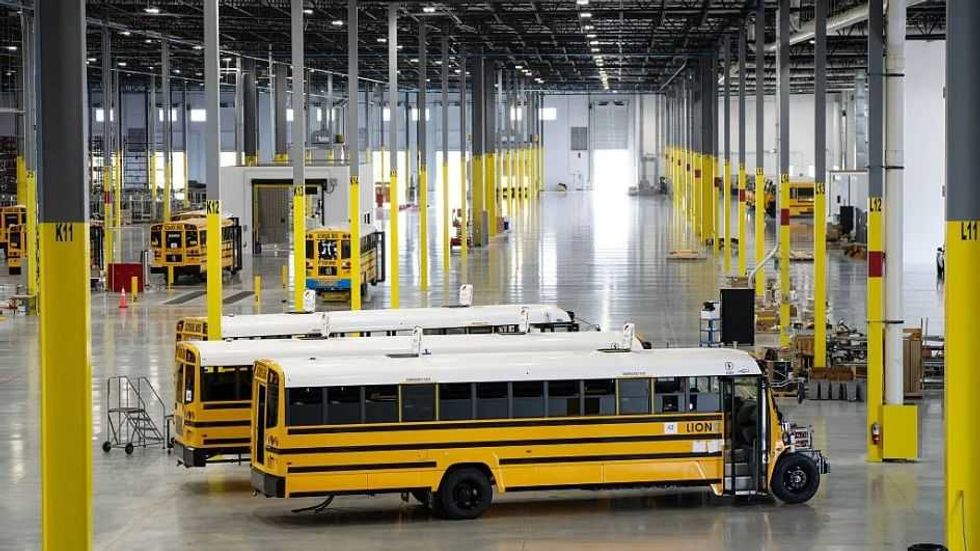
MISSING THE BUS: Inside Biden's $5 billion electric school bus debacle

Imagine getting paid hundreds of thousands of dollars for a school bus you haven't even built.That's how the Environmental Protection Agency's $5 billion Clean School Bus Program worked. Federal money went out before buses were delivered. Five years after Washington promised cleaner school transportation, hundreds of electric buses remain undelivered, and one manufacturer has gone bankrupt after receiving millions in federal funding.Why was so much public money exposed to a manufacturer that ultimately could not fulfill all its obligations?The money went out. The buses didn't always show up.According to EPA figures reported by the New York Post in September, approximately 1,100 electric school buses had been delivered from the program's initial round of roughly 2,600 funded buses. Another 854 were reportedly delayed, and 140 were not expected to arrive at all.Those figures do not cover every bus funded under the five-year program. But they raise serious questions about how Washington spent taxpayer money and whether the government did enough to ensure manufacturers could deliver what they promised.Pay first, deliver laterCongress authorized the $5 billion Clean School Bus Program in 2021, allowing school districts and other eligible organizations to replace older buses with electric and other lower-emission models.The Biden administration made electric buses a priority. By February 2026, approximately $2.7 billion in funding had been awarded under the program, with about 90% going toward electric buses, according to the EPA.The program's rebate system allowed recipients to request payment after submitting purchase orders. The buses did not have to be delivered first. In some cases, manufacturers received federal money long before they completed production.That arrangement created an obvious risk. What happens when a manufacturer takes the money but cannot deliver the buses?Federal watchdogs had concerns about the program's oversight well before the latest delivery figures emerged. In a July 2024 report, the EPA's inspector general found weaknesses in the agency's procedures for selecting recipients. The agency had not adequately verified that applicants seeking electric buses had school districts with suitable local conditions to operate them.In an April 2026 review, the inspector general identified additional problems with how the agency managed and accounted for program funds. EPA has completed or begun implementing corrective actions addressing those findings, according to the inspector general. But the delivery problems raise questions about whether those safeguards came soon enough.These are basic safeguards when taxpayer money is involved. Before Washington commits hundreds of millions of dollars, it should know whether the equipment can be delivered, operated, and maintained.Going brokeConsider Lion Electric, the Canadian manufacturer that entered creditor-protection proceedings in December 2024.According to the EPA, Lion received approximately $160 million directly through the Clean School Bus Program. School districts also used their own federal awards to purchase Lion buses. Some buses remained undelivered, and others were not being adequately maintained.Lion's own financial filings show how the system worked. The company received approximately $80 million in advance payments through the EPA's 2022 rebate program. As of September 2024, about $8.9 million of those payments remained on its books as deferred revenue because the associated buses had not yet been delivered. Lion's broader EPA-program deferred revenue, and liabilities totaled approximately $39 million.The company also reported approximately $2.4 million in repayments during the first nine months of 2024. In October, it returned another $7.1 million to the EPA under its funding arrangements.Two months later, Lion entered creditor protection.In a report submitted to the Quebec court, Deloitte Restructuring identified deferred revenue from federal Clean School Bus grants among the company's unsecured liabilities.That raised another problem for Washington: recovering money from a manufacturer that could no longer meet all its obligations. Unsecured creditors generally stand behind secured lenders when an insolvent company's assets are distributed.In February 2026, the EPA acknowledged that some Lion buses remained undelivered and said it was evaluating its options in the bankruptcy proceedings. The agency did not disclose how much taxpayer money it had recovered or expected to recover. The financial filings establish that some money was repaid before bankruptcy, but they do not establish the government's final losses.Why was so much public money exposed to a manufacturer that ultimately could not fulfill all its obligations?School districts need more than a purchase order. They need buses that show up, operate reliably, and can be serviced for years. When a manufacturer collapses, questions about replacement parts, repairs, and warranty support become very real.The cost of going electricElectric school buses also come with a substantial upfront premium.The Government Accountability Office reported in June 2025 that diesel school buses typically carried manufacturer-suggested prices between $98,000 and $154,000, compared with $300,000 to $440,000 for electric models. Charging equipment and electrical infrastructure can add to the cost.Electric buses may save money on fuel and maintenance over time. They also eliminate tailpipe emissions, an important consideration for children riding to school. But the actual savings depend on how the buses are used, local electricity prices, charging infrastructure, and reliability.A school district running short daily routes in a mild climate may find electric buses practical. Another district covering long rural routes in freezing temperatures may face different challenges.These are decisions school transportation officials should make based on their actual operating needs, not a federal preference for one technology.The GAO also found that EPA was not collecting complete information about some of the problems recipients encountered when putting new buses into service. Without that information, it becomes harder to determine whether the program is working as intended.RELATED: KILL-SWITCH UPDATE: 5 years later, error-prone tech could still strand sober drivers Sunset Boulevard/Mark Wilson | Getty ImagesWho is accountable?On February 19, 2026, the Trump administration announced plans to overhaul the Clean School Bus Program, citing delivery failures, Lion Electric's bankruptcy, and concerns about how taxpayer money was spent.That's a necessary discussion. But changing the program's priorities won't answer what happened to funds already distributed.Taxpayers deserve a full accounting of which buses were ordered, which were delivered, which are operating, and what happened to the money spent on buses that never arrived.Manufacturers receiving public funds should be able to demonstrate that they have the production capacity, financial stability, and service network to fulfill their contracts. And government agencies need enforceable safeguards when those promises fall apart.This is not an argument that every electric school bus is a failure. Some districts are making them work. It is an argument against treating any technology as the predetermined winner before the costs, capabilities, and risks are understood.School districts need reliable transportation for children, not expensive experiments that leave them waiting for buses.If Washington is going to spend billions of taxpayer dollars, the buses ought to show up.

Cover image for MISSING THE BUS: Inside Biden's $5 billion electric school bus debacle

The JFK secrets survived another Congress. Imagine that.

Hours after Democrats won the House on Tuesday, Rep. Robert Garcia (D-Calif.), poised to chair the Oversight Committee, offered two words: “Lawyer up.” He has named four priorities: Trump family business dealings, Homeland Security and ICE, corporate corruption, and public hearings on the Epstein files. The JFK and RFK assassinations, the CIA’s MK-ULTRA experiments, and the government’s UFO secrecy are absent from that list.That leaves the House Task Force on the Declassification of Federal Secrets in trouble. Established by the Republican-led Oversight Committee, it will not automatically continue when the new Congress convenes January 3. Democrats could renew its work, but they would have to choose to do so.If Congress walks away without even documenting the obstruction, every agency inclined to stall will have learned the same lesson: Waiting works.At a hearing last year, Rep. Tim Burchett (R-Tenn.) accused agencies of making jokes and trying to distract investigators. “I think they’re just trying to run the clock out of us,” he said. The election has brought that warning uncomfortably close to reality.The strange part is that the task force’s leading Republicans survived. Chairwoman Anna Paulina Luna won re-election in Florida, Eric Burlison held his Missouri seat, and Burchett prevailed in Tennessee. All three return in January, but without the majority that gave their investigation its authority.I heard variations of Burchett’s complaint while reporting on the task force. Agencies can outlast a congressional investigation. Their officials have every incentive to delay if they believe the political winds will change.When I interviewed Luna on July 30, I asked what remained unfinished. She said journalist Jefferson Morley was writing a final report on the JFK assassination. She said Sirhan Sirhan had agreed to testify about the murder of Robert F. Kennedy and that investigators planned ballistics tests on a firearm once owned by Thane Eugene Cesar, the security guard whose role has long figured in second-gunman theories.Luna also told me that government insiders had been released from nondisclosure agreements so they could speak and that the CIA had located missing MK-ULTRA files and included them in a declassification order.As far as I can determine from the public record, Sirhan has not testified, no new Cesar ballistics findings have been released, and the MK-ULTRA material Luna described has not appeared. Morley has confirmed that he is working on the JFK report. The public still needs to see it.RELATED: Inside the Langley showdown over JFK and MK-Ultra secrets Yutthana Gaetgeaw/Getty ImagesI want to be fair. Some Democrats on the task force took some whistleblower questions seriously. Nothing prevents a Democrat majority from continuing this work, and if its members believe in transparency, they should. But I have watched Washington long enough to know how this can go: The inquiry ends, the staff moves on, witnesses stop returning calls, and five years later someone writes a book about how close Congress came.Luna and her colleagues have less than two months. Publish Morley’s report. Pursue Sirhan’s testimony and the Cesar ballistics. Press for release of any MK-ULTRA records that can lawfully be made public. And for every unfinished lead, leave a written accounting: which agency has the records, what it promised, what it withheld, and how long Congress waited.January 3 need not be the end of the search for answers. But if Congress walks away without even documenting the obstruction, every agency inclined to stall will have learned the same lesson: Waiting works.

Cover image for The JFK secrets survived another Congress. Imagine that.

Hillary Clinton wants to subpoena Elon Musk after years of warning about weaponizing the system

Democrats love to claim that Republicans are fascists and then turn out and collude with Big Tech to censor speech, force people to get vaccines, and treat certain political opinions as threats to be managed by the state.BlazeTV’s Sara Gonzales calls it “projection.” “Constantly they're screaming that Donald Trump's a fascist, and he's literally Hitler, and Republicans are the authoritarians and the fascists,” she says, “and it's just a projection from them.”“There's no truth to it. There's no receipts that they can show. They just make it up because they are the party of projection.”The latest example of this, she argues, comes from none other than Hillary Clinton.For roughly a decade, the twice-defeated Democratic nominee has fearmongered that Donald Trump would weaponize the justice system to target political opponents.“The fact of the matter is if that were true, she'd be in jail,” says Sara.“Except she's not. So she knows that that's not the case. She knows that it's actually her party who's been doing this.”But it’s not just her party; Clinton herself recently violated the very principle she has long accused Trump of abusing.On Monday, during an appearance on the "Pivot" podcast with Kara Swisher and Scott Galloway, she argued that once Democrats control Congress, they should subpoena Elon Musk and force him to testify. She specifically noted that even if President Trump pardons Musk for any federal crimes, that wouldn’t stop a congressional subpoena.“And in fact, some legal experts argue that if you're pardoned, then you have no protection. You cannot take the Fifth Amendment because you have no jeopardy,” she added, “So let him pardon Elon and then let's call him in and figure out what he has to say.”Sara points out the irony of Clinton’s argument. In July, after receiving a broad preemptive pardon from Biden, Anthony Fauci was subpoenaed to testify before a Senate committee. He invoked the Fifth Amendment more than 100 times, refusing to answer questions about COVID origins and related matters.“Speaking of legal experts, you should also add in Rand Paul said it during the hearing,” says Sara, playing a clip of the Kentucky senator telling Fauci that obstructing a congressional investigation is against the law and that there would be repercussions for his refusal to testify.“So if she were being true in her principles and her morals and her convictions that we know that she doesn't have ... I am sure that Hillary Clinton will soon go on the record as supporting getting answers from Anthony Fauci, and if he refuses, he should go to jail,” she mocks.To hear more, watch the episode above.Want more from Sara Gonzales?To enjoy more of Sara's no-holds-barred takes on news and culture, subscribe to BlazeTV — the largest multi-platform network of voices who love America, defend the Constitution, and live the American dream.

Cover image for Hillary Clinton wants to subpoena Elon Musk after years of warning about weaponizing the system

Elon Musk's next target? America's self-entitled phone companies.

America loves competition, except, apparently, when it comes to your phone bill. For years, the wireless market has been dominated by three Mafia-like fat cats: Verizon, AT&T, and T-Mobile. They compete for customers, of course. But Americans could be forgiven for wondering whether somebody forgot to invite a fourth player to the party. The monthly bills keep coming. The dead zones remain, and escaping one carrier often means signing up for another version of the same expensive headache.Now, as the Washington Post recently reported, Elon Musk wants in. Through SpaceX, he's exploring ways to enter the $235 billion wireless market, potentially by acquiring Boost Mobile or using its network. His aim is to combine conventional mobile connectivity with Starlink satellites, challenging the way Americans have traditionally accessed wireless service.Rural America has spent far too long paying full price for half-baked service.It's an audacious undertaking, with enormous technical and commercial obstacles. But Musk loves a challenge. And the prospect of a serious new competitor should give America's established players something to sweat about.The wireless cartel has operated like a medieval feudal system for two decades. Three lords divided the fiefdom, then charged the peasants $200 a month for four lines and provided customer service reps who sounded like they were reading scripts at gunpoint. You hand over a small fortune every thirty days. Yet the moment you step onto a rural highway or enter a basement grocery store, your $1,200 smartphone turns into a rather luxurious paperweight.Dodging the oppositionThe corporate titans prefer this arrangement. Musk approached Verizon, AT&T, and T-Mobile to buy wholesale access to their cellular networks. All three slammed the door in his face. Standard corporate paranoia drove the refusal. Nobody invites a sledgehammer into a glass house.So Musk pivoted toward EchoStar, the corporate parent of Boost Mobile. Acquiring Boost would give SpaceX millions of existing subscribers overnight, along with valuable rights to use the airwaves. Boost currently leases network capacity from AT&T and T-Mobile. Buying Boost could give Musk a back door into the market, letting him sidestep the barriers established carriers put in his way.RELATED: 'Defund Musk': Robert Reich calls for government takeover of SpaceX and Starlink — and Elon responds Samuel Corum/Bloomberg/Getty Images To be clear, building a competitive nationwide terrestrial network requires years of hard graft and hundreds of billions of dollars. But Musk could skip the shovel work entirely. He already operates over 6,000 active Starlink satellites in low Earth orbit. He builds rockets in Texas, launches them from Florida, and controls the sky.Traditional carriers build cell towers. They secure local zoning permits and pray a passing tornado doesn't knock out coverage for three counties. SpaceX hangs its cell towers in space. By bonding low Earth orbit satellites directly to mobile networks, Musk can route a signal anywhere the sun hits the soil.The merger of orbital satellites and ground networks fundamentally alters the math for everyday Americans. Farmers operating combines in North Dakota could finally maintain high-speed connections across 4,000 acres of wheat. Long-haul truckers crossing remote stretches of Interstate 80 in Wyoming would no longer lose navigation maps mid-route. Emergency services operating in fire-consumed canyons could bypass incinerated ground cables entirely.Rural America has spent far too long paying full price for half-baked service. City dwellers enjoy five distinct bands of high-speed coverage while ranching families in Montana pay identical rates for a single, dodgy signal bar. Musk’s hybrid model treats geography as an engineering nuisance, not an excuse for extortion.A revolution in the makingNational security demands this kind of structural redundancy. The defense establishment already understands this reality. The U.S. military increasingly depends on private space companies to keep communications secure, while traditional defense contractors can take years to deliver even basic equipment. Musk moves faster than federal procurement officers can write meeting agendas.If America's first trillionaire's plan comes to fruition, the commercial fallout will hit home fast. The traditional carriers will fight this expansion in courtrooms, regulatory hearings, and corporate PR campaigns. They will claim satellite signals drop during heavy rainstorms. They will insist spectrum transfers threaten consumer safety. The unholy trinity can fight Musk all they want, but they can't easily stop Americans from wanting cheaper bills and better coverage.When Tesla entered the automotive market in 2008, Detroit executives laughed off the idea of a Silicon Valley start-up manufacturing family cars. Tesla subsequently forced every major auto manufacturer on Earth to overhaul their entire production lines. When SpaceX launched its first commercial rockets, legacy aerospace contractors declared reusable boosters mathematically impossible. SpaceX now launches more tonnage into orbit than every other country combined.The wireless market represents the next logical domino. Musk doesn't need to convert every smartphone user in North America to win this war. Stealing 10% of market share forces Verizon, AT&T, and T-Mobile to slash prices and actually repair dead zones. Healthy competition makes companies work for their money.The American consumer wins the second a real fight breaks out. For 20 years, phone bills have acted like a mandatory utility tax administered by a corporate triad. Musk brings capital. He brings orbit-proven hardware and a total disregard for industry decorum. He has been written off many times before and has always come through. Only a fool would bet against him now.

Cover image for Elon Musk's next target? America's self-entitled phone companies.

What happens to the human soul when AI makes work optional?

Tech entrepreneur Elon Musk has repeatedly predicted that a day is coming soon when AI and robotics will make traditional work optional in a utopian age of abundance, where humans will rely on universal high income while pursuing personal interests.Trading the daily grind for a life of comfort and leisure may be compelling, but is it good for the human soul?That’s the question Allie Beth Stuckey asked Stonebridge Bible Church Pastor Jonny Ardavanis, whose new book, “Get to Work: Seeing Your Daily Grind as God’s Good Gift,” explores why work is a divine gift rather than a burden to escape. “I just think that’s going to be a horrible, horrible existence,” Ardavanis says of Musk’s AI utopia.Regardless of one’s belief system, there’s an intrinsic understanding that work is a necessary part of the human experience, he argues, citing the oft-used expression “a job well done.”“You mow the lawn, you see the stripes in your lawn, and you put your hands on your hips and you go, ‘There’s something Edenic about this,”’ Ardavanis says.This sense of fulfillment, he says, can be traced back to the Garden of Eden, where Adam and Eve were first charged to cultivate and keep the garden as part of God’s original good design.“Deep down, God has hardwired Eden into our souls, and we’re pining away to get back there,” he tells Allie, citing Ecclesiastes 3:11’s reminder that God has “set eternity in the human heart.”But if AI removes the necessity of work, Ardavanis warns that the human heart, with its God-given orientation toward purpose and vocation, will wither.“When a robot starts mowing your lawn, you know, you’re going to start to be stripped and starved of the opportunities to reflect God in that way. And I think it is going to be soul-crushing,” he says.Work, he points out, isn’t just about doing; it’s also about thinking. When robots can think in our stead, what happens to the God-created mind?“What does it mean to be made in the image of God? Well, it means we have a mind. It means that we are to engage that mind,” Ardavanis says. “Almost all of the instruction in the New Testament regarding the Christian life is what we do with our mind.”“Your mind is God's gift to you, to employ it.”This longing isn’t limited to believers. Even non-Christians recognize the irreplicable uniqueness of the human experience. Ardavanis points to globally famous actor Tom Cruise, who, in response to a question about AI’s impact on filmmaking, said, “There is nothing like human.”“Even though Tom Cruise doesn’t know the God of the Bible, the God of the Bible has hardwired something into Tom Cruise’s heart,” he says. “We are to mirror and mimic God. When we do so, it gives us joy, and it gives us a level of purpose and meaning.”“I’m looking into a world where people are excited about the absence of work, the three-day work week ... and biblically speaking, I think that that’s hard to reconcile with the fact that we’ve been given a mission by God.”To hear more, watch the episode above.Want more from Allie Beth Stuckey?To enjoy more of Allie’s upbeat and in-depth coverage of culture, news, and theology from a Christian, conservative perspective, subscribe to BlazeTV — the largest multi-platform network of voices who love America, defend the Constitution, and live the American dream.

Cover image for What happens to the human soul when AI makes work optional?

Before AI takes a teacher's job, send it to the district office

With shrinking enrollment and ballooning expenses, public school districts across the country are not only facing massive budget deficits but are also quickly losing the goodwill of the public.Here in Texas, districts like Houston and Austin are seeing huge budget shortfalls. Around the country, school systems are on the path to bankruptcy yet have done little to cut spending.So many meetings, conferences, and email exchanges could be phased out, leaving more time to actually teach students.Many district leaders and their respective school boards seem to believe that these enrollment drops are nothing serious or that they can blame someone else for the problem and absolve themselves of responsibility. Consequently, instead of making significant spending cuts, they go on draining rainy-day funds or spending money they don’t have.Worse still, the bulk of these expenses do not go toward hiring more teachers, but instead go toward administrative staff, extracurricular programs, curriculum and technology specialists, and countless office workers with undefined roles working in office buildings that the district inexplicably owns and maintains. In the rare instances that cuts are made, it is mostly the teaching staff — that is, the actual people in the classroom working with students — who are affected.Realistically, can anything be done to prevent these districts from imploding in spectacular fashion? Speaking as a teacher currently in the trenches, this might be a place where AI can reduce costs while boosting instructional quality.I’m not talking about replacing teachers with AI-enhanced educational software, turning classrooms into computer lounges, and replacing principals with bored babysitters making sure the kids continue vegetating in front of their screens. According to a recent essay in the New York Times, this is the bold new idea at Alpha private schools: “At Alpha, there are no traditional teachers, few books, and little paper. All of the academic lessons are delivered via apps, and students can earn lavish prizes for completing their work. Adults are present, but only as motivational guides.”Predictably, this approach to education has mixed results. While the stronger students usually cruise through content and perform well on their standardized tests, the weaker students who need more help will often experience delays in their progress and opt out of the program altogether. More importantly, it neglects the most important aspects of schooling: socialization and humanization. Education is as much about results as it is about relationships. Teachers do not merely dispense information to compliant drones who mentally download this information through note-taking and worksheets. Teachers are supposed to design their instruction around the needs of their students, govern their classes equitably, and connect the content of their subject to the world outside the classroom. RELATED: The forgotten colleges that could restore hope to American education Crisserbug/Getty ImagesWhen this learning is outsourced to a computer and mediated through a screen, everything is reduced and flattened — of course, the superficial people in tech will mistake this for efficiency. Separated from the outside world, students engage with material through drill-and-kill pedagogy, working through assessments that offer practice on state standards. While this works well enough for math instruction, it becomes far less effective in the sciences or humanities. With all this said, there still might be a key role for AI in public education. While it can’t replace teachers, it can replace many of the people around them. And if used properly, it can also enhance the work that teachers do.In terms of cutting down bureaucratic bloat, all districts, even solvent ones, could use a DOGE-style audit to identify useless positions, departments, and redundancies. There are countless individuals in a school district who could permanently disappear without anyone noticing. Many of them are collecting paychecks and later pensions for irrelevant work, but no one notices them because they are usually hidden.Case in point: Years ago, I had a question about one of my paychecks. I sent out emails to the dozen HR people listed on the district website to see who could answer my question. When no one replied, I took a half-day off and drove over to the administration building to see if I could talk to someone face-to-face. Apparently, I went to the wrong administrative building and had to drive to the other one a mile away. Once there, the receptionist directed me to a hallway on the fourth floor to look for a person who knew about paychecks. After wandering about for 10 minutes, I finally found someone who directed me to yet another person who finally had the answer to my question.RELATED: AI doesn’t know you, but a good physician does Moor Studio/Getty ImagesMost public teachers have a story like this. Some random thing prompts them to take a journey through their district’s Kafkaesque bureaucracy, and then they realize just how many useless people are on the payroll. Today, most queries could be answered in a few seconds with a chatbot. Moreover, most duties done by non-teaching staff, like setting up schedules, organizing information, compiling data and documentation, and making presentations, could be done with AI.Just as importantly, the people who work with students could accomplish far more with AI support. So many meetings, conferences, and email exchanges could be phased out, leaving more time to actually teach students. So many roles requiring specialized training and higher salaries could either be removed entirely or replaced by those with general experience and aptitude.In such a system — which would resemble something like Singapore’s exceptional educational program — good teachers would be rewarded with more respect, authority, and income while administrators would function as their subordinates. Good teachers are far less replaceable than administrators, so they should be encouraged to stay in the classroom and help more students.Like any large organization, most school districts have grown into something so unwieldy and chaotic that enacting meaningful reform is next to impossible. Those with the authority to do so are usually too incompetent and complacent to do anything, and those with competence and wherewithal to do something lack the authority. Meanwhile, taxpayers funding public schools tend to focus their ire on the people they can see and ignore the true source of the problem.It may be difficult to imagine an alternative to the current dysfunction, but it can be done. And if done right, it will be a good thing for everyone involved.

Cover image for Before AI takes a teacher's job, send it to the district office

Elderly man on e-bike brutally beaten in unprovoked attack in broad daylight. Then Good Samaritan lends unexpected help.

"I'm lucky to be alive," 77-year-old Herb Freeborn told WPVI-TV in the wake of a brutal, unprovoked attack he suffered just after noon Wednesday in Ridley Township, Pennsylvania, while he was riding his e-bike. Ridley Township is just under 30 minutes southwest of Philadelphia.'I ain't used to people helping me like that, you know.'Freeborn told the station he was waiting to cross Chester Pike in the Crum Lynne section when a male approached him from behind and began punching him.Surveillance video shows the suspect crossing through traffic and heading toward the victim before the attack, WPVI said."This guy came up behind me, started punching me and punching me," Freeborn recalled to the station.WPVI asked him if the suspect said anything during the attack, but Freeborn said, "No, didn't say nothing, just came up to me and started hitting me."The station said Freeborn suffered injuries to his eye and face.RELATED: Laughing 'piece of s**t' thug caught on video punching victim in face as pair pass each other in Philly crosswalk Surveillance video shows Freeborn managing to run from the attacker, WPVI reported.At that point, one might expect the suspect to make off with the victim's e-bike — but he didn't.The station said the suspect actually threw Freeborn's e-bike and walked away.Surveillance video also captured a bystander — Danny Doyle — stepping in to help, WPVI noted.Doyle told the station he saw the incident and went to assist Freeborn, grabbing the victim's e-bike and checking on his condition."At first I thought he was stealing his bike; that's why I went and grabbed it for him," Doyle recalled to WPVI.Freeborn told the station that Doyle's actions meant a lot to him: "I want to thank him very, very much. I appreciate everything he done for me."The elderly man then added a gut-wrenching admission WPVI: "I ain't used to people helping me like that, you know."Ridley Township police released surveillance photos of the suspect and announced just before 4 p.m. Wednesday that he had been taken into custody.Police on Friday didn’t immediately respond to Blaze News’ request for more information about the arrested suspect."If he did it to me, why wouldn't he do it to somebody else?" Freeborn asked the station.Commenters under the police department's Facebook post about the incident didn't hold back:"Typical coward. Prey on the elderly. Not surprised," one user stated."Piece of s**t," another commenter declared. "I hope they find out what he did when he goes to jail, and those boys stomp him out for it.""Like why WTF," another user wrote."Always carry ... end them," another commenter suggested.Like Blaze News? Bypass the censors, sign up for our newsletters, and get stories like this direct to your inbox. Sign up here!

Cover image for Elderly man on e-bike brutally beaten in unprovoked attack in broad daylight. Then Good Samaritan lends unexpected help.

Who rules the ruling class?

The results of the midterm elections are clear; their meaning is not. The blue tsunami apparently has not budged either of the dominant intellectual factions on the right. The so-called “doomers” see fresh support for their conviction that the republic is sliding more or less inexorably into ruin. The more conventional old guard, who find such talk alarming, continue to insist that “you win some, you lose some” and that Republicans will live to fight another day.What makes the current political scene so perplexing is that both sides can point to certain undeniable facts to support their position. The United States is, for now, neither all one thing nor all the other. James Madison’s Constitution, though beaten and bruised, is still functioning, according to the conventionalists. American politics remains fundamentally “normal.” To what degree the ruling class actually believes in or cares about the various oppressed classes it purports to champion is an open question.In reply, the pessimistic wing accuses the “normie-cons” of naivete and complacency. The original Constitution, they argue, has by now been almost entirely pushed aside by a new, second Constitution, based on a new understanding of justice and human nature and fanatically devoted to implementing the ideological left’s agenda.It is hard to deny that virtually all aspects of our public life have become distorted and dysfunctional in a way the founders would hardly recognize. Yet the old guard does seem to be correct to insist that elections — the most important safeguard of popular consent — are still respected by both sides, however tenuously.Despite a few vocal outliers and occasionally heated rhetoric, both parties have grudgingly accepted the results of the last several voting cycles, if not in equal measure. (It is worth noting that during Joe Biden’s entire four-year term, no one from the allegedly extreme party of gun violence tried to assassinate him.) Presumably, this will still hold in two years, even if — as seems quite possible now — the Democrats not only maintain significant majorities in both chambers of Congress, but take control of the White House as well. That, oddly enough, could represent a notable return to something very traditional and normal in American politics: the “realigning election.”Until a few decades ago, the regularity of realigning elections had been such a reliable feature of American history that political scientists had come to treat the phenomenon as almost an iron law. Beginning in 1800, the American people seemed to prefer that one party hold authoritative control of the federal government for a full generation or so, at which point they decisively switched their allegiance to the other party. Thus, Republicans and Democrats essentially traded control over the national government every few decades: in 1828, 1860, 1896, 1932, and then, perhaps, in 1968 or ’72 — but this is where things took a turn.In an essay titled “Political Parties, the Constitution, and the Future of American Politics,” Charles Kesler notes that realigning elections consistently allowed the American people to choose between two “well-developed interpretations” of the Constitution: “a more democratic or a more republican view.” “The former view emphasized popular sovereignty, the latter popular responsibility.”RELATED: Trump conquered the Republican Party. What a waste of a victory. Brendan SMIALOWSKI/AFP/Getty ImagesParties competed to prove their fidelity to the Constitution, each grudgingly conceding the legitimacy of the other(s), but insisting on its own superior credentials — and thus its right to define what was common ground, and what was forbidden, in public life.In practice, these boundaries were set by the majority party, but the fight was always over who would get to set them — whose view of the Constitution would prevail. When the competing views became sufficiently discordant, the American people faced a critical election whose consequences might include the overturn of the existing majority party, and the establishment of a new one.Such realigning elections are rare but revealing: They set the grounds of electoral competition for the next generation or two, and renew the nation’s dedication to the moral and political goals of republicanism proclaimed in the Declaration of Independence and incorporated in the Constitution. Thus America’s party system reflected the continuing vitality of the Constitution, and presupposed a healthy respect and even reverence for it.Kesler notes that this regular process seems to have stalled in the 1980s. The Reagan revolution ought to have solidified Nixon’s 1972 landslide re-election and inaugurated a generation of Republican dominance. But by this point, the federal government itself had become a significant — perhaps the most significant — faction in American politics. The will of the voters now had to contend with the will of the bureaucracy. As a result, Kesler notes, the United States has “tilted away from elective representation and party politics and towards new, non-elective and non-deliberative modes of representation.” Consent steadily yielded to the benevolent administration of scientific experts.Picking up on this theme, the late Angelo Codevilla, another great Claremont scholar, noted in 2020 that the institutional changes wrought by the second Constitution have been driven by a potent intellectual critique that guided “the campaigns for social improvement into which Progressives have led the American people ever since the 1930s, and especially since the 1960s.”The ruling class chided Americans for insufficient commitment to education, to well-being for the poor and disadvantaged, to a healthy natural environment, and to public health, as well as for oppressing women, and, above all, for racism. The campaigns for remedying these conditions have been based on propositions advanced by the most highly credentialed persons in America — experts certified by the U.S. government, whom the media treated as truth-telling scientists, their opponents as enemies of the people.RELATED: The day after tomorrow: A new GOP Tom Brenner/Getty ImagesNot surprisingly, this ostensibly moral agenda coincided very nicely with the political and economic interests of the ruling class, which appointed itself the guardian of the progressive second Constitution. To what degree the ruling class actually believes in or cares about the various oppressed classes it purports to champion is an open question. As Codevilla perceptively emphasizes, its disdain for traditional, working-class voters is evident; the desire to actually improve life for the American citizenry is less clear. If this were nothing more than hypocrisy, it would hardly matter.But the political problem, not just for the left but for America, is that the ideological cart to which the ruling class hitched its pursuit of power — the postmodern crusades for sexual liberation, racial grievances, and the autonomy of the uninhibited self — turns out to be rather difficult to manage. The radical vanguard that supplies the Democrats with energy, zeal, and fashionable cachet, what Codevilla calls the “intersectional” component of the left, believes (not without good reason) that it is in charge. This makes for an uneasy coalition. “For most ruling class notables,” Codevilla observes, “enjoying and parceling out victory’s prerogatives is the revolution’s point.”They would prefer to suppress the deplorables while minimizing disruption of the economy and avoiding violence. For these chiefs, rubbing the deplorables’ faces in excrement is mostly an instrument of conflict. But for the intersectionals, it is the revolution’s very objective, its driving logic. For them, vengeance is electoral victory’s foremost prerogative. Determined as the chiefs may be that the intersectional tail must not wag the revolutionary dog, the fact is that each and every part of the intersectional coalition sees itself as the dog.The crucial question in 2028 and beyond will be: Who is really the top dog in the ruling class?A few days ago, National Review’s Dan McLaughlin — hardly a MAGA extremist — tweeted, “I understand entirely the instinct to teach the House GOP a lesson. But if you punish the Senate GOP, it will be 6 years before they can do anything about it. And we can lose the Republic before then.” If this week’s midterm elections does indeed foretell a critical realignment to the left in 2028, it will mean not six but at least 30 years of unchallenged dominance by the Democrats — with very little assurance that the neoliberal oligarchs will be able to moderate the intersectional fanatics. That might be enough to make even the most complacent “normie-con” blanch.Editor’s note: This article was originally published in the American Mind.


Cover image for Who rules the ruling class?

Pastor sexually assaulted and trafficked women and children of his Oklahoma church

An Oklahoma pastor claimed to be a part of the notorious MS-13 criminal gang in order to coerce members of his flock to work for him without pay.Elmer Baca Flores, 41, told his church members to quit their jobs and work for him, according to a post from the Oklahoma Bureau of Narcotics.'As parents, we have to be hypervigilant about protecting them. Ninety percent of the time, children are abused by someone they know, love, and trust.' Officers interviewed several people who said their family members had gone to church and didn't come back home. Flores used his influence as a spiritual leader to coerce the members to leave their families.The scheme was first reported after a family told police their daughter had been sexually abused. "One victim told Agents that Flores gave her a test to prove her ability to resist temptation. During this test, the victim was sexually battered by Flores," said Mark Woodward, a public information officer with the OBN."Flores used his influence as a pastor to spiritually coerce the victims by targeting their religious convictions," Woodward added.Flores was arrested in April 2025 and booked on three charges of lewd conduct with a child.Six months later, the charges were amended to include human trafficking for labor and one count of sexual battery.On Tuesday, he was convicted of 13 counts of human trafficking for labor as well as various child sex charges.He was sentenced to 30 years in prison and will have to register as a sex offender. He also faces deportation.He called his church the "Ministerio Levantando Adoradores Para Cristo Inc.," which was based in his home. A sign of the church from a KOCO-TV report indicated that it was Pentecostal.RELATED: Pastor allegedly tried to meet minor for sex — he ran for Congress as a Democrat and was an NAACP leader The OBN said Flores' conviction for human trafficking for forced labor was the first such conviction in the state of Oklahoma."I appreciate the amazing work by our Human Trafficking Unit and the Oklahoma County District Attorney's Office in this landmark case," OBN Director Donnie Anderson said. "And I applaud the bravery of these victims for coming forward to hold their trafficker accountable."Stacy McNeiland, the founder of ROAR at the Care Center, told KOCO that parents need to be vigilant against predators manipulating their children. "As parents, we have to be hypervigilant about protecting them. Ninety percent of the time, children are abused by someone they know, love, and trust,” McNeiland said. Like Blaze News? Bypass the censors, sign up for our newsletters, and get stories like this direct to your inbox. Sign up here!

Cover image for Pastor sexually assaulted and trafficked women and children of his Oklahoma church

This two-time World Series champion is exactly the kind of immigrant conservatives want to see

Conservatives get smeared as anti-immigrant, but the truth is simple: They want people who come here legally, respect the process, and actually want to become Americans. Miguel Rojas is exactly that immigrant.BlazeTV host Pat Gray played a clip of the newly retired Dodgers infielder and two-time World Series champion explaining how he approached the U.S. citizenship test he passed last month. When asked by reporters if he was nervous about the test, Rojas didn’t flinch: “No, I wasn’t nervous because I was prepared.”“I felt like I was ready for it. I didn't know what to expect because it's kind of like my first time going into a conference room with an official … but at the end of the day, I knew all the 100 questions, and I knew the answers,” he added confidently.Rojas then expressed pride in becoming an American.“It makes me feel really special, really proud because of my family, because of my kids, because of what I've been doing the last 21 years in this country. This country opened their doors to me to be a professional baseball player, and kind of I took that opportunity as a life opportunity as well, and I don't take it for granted,” he said.He also noted that he was glad that the person who administered his citizenship test didn’t recognize him because he did not want to be shown any “preference.”“Because this process has nothing to do with baseball. I felt like as a citizen, as a human being, I always wanted to be a good person off the field and not let my performance influence anything because we all know how hard this game can be and how high you can be and how low you can be one day,” Rojas explained. “So I don't want to be kind of like judged by my performance on the field. I want to be judged by the person who I am and my preparation.”Pat is delighted by Rojas’ response.“That’s what you like to see is an immigrant who’s doing it the right way, came here legally … appreciates his opportunities here, appreciates the country, loves the country, wants to be a part of it,” he raves.“Doesn’t need an interpreter,” adds co-host Jeffy, highlighting Rojas’ excellent English.“People like that, you welcome with open arms. … It’s great to have you here,” says Pat.To see the clip of Rojas and hear more of Pat and the panel’s commentary, watch the episode above.Want more from Pat Gray?To enjoy more of Pat's biting analysis and signature wit as he restores common sense to a senseless world, subscribe to BlazeTV — the largest multi-platform network of voices who love America, defend the Constitution, and live the American dream.

Cover image for This two-time World Series champion is exactly the kind of immigrant conservatives want to see