GAO Says Debt Held by Public to Grow Faster than U.S. Economy

- Comments
- Related Articles
- The Growth of the U.S. National Debt Since It Began
- Why Do Democrats Hate Medicare Advantage?
- We’re Always Just One New Tax Away From Utopia
- The Outlook for Social Security Gets Worse
- The FDA Can’t Manage Its Own Risk Problem
- Stablecoins Won’t Save Us From Fiscal Folly
- Sink the Battleship (Program)
- California’s Bullet Train Burning Money Slower, Still Going Nowhere
- The Failed Promise of Housing First
- Remembering and Rebuking the Covid Regime
- Addressing U.S. Government Fraud Issues
- Even Before the Iran Oil Shock, U.S. Economy Was Under Stress
- The Fed’s 2% Inflation Target Is No Longer Enough
- Constitutional Distortion and America’s National Debt
- Why “U.S. Insolvency” Wasn’t News
- Another Trillion Racks Up for the National Debt
- NASA’s Next Moon Shot
Discerned → in General
The latest GAO report paints a stark picture of America’s worsening fiscal outlook.
July 8, 2026
4 Shares
They say, “A picture is worth a thousand words.”
Here then is a picture that tells a long, depressing story. It is the first figure that appears in the General Accounting Office’s June 2026 Annual Report to the U.S. Congress on the Nation’s Fiscal Health, entitled “Debt Held by the Public Is Projected to Grow Faster Than the Economy”. All it does is show how the publicly held portion of the U.S. government’s total public debt outstanding has changed and is projected to change as a percent of the nation’s Gross Domestic Product (GDP) over the years from 1900 through 2056.
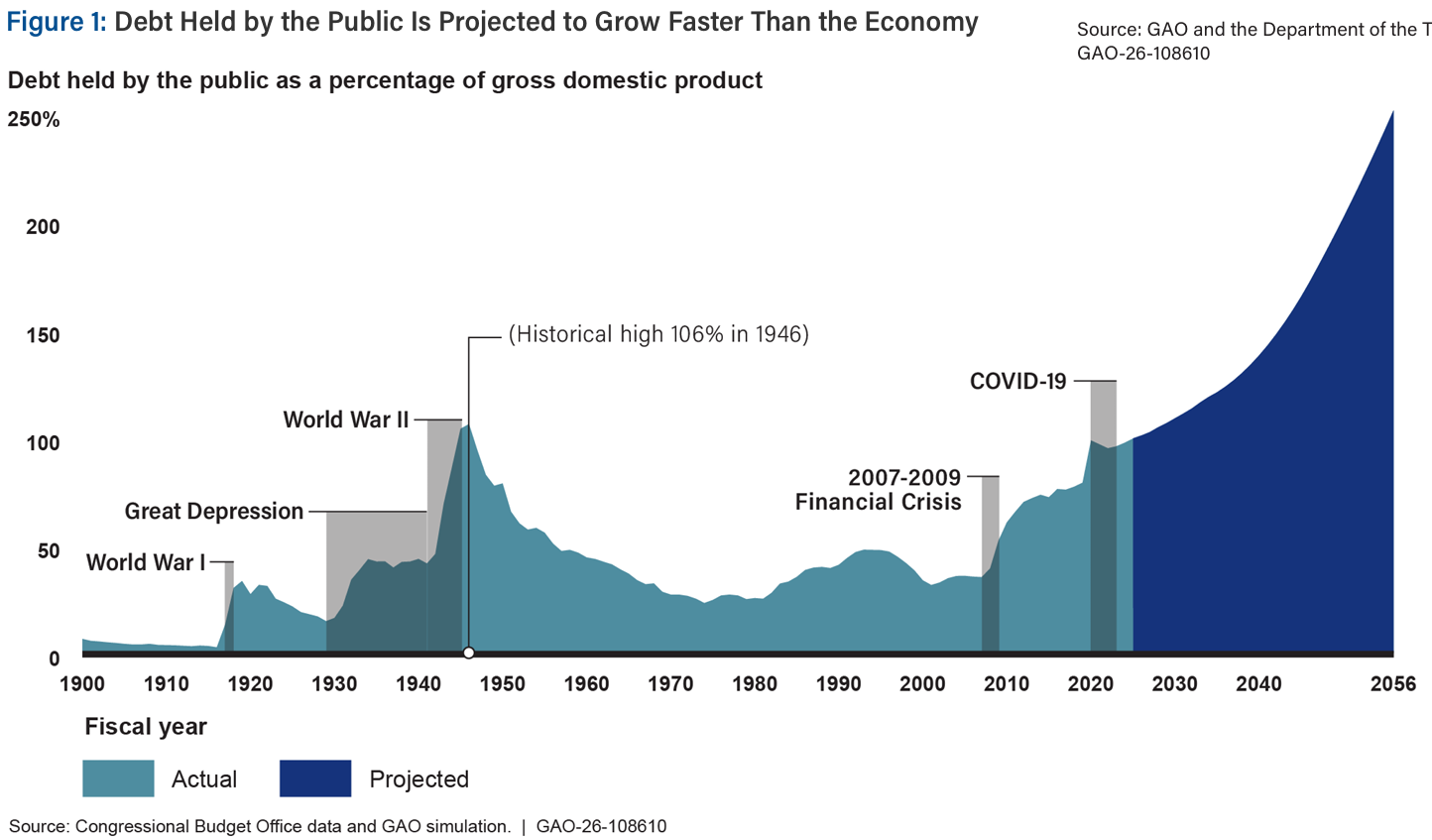
The GAO’s report explains why this problem exists and why it will continue to get worse without serious fiscal reforms:
For over two decades, the government has consistently run primary deficits (i.e., excluding interest payments), as revenue averaged 16.7 percent of GDP annually compared to annual average program spending of 20.7 percent of GDP. The primary deficit of $805 billion for fiscal year 2025 represented 2.7 percent of GDP.
Under current policies, revenue is projected to increase (as a percentage of GDP) but not enough to keep pace with spending increases, resulting in increasingly large primary deficits.
The GAO’s report features another figure that clearly illustrates the cause of the problem. Here it is:
Notice how steady the line representing the U.S. government’s projected revenues as a percent of GDP is, while the line representing spending curves upward. That’s a clear sign the true threat to the nation’s fiscal health is excessive spending under the government’s fiscal policies.
The GAO identifies the programs that are responsible for the growth of the government’s projected excessive spending:
Projected growth in program spending is largely driven by Social Security, Medicare, and other federal health care programs. The American population is aging, which increases the number of Social Security and Medicare beneficiaries relative to the overall population. In addition, Medicare and other federal health care programs face increasing health care costs per beneficiary. Federal health care spending consists of Medicare, Medicaid, the Children’s Health Insurance Program, and subsidies for insurance purchased through the health insurance exchanges.
The GAO also confirms that paying interest on the national debt has become the fastest-growing component of the federal government’s spending:
Interest costs have increased rapidly since 2021 because
- debt has accumulated quickly as large annual deficits have required more borrowing, and
- higher interest rates have increased the cost of borrowing.
Under current policy, we project that spending on net interest will grow quickly, reaching almost 10 percent of GDP in 2056—more than three times current levels.
Paying interest on the national debt is the only truly mandatory portion of the government’s spending. If the government fails to pay that interest, it will default on the national debt. A default would ensure enormous and negative consequences.
That’s quite a scary story to tell with a picture!
-
is a Research Fellow at the Independent Institute and Instructor in Business and Mathematics at Axia College of the University of Phoenix.
Fiscal Policy/Debt Government Waste/Pork
Comments
Related Articles
Jul 13, 2026
The Growth of the U.S. National Debt Since It Began
July 4, 2026, marked the 250th anniversary of the United States’ declaration of…
Jul 13, 2026
Why Do Democrats Hate Medicare Advantage?
It’s the best program in the entire U.S. healthcare system, including even employer-sponsored…
Jun 20, 2026
We’re Always Just One New Tax Away From Utopia
Elon Musk’s newfound trillionaire status has galvanized calls for an unworkable wealth tax.
Jun 18, 2026
The Outlook for Social Security Gets Worse
Every year, Social Security’s Trustees report on how well the payroll tax-funded program is…
Jun 16, 2026
The FDA Can’t Manage Its Own Risk Problem
Risk management is the leading reason the Food and Drug Administration cites medical device…
Jun 5, 2026
May 29, 2026
Stablecoins Won’t Save Us From Fiscal Folly
It’s a flashy stopgap for a long-term structural problem.
May 28, 2026
Sink the Battleship (Program)
Why Congress should scuttle the boondoggle.
May 21, 2026
California’s Bullet Train Burning Money Slower, Still Going Nowhere
California’s zombie bullet train boondoggle is burning through…
May 11, 2026
The Failed Promise of Housing First
Housing First has failed to improve health outcomes, or save taxpayer money, but has significantly…
May 11, 2026
Remembering and Rebuking the Covid Regime
Stephen Macedo and Frances Lee’s In Covid’s Wake amply documents the consequences of…
May 5, 2026
Addressing U.S. Government Fraud Issues
No matter how you slice it, the U.S. government has a major fraud problem. The federal government’s…
May 1, 2026
Even Before the Iran Oil Shock, U.S. Economy Was Under Stress
Rising deficits, inflation, and weak jobs signaled trouble even before oil…
May 1, 2026
The Fed’s 2% Inflation Target Is No Longer Enough
Federal Reserve Chair Jerome Powell held interest rates steady Wednesday for a third time…
Apr 28, 2026
Constitutional Distortion and America’s National Debt
Expansive readings of federal power fueled unsustainable debt growth.
Apr 17, 2026
Why “U.S. Insolvency” Wasn’t News
Treasury figures show long-term imbalance, not sudden insolvency or crisis.
Apr 15, 2026
Another Trillion Racks Up for the National Debt
The U.S. government’s total public debt outstanding is on the verge of permanently…
Apr 9, 2026
NASA’s Next Moon Shot
The Artemis II mission to the Moon has captured a lot of pent-up excitement among Americans excited to see NASA…
View more discerns at https://discerned.online/discerns
Write a comment