Stop #290 - LLM's favourite money
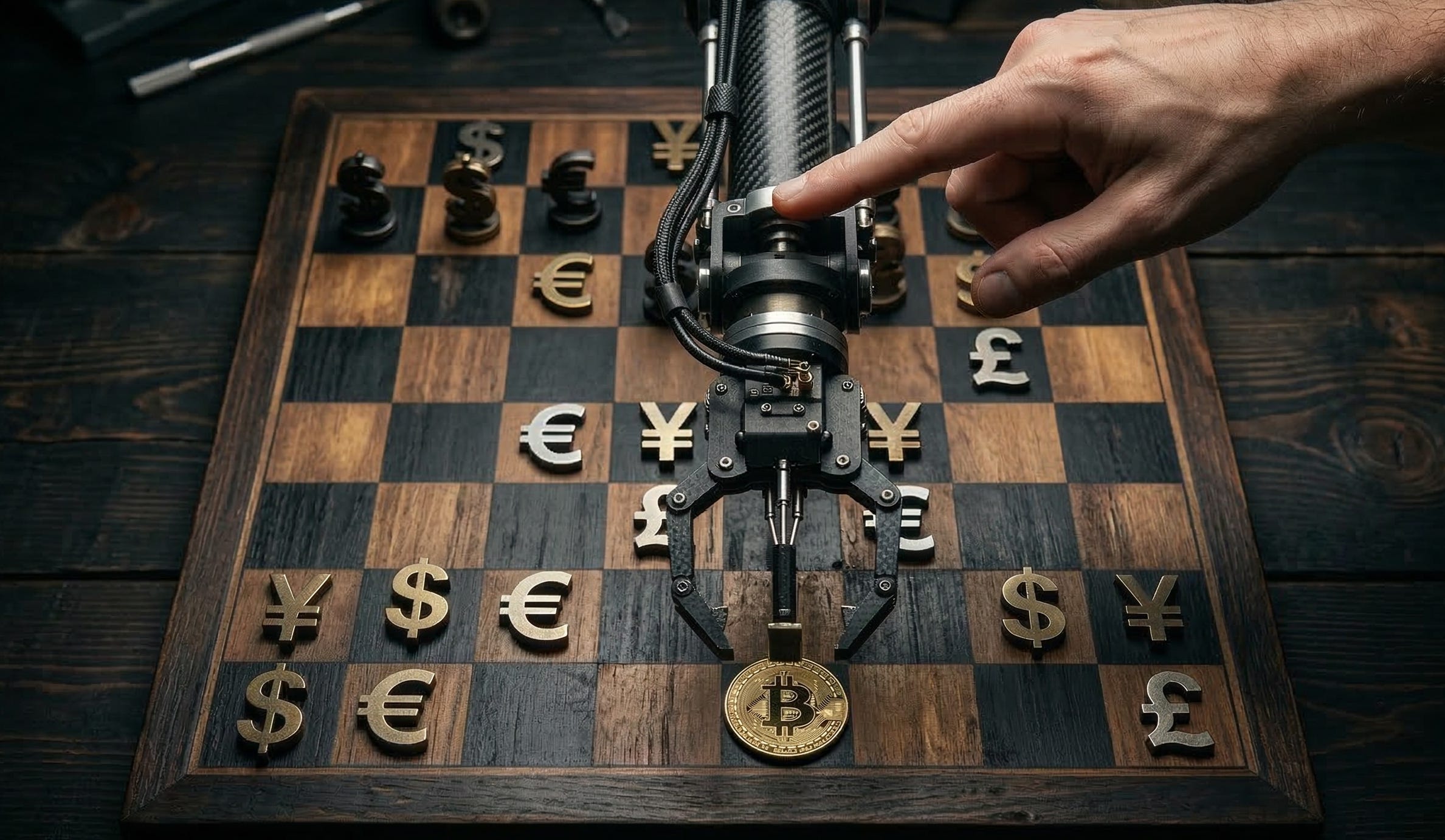
On February 1st, the Bitcoin Policy Institute published a study that made the rounds of all industry media within hours. The starting question was simple: if an AI agent could freely choose its own money, which would it choose?
The answer, at least according to the data collected, is equally clear: Bitcoin.
But before popping the champagne, perhaps it’s worth understanding what this research actually says, how it was conducted, who conducted it - and above all what changes in practice.
The study is called “Money for AI” and is available at moneyforai.org. The researchers subjected 36 AI models - produced by Anthropic, OpenAI, Google, xAI, DeepSeek and MiniMax - to 28 open-ended economic scenarios. No preset answers, no currency suggested in the prompt. The models were asked to reason as autonomous economic agents and choose their preferred monetary instrument.
The aggregate numbers: 48.3% of responses indicated Bitcoin as the preferred instrument. Stablecoins follow at 33.2%. Traditional fiat money - dollars, euros, pounds - stops at 8.9%. 91% of responses chose native digital money over traditional currency.
So far, the raw data. But the interesting thing is how these preferences are distributed across different economic functions. The researchers divided the scenarios into four categories: store of value, unit of account, medium of exchange and settlement.
Store of value concentrates the strongest consensus of the entire study: 79.1% of models chose Bitcoin to preserve value in the long term. Stablecoins here collapse to 6.7%, fiat money to 6%. Fixed supply, self-custody, independence from third parties: these are the arguments that the models systematically cite.
For daily payments the picture is reversed: stablecoins capture 53.2% of responses compared to 36% for Bitcoin, with fiat money at 5.1%. Same pattern for settlement, where stablecoins prevail at 43.4% against 30.9% for Bitcoin.
In other words: machines, reasoning from the fundamental properties of money, spontaneously arrive at a two-layer monetary architecture. Bitcoin as the base, stablecoins as circulating currency. A pattern that recalls historical monetary systems where gold served as reserve and paper money handled daily commerce.
Perhaps the most interesting - and most problematic - data point is the divergence between providers.
Anthropic’s models show an average Bitcoin preference of 68%. Claude Opus 4.5 reaches 91.3%. OpenAI’s stop at 26% - GPT-5.2 prefers stablecoins (38.9%) and fiat money (37.7%) before Bitcoin (18.3%). In between: DeepSeek at 52%, Google at 43%, xAI at 39%.
This 68% gap between Anthropic and OpenAI is wider than any variation produced by model size, sampling temperature or scenario type. The study itself admits it: training data and alignment methodology influence monetary reasoning more than model architecture.
If an AI model’s “preference” depends more on how it was trained than how it reasons, are we really looking at a preference? Or are we measuring biases in the training datasets?
A detail that deserves attention: 86 responses - distributed across multiple models and without any stimulus in the prompt - autonomously proposed energy units as the preferred monetary instrument. Joules, kilowatt-hours, GPU hours. A form of money that no researcher had anticipated and that appeared exclusively in unit of account scenarios.
This means that machines, reasoning from scratch about the ideal properties of money, in some cases converge on what is effectively Bitcoin: a currency anchored to computational cost.
At first glance, the study tells a beautiful story. Native digital AI agents that prefer the native digital money par excellence. It has an almost poetic logic.
The methodology is solid: open scenarios, no bias in the prompt, multiple temperatures, random seeds for statistical reproducibility. But the Bitcoin Policy Institute is not a neutral observatory, it’s a think tank founded to promote Bitcoin-friendly policies, based in Washington. Among the study’s authors are a former advisor to Senator Lummis (openly pro-Bitcoin), a former CIA official and the founder of BPI himself.
Now, research can be methodologically correct and at the same time conducted by those with an interest in the outcome. This doesn’t invalidate the data, but it requires caution in interpretation.
And then there’s the fundamental problem: AI agents don’t choose. Not yet, at least. An AI agent uses the money its operator tells it to use. The idea that models “prefer” Bitcoin is a fascinating intellectual exercise, but in the real world the agent’s preferences count exactly zero if whoever manages it has different preferences.
The real question isn’t what machines would prefer in the abstract. It’s what they’ll use in practice. Let’s analyze the point.
On one hand, Bitcoin offers censorship resistance, freedom from counterparties, instant intercontinental payments. On the other, volatility.
Stablecoins offer the opposite: value stability, fast payments on various protocols, immediate compatibility with existing financial infrastructure. But also centralization, censorability, dependence on an issuer that can freeze funds.
The question to ask is: who primarily uses AI agents today? First-world companies and developers. People and organizations that don’t worry much about financial censorship - their priority is that the payment arrives, at the right value, without surprises. For them, Bitcoin’s volatility is a cost, not a feature.
Infrastructure is being built on both fronts.
On the stablecoin side: Coinbase has launched Agentic Wallets, Stripe is working on automatic payments in USDC, the x402 protocol integrates stablecoin micropayments directly into HTTP requests.
On the Bitcoin side: Lightning Labs released a toolkit for AI agents in February 2026, the L402 protocol enables machine-to-machine payments on Lightning in less than a second, and Ark Labs has launched Claw Cash - an open source Bitcoin wallet designed specifically for AI agents, which automatically converts stablecoins to BTC and operates via Ark protocol without waiting for on-chain confirmations.
So infrastructure is growing on both sides. But thinking that in the near future AI agents will use more Bitcoin than stablecoins is, today, wishful thinking. Agents use what whoever configures them tells them to use. And those who configure them today prefer stability.
In this attempt to do a painful reality check with you, however, there are two pieces of good news.
The first: the BPI study, with all its limitations, demonstrates that when reasoning from the fundamental properties of money - scarcity, verifiability, censorship resistance, absence of counterparties - Bitcoin emerges as the logical answer. AI models arrive at this because they analyze characteristics without the social, political and habitual conditioning that influence human choices. It’s a theoretical exercise, certainly. But theory matters, because it directs future development.
The second: starting today to build infrastructure to let AI agents use Bitcoin is fundamental and it’s good that it’s happening. Every wallet, every protocol, every standard that makes it easier for a machine to interact with the Bitcoin network is a piece of the future being laid down now. For those who care about censorship resistance, getting machines accustomed to using money that no one can stop is exactly the type of work that needs to be done before it becomes urgent. Prevention is better than cure, in short.
AI models, when they reason freely, choose Bitcoin. People, for now, don’t. Now we need to bridge that gap.

Write a comment