Stop #291 - Everyone's Weapon
Friday, February 28, 2026, 6:15 a.m. local time. Israeli and American aircraft strike Tehran. Nuclear facilities, missile sites, the Pasteur district where Khamenei resides. In the following hours, confirmation arrives of his death, along with that of other high-ranking officials.
Thousands of kilometers away, on the screens of Chainalysis analysts, something happens. Withdrawals from Nobitex—Iran’s largest exchange—explode by 700% within minutes. Over the following 72 hours, $10.3 million in bitcoin and stablecoins are moved from exchanges to personal wallets. Pay attention to this detail: not to other foreign exchanges or trading platforms: to wallets that no one controls except those who hold the keys.
60% of those wallets, three weeks later, still hold the funds. We’re therefore talking about users who decided to take control of their own savings before someone else did it for them.
To understand what’s happening, we need to take a step back.
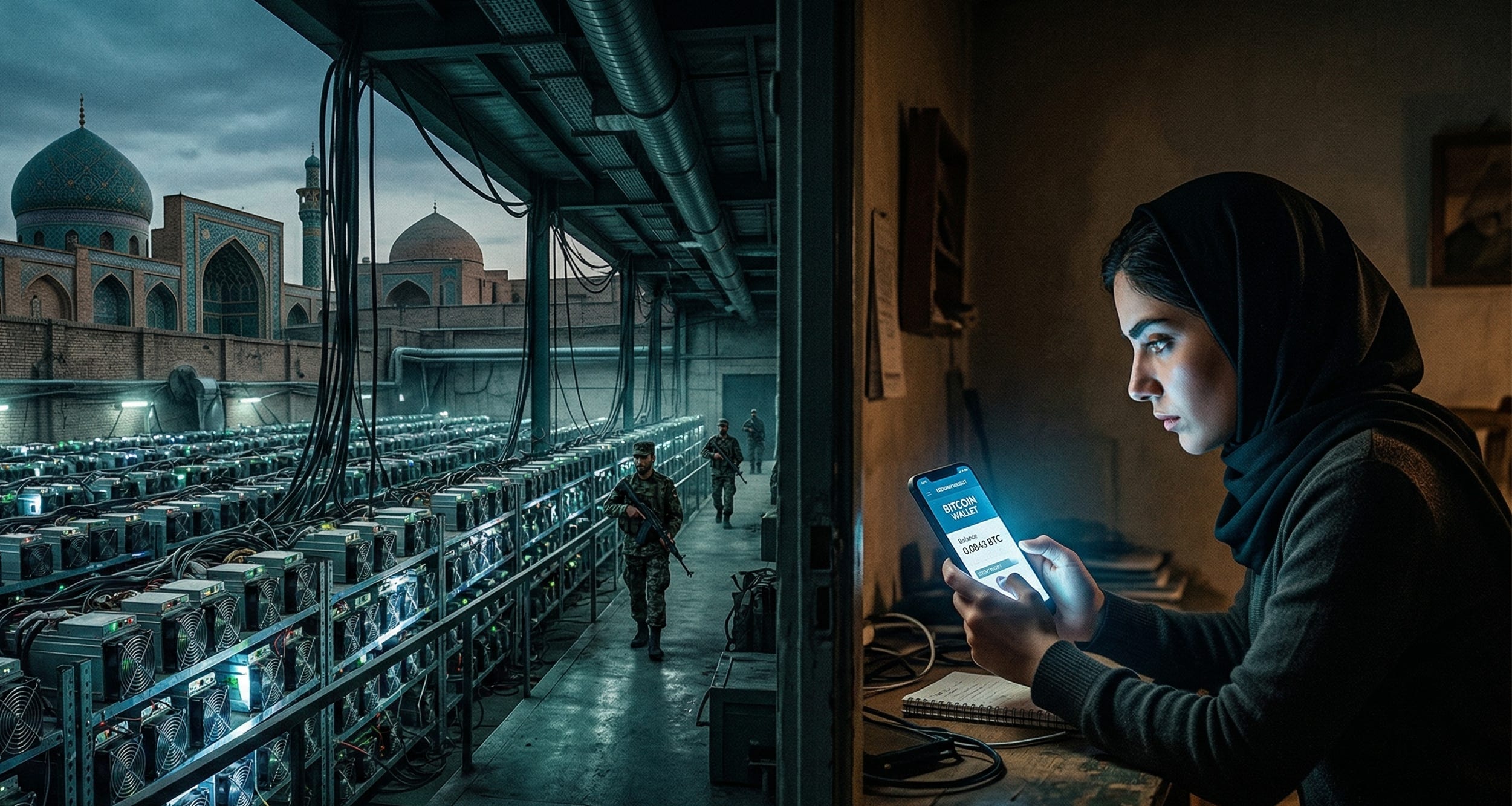
Iran has built over the years a $7.8 billion parallel economy using Bitcoin and other cryptocurrencies. It did so because American sanctions cut the country off from the international banking system and the regime needed an alternative to continue moving money.
The Revolutionary Guards have financed industrial-scale mining operations, exploiting state-subsidized energy to mine bitcoin and convert it into foreign currency. According to estimates, Iran represented between 2% and 5% of global hashrate before the conflict.
The Western narrative stopped here. Bitcoin is the bad guys’ tool. Iranians circumvent sanctions with cryptocurrencies. More regulation, more surveillance, more control. The argument is simple, linear and—as often happens with simple arguments—incomplete.
Because there’s another half of the story that few tell.
The Iranian rial went from 892,000 per dollar in February 2025 to 1.5 million in January 2026. Official inflation exceeded 42%, real inflation probably double. Food, medicine, basic necessities: everything costs more, every week.
In such a context, saving in rials equals watching your money evaporate. Iranian banks are under sanctions. International circuits—Visa, Mastercard, SWIFT—are inaccessible. Physical gold is difficult to transport and hide. Paper dollars circulate on the black market at prohibitive rates.
What’s left?
The pattern that Chainalysis documented is clear and repeated twice in a few months. During the December 2025 protests, withdrawals from Iranian exchanges to personal wallets grew steadily in the days preceding the January 8 internet blackout. They dropped to zero during the blackout. They resumed immediately after connectivity was restored. People were anticipating instability and moving to bitcoin while they could.
The same pattern repeated with the February airstrikes.
You need a phone, an internet connection, and the will to remove your savings from a collapsing system. Twelve words in your head—a seed phrase—and your money crosses any border, any blockade, any blackout.
Merve Pourkaz, a hairdresser from Golestan, traveled 1,500 kilometers to the Turkish border at Kapikoy after the bombings near her home. Hundreds of people cross that border every day. How many of them carry a seed phrase with them is impossible to know—the 329,000 refugees worldwide who have already used bitcoin to preserve their savings suggest the number is far from negligible.
There’s a point, however, that deserves honesty.
Iran suffered one of the most severe internet blackouts in modern history. Connectivity dropped to 4% on February 28. Over 360 hours without network access. The government seized Starlink antennas, jammed GPS signals to disrupt satellite connections, blocked access to sites through a whitelist system.
Does Bitcoin work without internet? Yes, but only if you’re prepared. Blockstream Satellite broadcasts blockchain blocks via satellite, allowing you to receive transactions without terrestrial connection. Machankura allows sending Lightning transactions via SMS. However, these are technologies that, while perfectly functional, are not yet accessible to most of the population.
In a country where the government can shut off the internet at will, Bitcoin remains an imperfect lifeline due to limited adoption (not its infrastructure). During the January blackout, withdrawal flows dropped to zero. People who hadn’t moved to self-custody before the blackout were left stranded.
Yet the Iranian government also shut off the internet to prevent communications, protest coordination, and news dissemination. The economic cost declared by the Minister of Communications was $35.7 million per day. A government that accepts burning $35 million a day to maintain control is implicitly admitting that its citizens’ digital tools—Bitcoin included—represent a threat to its authority.
And despite the effort, the shutdown was partial. Starlink connections continued to function despite the jamming, with an estimated packet loss of 30%. More than enough to get a Bitcoin transaction through.
Let’s return to the complete picture.
Iran uses Bitcoin to circumvent sanctions. Iranian civilians use Bitcoin to survive war and inflation. The same technology, the same network, the same protocol. Zero moral filters built into the code. Zero ethics committees deciding which transactions are legitimate and which aren’t.
Bitcoin ignores the war in Iran. It ignores the difference between a Revolutionary Guards payment and the desperate withdrawal of a hairdresser from Golestan. It ignores documents, identities, sanctions.
This neutrality is, for many, the problem. For those who think finance should be a tool of foreign policy—sanctions, embargoes, account freezing—a monetary system that ignores borders is a defective monetary system.
The same argument has been used against cash for decades. Criminals use cash, therefore cash must be eliminated. Traffickers use dollars, therefore large-denomination bills must be withdrawn. The reasoning has internal logic and leads to a single conclusion: a world where every transaction is visible, traceable, and censorable. A world where money is an extension of state power.
Iran demonstrates this in real time, from both sides of the conflict. The regime uses Bitcoin because the traditional banking system excluded it. Civilians use Bitcoin because their own country’s banking system is robbing them through inflation and capital controls.
Neither group chose Bitcoin for ideological reasons. They chose it because it works when everything else stops working.
The neutrality of a monetary good is the property that makes it money.
Those who want money that discriminates want a weapon, not money.
Morning Blend by Atlas21 is here!
Monday through Friday, at 07:00 sharp, the newsletter that tells you the most relevant news of the day on Bitcoin, technology, and finance. Subscribe for free here:
Write a comment