Between Lecture Halls and City Streets
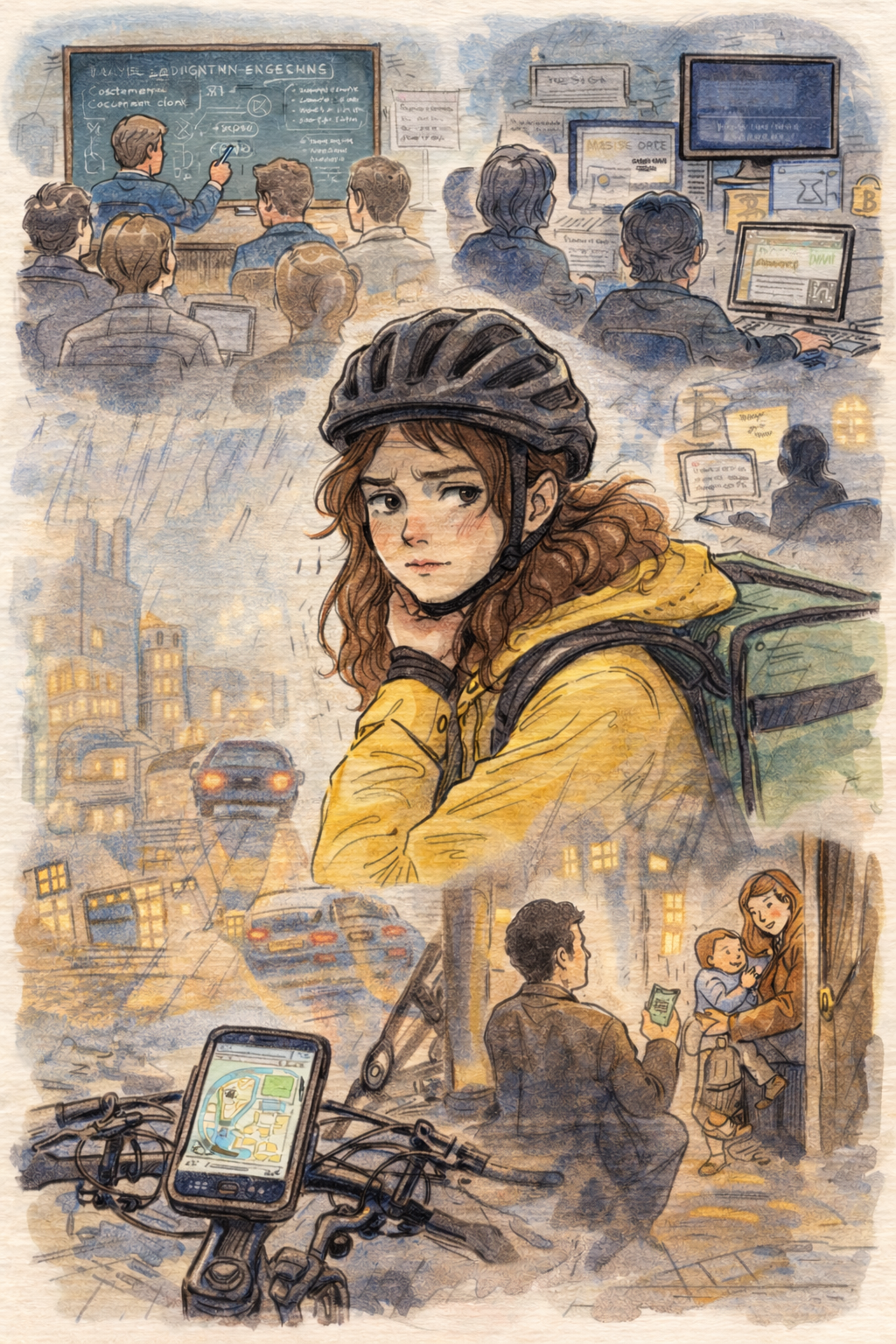
It was one of those nights where the rain isn’t dramatic enough to feel poetic, it’s just… constant. Not even heavy. Just thin needles of water that find every gap in your jacket and slowly convince your body that warmth is a rumor.
I was waiting at a red light, balancing the bike with one foot on the curb, the other clipped into the pedal like I’m pretending I’m in the Tour de France instead of delivering someone’s late-night ramen. My phone was strapped to the handlebars in its cheap plastic case, vibrating every few seconds like an anxious little pet. I could feel the app watching me. Not literally, but you know what I mean — that quiet pressure of being tracked, timed, evaluated.
And I was thinking about a bug.
Not the kind crawling up the streetlight pole. The kind I left in my code an hour earlier, back when I was still indoors, still “a computer science student” instead of “a wet person on a bicycle.”
There’s this moment that happens sometimes when I’m riding. My legs are burning and my hands are stiff and my brain suddenly decides: Now is the perfect time to solve something. Not at my desk with tea and a second monitor. No. Now. In the rain, at 1 a.m., while a car behind me honks because I’m not accelerating fast enough.
The bug was simple, too. One of those things that makes you want to throw your laptop out the window because it’s small and dumb and somehow has total control over your mood. A missing edge case. A little misbehaving loop. Earlier, I’d stared at it until my eyes got that dry-glassy feeling from the screen glare, and the imposter syndrome started doing its usual performance: Maybe you’re not actually good at this. Maybe you’re just stubborn.
But on the bike, with water dripping off my helmet into my eyes, I thought: Wait. If the state changes here, then the message gets sent twice. Like my brain had been quietly debugging in the background while my body did something else.
It’s funny how different kinds of exhaustion feel.
Mental exhaustion is like being wrapped in fog. Physical exhaustion is honest. Your thighs hurt because you used them. Your back aches because you carried a backpack full of drinks up five flights of stairs. It’s almost comforting, in a weird way. Like: okay, at least this pain has a clean explanation.
In computer science, the pain is more abstract. Sometimes I leave a lecture and I’m not sure if I learned something or if I just watched someone else be smart for ninety minutes.
I’m in my late twenties, which means I’m older than a lot of my classmates, but still somehow feel like I’m behind. Not behind in a measurable way — I don’t have a spreadsheet of my failures — but behind in that internal sense of everyone else having gotten a secret beginner’s guide to life.
And I’m also a woman, which is still a thing in computer science in a way I didn’t fully understand before I started.
I knew the statistics. I knew the “women in STEM” stuff. I knew the polite version of the story.
But living inside it is different. It’s small moments. Death by paper cuts.
Like being one of three women in a lecture hall of eighty people, and feeling your body become slightly more present because you’re aware of being visible. Like when the professor asks a question and the same three guys answer every time, fast and loud, and the rest of us disappear into our laptops. Like when you do answer and someone looks surprised — not impressed, not annoyed, just surprised, like you accidentally spoke in the wrong language.
Sometimes it’s not even something anyone says. It’s the little assumption hovering in the air: that you’re visiting. That you’re here temporarily. That the real builders are somewhere else.
And sometimes it is something someone says. A guy in my study group once explained Git to me like I was a lost tourist asking for directions. I didn’t even ask. He just saw my screen, saw the terminal, and his whole body went into “helper mode.”
I remember saying, “Yeah, I know,” probably too sharply. And then spending the next hour silently punishing myself for not being nicer about it.
That’s one of the weirdest parts. I can recognize the sexism, and still somehow I’m the one doing emotional cleanup afterward.
Meanwhile, on the bike, nobody cares if I understand Git. They care if their food is warm.
Delivery work has its own kind of gender stuff, but it’s different. Out there, I’m more like a moving object than a person. A cyclist in dark clothes. A reflective stripe. A backpack. People see me, but they don’t really see me.
Sometimes I deliver to these beautiful apartments with staircases that echo. The kind of place where the air smells like expensive candles. I stand there in my soaked jacket and dripping hair and I feel like a ghost that wandered in from a different layer of the city.
And then the door opens and someone takes the bag without looking at my face. “Danke.” The door closes. And that’s it. Two seconds of contact.
Other times it’s more human. A tired dad juggling a baby and a key. A student with wet socks too, smiling like we’re in the same club. Once, a woman opened the door and just went, “Oh my god, it’s awful out. Are you okay?” like she’d remembered I was a person. I almost laughed because it felt so unexpected. I said, “Yeah, I’m fine,” which was a lie, but a friendly one.
There’s a version of me that exists only in those doorways. A service. A function call. Input: money. Output: food.
And the whole thing is controlled by this app that pretends to be neutral. It assigns routes and times and priorities. It pushes me toward busy streets at the worst moments and then punishes me for being slow. It’s capitalism with a UI.
The irony is not subtle: I spend my days learning about distributed systems, about fault tolerance, about protocols and coordination and how centralized points of control become points of failure — and then I spend my nights literally being managed by a centralized algorithm that knows my location better than my friends do.
Sometimes, waiting outside a restaurant while the kitchen is behind schedule, I stare at the map on my phone and think about how much power is hidden inside “optimization.” Like, who decided what “efficient” means? Efficient for whom?
At university, “algorithm” is a clean word. It lives on whiteboards. It gets proven and analyzed and admired. On the street, it’s sweaty and impatient and slightly humiliating. It’s the thing that makes my phone buzz at the exact moment I finally take a sip of water. It’s the thing that sends me across town for a four-euro delivery because “demand.”
The lectures don’t talk much about that part. Or they do, but in a theoretical, distant way. Like ethics is a side quest.
I didn’t choose computer science because I wanted to be part of a shiny tech future. I chose it because the internet was the first place that ever felt like it belonged to everyone, and then I watched it get slowly fenced off.
I remember being younger and finding Linux forums where strangers would help you for free, just because knowledge was meant to move. I remember the first time I read about peer-to-peer networks and felt my brain light up — not because I understood everything, but because the idea was so… respectful. Like the system wasn’t built around one authority. Like it assumed people could be trusted to cooperate.
Now I’m on Nostr, which is messy and stubborn and sometimes full of questionable vibes, but also feels alive in a way most platforms don’t. People write like humans there. They argue like humans too. There’s no invisible feed ranking my thoughts. No “creator mode.” Just posts traveling between relays like little messages in bottles.
It’s not perfect. Nothing is. But I like that it doesn’t pretend to be my friend while also trying to monetize my attention.
And I think my delivery job is part of why decentralization matters to me more than it does to some of my classmates.
Because when you’ve been on the receiving end of “the system decided,” you start to hate that phrase.
When the app decides your shift. When rent decides your lifestyle. When the university decides whether you’re allowed to keep studying based on paperwork that nobody can explain. When some guy in a group project decides you’re the “documentation person” and not the “real coding person” and you don’t even notice it happening until later.
It’s not the same scale, obviously. But it’s the same feeling: being a node that doesn’t get a vote.
I don’t want to romanticize my situation. I’m not out here suffering heroically. I have privilege, too. I’m in higher education. I can read papers and complain about architectures and think about protocol design like it’s art. That’s a luxury. The fact that I can even spend time caring about decentralization is, in itself, a kind of privilege.
But it’s also a struggle that feels… thinly held together. Like if I get sick for a week, the whole thing wobbles. If my bike breaks, my income disappears. If I fail an exam, I lose a semester. There’s no buffer. There’s no graceful degradation.
Fault tolerance, but for humans. Still working on that.
Sometimes, I’m in a study group and someone makes a joke about “people who do unskilled work,” and I’m sitting there with bruises on my shins from slipping on wet tram tracks, thinking: you have no idea how skilled you get at not dying in traffic.
And also: you have no idea how much your systems depend on those workers you’re dismissing. Your food, your packages, your convenience. All delivered by people treated like temporary infrastructure.
It makes me see “users” differently, too. When professors talk about “the user,” it’s always abstract. A rectangle in a diagram. A persona. A stick figure.
But my users are real. They open the door in socks. They have tired eyes. They forget to write the correct address. They order ice cream in winter. They tip sometimes, and sometimes they don’t, and it’s hard not to read meaning into that even though I know it’s complicated.
And then I go home and I open my laptop and I’m building things for “users” again, except this time it’s a program, not a pizza, and the distance feels bigger.
I wish I could say there’s a clean connection between these two parts of my life. Like I’m learning valuable lessons on the bike that make me a better engineer, and my studies are empowering me to fight the gig economy from within, and everything is thematically aligned.
But mostly it’s just… my life.
Some days I feel strong. Like I can do this. Like I can be tired and still keep going. Like I’m allowed to take up space in computer science even if I’m not the loudest person in the room.
Other days, I feel stupid. I make a tiny mistake and it spirals into “maybe I don’t belong here.” I get mansplained something basic and it sticks under my skin longer than it should. I deliver food to someone in a warm apartment and feel this sharp, irrational anger at the whole setup.
And in the middle of all that, I still genuinely like computers. I like the feeling when something finally works. I like the elegance of a clean protocol. I like when a complicated idea clicks. I like being part of a community where people care about these things deeply, not because it’s trendy, but because it affects real freedom.
I just don’t want to have to become a different person to stay in it.
I don’t want to harden into someone who’s always performing competence. I don’t want to laugh off the weird comments and pretend I’m unaffected. I don’t want to be the “exception” or the “inspiration.” I want to be allowed to be average sometimes. To learn slowly. To ask questions without apologizing.
Tonight, after my last delivery, I carried my bike up the stairs and my legs were shaking in that satisfying way that means I actually did something physical. My room smelled like wet fabric and cheap chain lube. I peeled off my gloves and my fingers were wrinkled like I’d been swimming.
I opened my laptop anyway. The screen felt too bright, like it was judging me. I fixed the bug in ten minutes. Of course.
And for a second, I just sat there and watched the code compile, feeling this quiet mix of pride and annoyance. Pride because I solved it. Annoyance because I had doubted myself so hard earlier.
Maybe that’s the overlap between the lecture hall and the streets: both keep offering me reasons to doubt my place.
And I keep showing up anyway.
Not because I’m brave. Not because it’s a “journey.” Just because I’m here, and I want to understand the systems we’re living inside — the ones we write, and the ones that write us back.
Write a comment