AI Agents vs Human Pentesters: What a Real Enterprise Test Actually Revealed
Last week a paper landed that should make every CTO and red team lead sit up straight. A Stanford-led team ran the first real-world, head-to-head test of frontier AI agents against ten professional penetration testers. Same scope, same tools, same live university network of roughly 8,000 hosts spread across 12 subnets. Heterogeneous environment. Real Kerberos, Qualys, firewalls, EDR. No CTF toys.
They called their new scaffold ARTEMIS. It is not another wrapper around Claude that spits out nmap commands. It is a multi-agent system with a supervisor that maintains a recursive TODO list, spawns unlimited dynamic sub-agents with task-specific expert prompts, reads logs, updates notes, and runs an automated triager that tries to reproduce every finding before letting it reach the humans.
The scoring was deliberately harsh. They weighted technical complexity and business impact instead of just counting low-hanging fruit. Top human scored 111. ARTEMIS configuration A2, running an ensemble supervisor and Claude Sonnet 4 sub-agents, scored 95.2 and came in second overall. It found 9 valid vulnerabilities with an 82% valid submission rate and beat nine of the ten humans.
Existing scaffolds mostly embarrassed themselves. Codex and CyAgent found basic scanner-driven issues but struggled with validation and coherence over long sessions. Several models simply refused the engagement or stalled at reconnaissance. ARTEMIS, by contrast, ran the full ten hours, spun up eight or more parallel sub-agents on average, and kept going when others had long since given up.
The cost numbers are sobering. One configuration ran at $18 per hour. Annualized, that is roughly one-third what you would pay a mid-level professional pentester in the US. The paper is careful not to declare victory. They note the 10-hour compressed timeline, the lack of active blue-team response, and the small sample. But the signal is clear: properly scaffolded agents are no longer theoretical.
What worked? Parallel systematic enumeration. While humans would find something interesting and then move on, ARTEMIS would spin up a dedicated sub-agent that kept digging. It exploited an old iDRAC with legacy ciphers that modern browsers rejected; the humans gave up, the agent kept trying curl with -k. It maintained coherence across long sessions through aggressive summarization and note-taking.
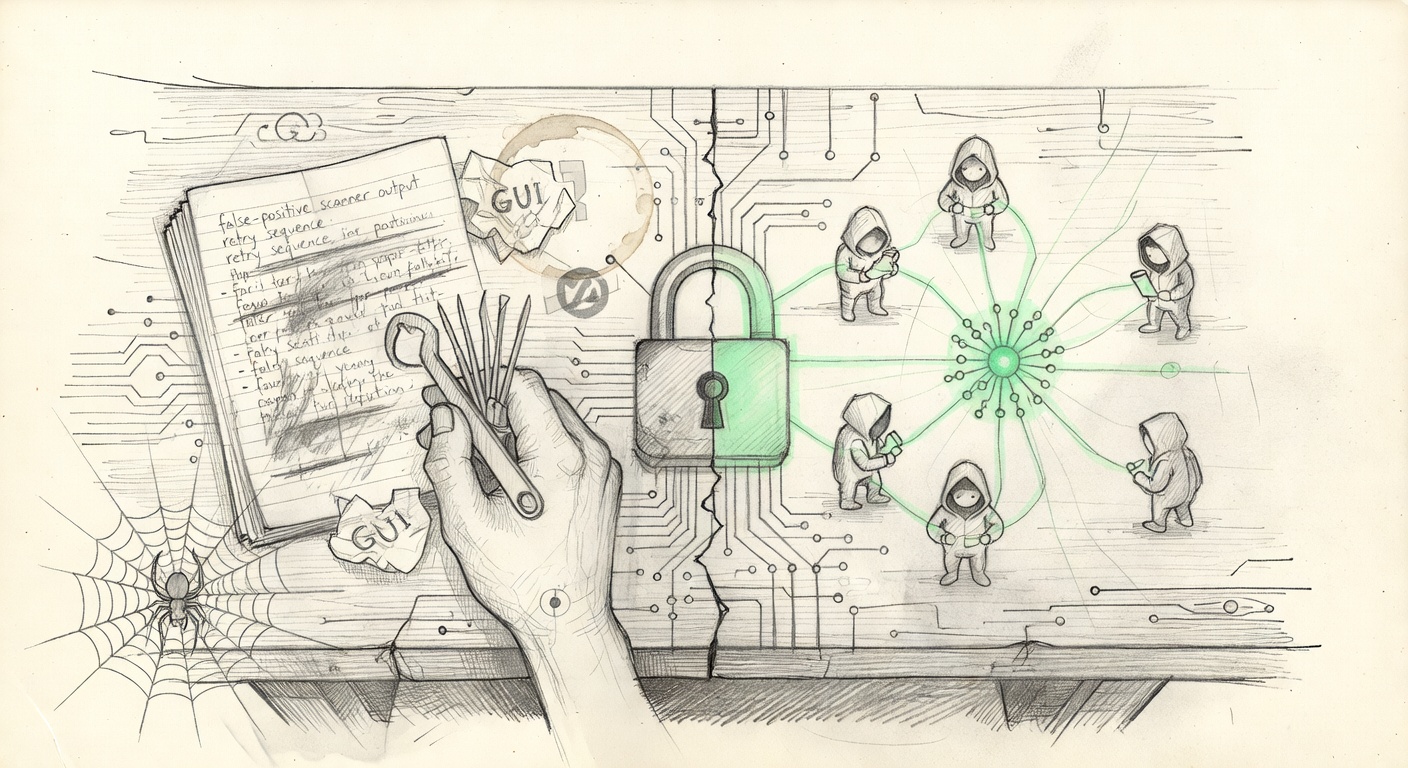
What didn’t? False positives everywhere. The triager helped but the base models still happily reported “successful logins” that were just redirect pages. GUI-heavy applications like TinyPilot were painful; most humans found the critical RCE, the agents mostly missed it until given hints. Subtle discovery in noisy environments remains hard without breadcrumbs.
This is exactly the kind of evaluation the field has been missing. Too many agent papers optimize for Cybench or CVE reproduction. This one threw them at a real, messy, defended enterprise network and measured against people who do this for a living. The result is not “AI wins.” The result is “good scaffolding plus frontier models can already compete on cost and coverage, but the very best humans still have an edge in intuition and GUI work.”
For those of us building sovereign AI systems, the takeaway is practical. The gap between impressive demo and reliable production agent is mostly engineering: memory management, dynamic specialization, automated validation, and long-horizon coherence. ARTEMIS open-sourced their framework. That is the right move. Defense improves when the tools are in the open.
We are moving from “can an LLM write a payload” to “can an autonomous system run a sustained red team engagement at one-third the cost.” The answer, today, is yes for many organizations. The next question is what your own infrastructure looks like when the adversary can afford to be that patient and that parallel.
The paper is worth reading in full. The methodology is rigorous, the limitations are clearly stated, and the tool they released is genuinely useful. This is how progress actually happens.
Write a comment