The Megawatt Doesn't Rebound
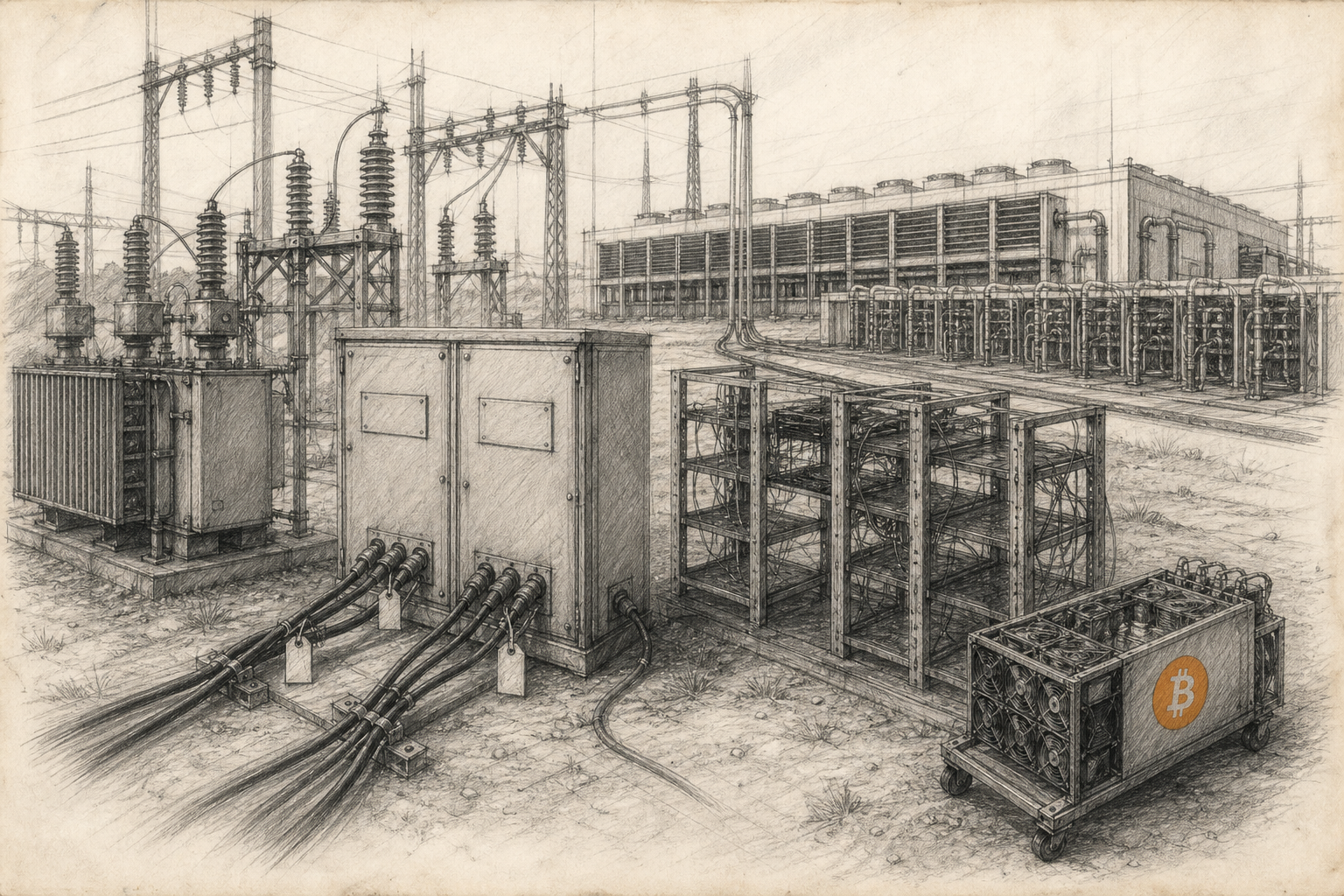
- The old reflex broke
- Spot hashprice met a lease
- Difficulty is not a recall button
- Score the bid stack, not the pivot narrative
The old reflex broke
For most of Bitcoin’s life, a rising price brought hashrate back. Idle machines turned on. Curtailed sites reopened. Difficulty climbed. The feedback loop was ugly, noisy, and reliable enough that operators treated it as physics.
That reflex is stalling. On the smoothed series most people use to declare records, network hashrate has spent hundreds of consecutive days beneath its late-2025 peak — roughly a 20% gap that has persisted through a rising coin price and repeated downward difficulty adjustments. Winter storms and summer curtailments still move the dial. They no longer explain the drought.
Something else is bidding for the same megawatt.
Spot hashprice met a lease
Public-miner disclosures make the substitution concrete. One large listed operator’s FY26 SEC filing shows installed mining capacity roughly halved year over year, with a plan to finish converting that data-center shell to AI cloud services by year-end. The same earnings cycle reported multi-billion annualized contracted AI revenue and hundreds of millions in non-cash impairments tied to decommissioned mining hardware.
Sector analysis of comparable public miners tells the same story in aggregate: tens of EH/s of realized hashrate shed in the first half of 2026, with HPC and AI revenue up sharply quarter to quarter — and, for the operators furthest into the pivot, AI or colo lines overtaking the mining revenue being wound down.
The interesting comparison is not “AI cloud vs ASIC” on a headline revenue chart. Full-stack GPU cloud can print several times mining revenue per megawatt-hour because it prices GPUs, networking, and utilization risk into the invoice. The sharper line is HPC colocation versus mining. Recent EnergyMag estimates put median recurring HPC colo near the same dollars-per-MWh band as a current-generation hydro ASIC’s mining revenue. Revenue density alone does not force the exit.
Duration does. Colocation and AI capacity agreements are generally contracted for years and often pass power costs through. Mining revenue reprices continuously with coin price, difficulty, and fees. A five-year hyperscaler or neocloud lease cannot be paused because hashprice recovered for a quarter. The megawatt is no longer an interruptible bidder. It is a booked tenant.
Difficulty is not a recall button
Difficulty still does its job. When capacity leaves, surviving miners get a softer target. Margins on the remaining fleet can improve even while total hashrate stays below its prior high. That is cold comfort if you are scoring network elasticity.
The historic loop assumed power and shells would return when the coin paid better. Contracted AI load breaks that assumption at the interconnection. The same site that used to curtail for grid stress or chase seasonal power now has a creditworthy tenant whose service-level agreement does not care that Bitcoin is up 30%. You can still mine elsewhere. You cannot teleport a multi-year leased megawatt back onto the timechain because the chart looks green.
For security absolutists, nine hundred-plus EH/s remains an extraordinary commitment. Absolute security and reflexive elasticity are different products. This week’s filings argue the second one is being sold off.
Score the bid stack, not the pivot narrative
The market story writes itself: “miners become AI companies.” Stock charts reward the rebrand. That sentence is true and almost useless for operators.
What changed is the bid stack for energized megawatts at sites that can host dense compute. Bitcoin used to win a lot of those auctions because it was the highest-paying interruptible load — the customer that could unplug overnight. AI wins a different auction: highest-paying committed load with multi-year cash flows and pass-through power. When those two auctions compete for the same transformer, the interruptible bidder loses even if spot hashprice looks fine on a spreadsheet.
Ask blunt questions of any miner-turned-host narrative. How many megawatts are under contracts that cannot be interrupted for mining without breaking an MSA? What share of FY capacity is still ASIC-optional versus lease-locked? If coin price doubles next month, which sites can actually return hashrate in weeks rather than in a press release?
Price can still rally. Difficulty can still adjust. The megawatt that signed a five-year AI lease does not rebound on command. Treat that as infrastructure fact, not as a culture-war about which compute is more virtuous.
Write a comment