The Programmed End of Cash : Towards a Society Under Total Control?

- 1. Crises as Pretexts for Expanded Surveillance
- 2. The Risks of a Cashless World: Control and the End of Sovereignty
- 3. Toward a Techno-Totalitarian Future: Social Credit, European Edition
- 4. Cash Is Not Just Money—It’s a Line of Defense
- 5. Bitcoin: Your Freedom Insurance Policy
- 6. You Don’t Have Much Time Left
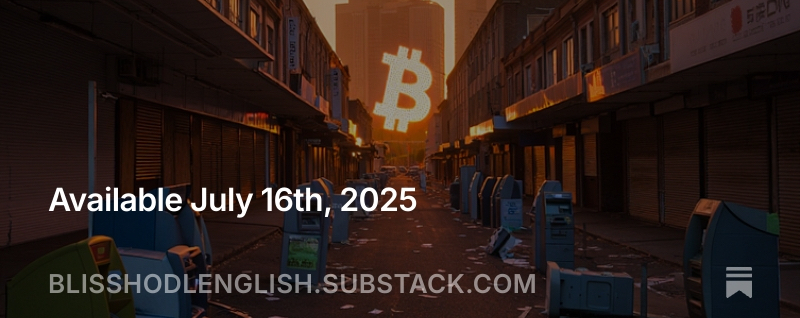 I want to draw your attention to an imminent danger: the elimination of physical cash in favor of a so-called “digital euro.”
Of course, it’s being sold to us as progress. Faster. Safer. More modern. But behind the shiny facade hides something much more insidious: a shift from a society built on individual freedom to one where everything must be authorized, traced, and controlled. The disappearance of cash is not just a technical change—it’s a shift in power, one that threatens to lead us directly into a techno-authoritarian society. One where something like China’s social credit system could be adapted, quietly, to the European context. And once you grasp this, you may feel the urge to speak up. Because the time to act is now.
You’ve probably already noticed: paying in cash is becoming harder and harder. ATMs are disappearing. Some merchants reject cash altogether. And of course, they tell you it’s for your own good—greater efficiency, more security. But let’s be honest: we’re partly to blame too. Out of habit, convenience, or complacency, we’ve slowly abandoned physical money. But the real question is: why the rush to kill cash? And in whose name?
This shift is anything but organic. It’s being pushed, actively, by institutions. What’s being framed as a “technological advancement” is in fact a radical reordering of power—one that could make your financial autonomy conditional, revocable… or completely illusory.
1. Crises as Pretexts for Expanded Surveillance
It’s an old playbook. Governments exploit crises to push through liberty-crushing policies.
During the pandemic, entire healthy populations were locked down instead of focusing protection on the vulnerable. To fight crime, authorities rolled out real-time surveillance cameras powered by algorithmic tracking, instead of fixing a broken justice system or targeting actual criminals. Under the guise of “protecting children,” they now want access to everyone’s private messages—erasing privacy for the innocent.
Each time, the pattern repeats: a real crisis is used as cover for disproportionate responses that increase surveillance and shrink personal freedom.
Now imagine a world where every exchange, every transaction, is meticulously logged. You grab a coffee? It’s recorded. Lend a friend €10? Tracked. Buy a book that questions the dominant narrative? Logged. Book a trip to the “wrong” country? Flagged.
This isn’t conspiracy talk. I can already hear the fact-checkers gearing up. But it’s reality. Just look at China, where cash has nearly vanished, replaced by apps like WeChat Pay or Alipay, tightly integrated with the social credit system. Spend too much on video games or non-eco products? Your score drops. And with a low score, you’re denied trains, planes, jobs—you name it.
Think it’s just China? Think again.
The European Union is developing the digital euro. Sweden nearly went fully cashless before backtracking with a 2020 law requiring banks and shops to accept physical money again. Why? Because they realized how dangerous exclusion and overreach could become.
Even in Switzerland, there’s a movement to enshrine cash in the constitution—to guarantee it remains legal tender.
2. The Risks of a Cashless World: Control and the End of Sovereignty
Countries that still allow cash understand a fundamental truth: eliminating it gives governments and banks enormous power.
Then there’s an even more dystopian twist: programmable money—money that expires if you don’t spend it within a set time. Your salary? Gone in an instant if you don’t comply. The end of savings. The end of private property.
Imagine a “green” government that blocks meat or fuel purchases. Or a hygienic regime that dictates your diet. Your money—their rules.
This strikes at the heart of it all: the end of ownership.
In a world without cash, you no longer own your money. You need permission to spend. You must justify your choices. Individual sovereignty dies—following the national sovereignty that’s already long gone.
Who wins? Not you. Not your children.
Those who benefit are the unelected private interests—central banks, politicians, global corporations—that control the pipes of the system.
With a Central Bank Digital Currency (CBDC), everything is centralized. Every payment can be taxed, frozen, or reversed. Your purchasing power shrinks, while their control grows.
Sound familiar? It should.
As the World Economic Forum put it: “You will own nothing. And you will be happy.” (Except you won’t have a choice.)
3. Toward a Techno-Totalitarian Future: Social Credit, European Edition
This is the real danger: a techno-totalitarian society built on surveillance and “behavior-based access.”
Gérald Darmanin, French Interior Minister, openly praised Asia’s systems in 2025 as a model to follow.
These tools—cash removal, transaction tracing, programmable money—are the infrastructure of full-spectrum control.
Soon, every purchase, movement, and expression could be scored.
Buy too much meat? Lose points. Criticize policy online? Lose points. Fail to meet eco or health standards? Locked out of services.
In China, this system already paralyzes millions of lives. Europe might dress it up differently, but the result will be the same: a society where freedom is contingent on obedience.
QR codes during lockdowns, predictive cameras, banned encryption, canceled access—this is not a future scenario. It’s the ongoing construction of a digital prison.
And the majority—those without digital literacy or “freedom tech”—will be trapped inside.
4. Cash Is Not Just Money—It’s a Line of Defense
The end of cash isn’t about convenience—it’s the final domino in the collapse of personal freedom. No anonymity. No breathing room. Once it’s gone, there’s no going back.
Just remember the massive outage that hit Spain and Portugal: for hours, cards and apps were down. No food, no water, no purchases.
Now imagine the same during a cyberattack. Banks targeted. Systems offline. You’re cut off—and cashless. You’re helpless.
Criminals will adapt. They already use alternatives: P2P crypto over mesh networks, bartering, gold, foreign currencies.
But ordinary citizens—reliant on Visa cards and checking accounts—will be left exposed, naked before a fragile, centralized system.
And what about the forgotten ones? Seniors, the poor, rural communities? For them, cash is lifeline. A human connection. A vital tool.
Taking that away is not modernization—it’s marginalization.
Give a coin to someone in the street. Hand a bill to a local vendor. These are real acts. Simple. Human. Killing cash severs these ties and accelerates exclusion.
5. Bitcoin: Your Freedom Insurance Policy
“What we need is an electronic payment system based on cryptographic proof instead of trust, allowing two parties to transact directly without a trusted third party.” — Bitcoin: A Peer-to-Peer Electronic Cash System (2008)
So what does Bitcoin have to do with cash?
On the surface, nothing. One jingles in your pocket, the other lives on a digital ledger. But they share a common enemy: total control.
Bitcoin is not just a tech fad or a speculative asset. It’s a lifeboat in a world where every transaction is meant to be traceable, programmable… and stoppable at will.
Bitcoin was designed for this moment.
It doesn’t just protect your savings from inflation and theft—it gives you a way to exit. Exit the sinking ship that is the European economic Titanic.
More than that, Bitcoin is resistance—a safeguard against the authoritarian creep of state-controlled digital currencies.
Here’s why:
-
Decentralization: No central bank. No government control. No one to block your transaction or freeze your account.
-
Pseudonymity: Unlike CBDCs tied to your digital identity, Bitcoin allows privacy—if you take the time to learn and use it properly.
-
Self-custody: No authority can seize your Bitcoin if you hold your own keys.
-
Fixed supply: Bitcoin is capped at 21 million. No hidden inflation. No political manipulation.
-
Borderless: Bitcoin works anywhere. No matter what your country says or bans.
-
Censorship resistance: Bitcoin can be sent via satellite, Tor, radio waves, or mesh networks—even under authoritarian firewalls.
In short, Bitcoin is monetary self-defense—an escape hatch from a system that wants to own you.
It defends your time, your energy, your children’s future—and your right to be free.
Those who continue to work for fiat, a currency created out of nothing by a corrupt elite, are choosing voluntary servitude. They are being robbed—quietly—of their time, their labor, and their freedom.
6. You Don’t Have Much Time Left
The window is closing.
To all my friends and early readers: what you do now will define your future.
By 2030—likely sooner—the shift will be irreversible.
While most people are distracted by news, panic, and falling living standards, billionaires are already buying billions in Bitcoin. Institutions and nation-states are entering the game. The supply shock will be brutal—and prices will explode beyond comprehension.
If you still have time for Netflix or doom-scrolling online, you have time to learn Bitcoin. One or two hours of focused learning could change your life, and your family’s life, for generations.
If you ignore this, don’t complain later about the outcome. Because it won’t be fate. It will be a consequence of your choice.
There is still a way out. But it’s not forever.
The fiat system is a scam. A Ponzi. The masks are falling.
Gold is rising. But Bitcoin is rising faster—and it’s built for this century. Gold belonged to the past. Bitcoin is the future.
There will be no slow adoption. Just panic. FOMO. Scramble.
The wealthy are already moving. The data is clear. Governments are quietly preparing for the end of fiat. Some are resisting. Others are accumulating. But Bitcoin cannot be stopped. Censored. Or controlled.
If that doesn’t terrify you, it should. Because it means time is running out.
Those who sit on the sidelines now may end up with nothing later. Working harder than ever for a tiny slice of Bitcoin—while they could have claimed it freely, today.
Because one day soon, everyone will use Bitcoin. And they’ll look back, in disbelief, at how blind we were during the 2020s—when the greatest wealth transfer in history happened… in plain sight.
Do your own research.
Don’t just take my word for it. Don’t believe the economists who dismiss Bitcoin while clinging to the very system it will replace. And don’t blindly follow maximalists like me either.
Study it. Understand it. Decide for yourself.
“Bitcoin is like discovering the rarest digital land known to man—before the world realizes what it really is.”
— Jack Mallers
**
Sources & inspiration**: Tony Yazbeck, Béatrice Rosen
Write a comment