Incandescent vs LED Lights (Everything You Need to Know)

- Intro
- OVERVIEW
- Incandescent vs LED fundamentals
- Light Spectrum (Incandescent vs LEDs)
- Color temperature
- Light uniformity + distribution + aesthetic
- The Solution
Intro
Incandescent lights are all the rage right now. Every time I post or see a post about them, it goes viral. They seem to be the nostalgic knight in shining (gold) armor that is fighting back against the harsh, overstimulating world of cold LED lighting. The Anti-LED movement is equally as viral albeit our lives are pretty much entirely centered around this form of lighting.

[](https://substackcdn.com/image/fetch/\)s_!UqqZ!,f_auto,q_auto:good,fl_progressive:steep/https%3A%2F%2Fsubstack-post-media.s3.amazonaws.com%2Fpublic%2Fimages%2Fc0d4c361-39c2-4382-baae-679e056ceb71_468x800.png)
Many are fervent supporters of filament bulbs making a comeback, but others…not so much. They state that incandescents are “bad for the environment”, a “waste of energy”, “have no health benefits”, “a safety hazard” and that LEDs are clearly the best lighting choice. I was even recently interviewed by a “Climate Reporter” from Yale about the environmental impact of incandescents (more on this later).
Thanks for reading Decentralized Health! Subscribe for free to receive new posts and support my work.
And then there are the regulations…are incandescent lights actually banned? Did Trump reverse the Department of Energy (DOE) lumen/watt energy efficiency standards for general purpose lighting? How can you buy some incandescents at hardware stores but not others? The short answer is…it’s complicated but no President Trump did not reverse the DOE regulation standard of 45 lumen/watt.
It’s time to unpack all of the details as to why I believe incandescent bulbs are far superior to LED lighting, especially for nighttime use cases.
OVERVIEW
-
Incandescent vs LED fundamentals
-
Light spectrum (infrared light)
-
Color temperature
-
Flicker
-
Light uniformity + distribution
-
Energy efficiency & Regulations
Incandescent vs LED fundamentals
Incandescent = a tungsten filament bulb that uses AC electricity to heat up 2000-3000K (that’s hot!) and emits light as a result of that. It’s basically an electrochemical fire housed in a glass bulb, and that bulb envelope also contains an inert gas (typically argon) to keep oxidation from occurring. This radiates a smooth “blackbody-like” spectrum that is mostly infrared light with a bit of visible output (10:1 ratio). The filament also has thermal inertia, so it doesn’t instantaneously switch on and off electrically the way electronics do, which smooths a lot of the AC grid’s ripple and is part of why incandescent light feels so steady and calm at night (low flicker).
LED = light emitting diode. Not a heater, but rather a semiconductor photon machine. Current crosses a p–n junction, electrons drop an energy level, and that energy is emitted as photons (electroluminescence). Each color of an LED is tied to the bandgap of the material. Then LED colors are mixed to produce more colors, such as white light. White LEDs are usually a blue LED plus a phosphor that converts some of that blue into a broader yellow/green/red blend that your eye perceives as white. Because LEDs are electronic devices, they need a driver to turn household AC into something the diode can use, and depending on design (cheap drivers, rectification ripple, PWM dimming), this where the light output can get modulated heavily or “flicker”.
Incandescent = analog, primitive, old school, classic
LED = digital, new age, innovative
Light Spectrum (Incandescent vs LEDs)
In my opinion the most important difference between an incandescent bulb (or any filament bulb) and an LED is the actual light spectrum that they emit. There are many types of LEDs at various color temperatures, but we can break them down into two main buckets: warm white LEDs + cold white LEDs. Incandescents also vary slightly in color temperature, but for the most part their light spectrum is pretty consistent.
You can see the spectrum comparisons of warm and cold LEDs below. Cold white LEDs have that horrendous blue peak around 450-460nm which is a major problem for cellular health, because it is not balanced by any red or infrared light. Isolated blue light can damage eye health, mitochondrial function, and if exposed to at nighttime severely disrupt your circadian rhythm. Warm white LEDs do not have as much of a blue light hazard relatively, but they are still very much absent in biologically important near infrared light. If you want an in depth rundown on blue light, read this article I wrote.

(PS - sunlight is >50% near infrared light from an energy perspective and >70% from a photonic perspective. Modern windows that are low-emissivity also filter out infrared light).

Now enter incandescent lights. All incandescents are actually predominantly infrared light (that healing good stuff). Mainstream will say this is what makes them inefficient, but that I’d say that is what makes them so good for us. The warm incandescents (\~2100K) that I use and we sell at [Daylight Labs](http://daylightcomputer.com/labs) are actually nearly identical in light spectrum to a candle. The only difference is that a candle has a slightly warmer color temp (\~1900K). This is why I firmly believe that warm incandescents at low wattage (25-40W) are the absolute best light for nighttime use - because it is an electric fire. And there is something about staring into a fire before bed that just hits different sleep quality.

If you look at a drawn out light spectrum reading, typically incandescents actually peak in the 1100-1200nm range and emit energy all the way out to 3000nm. Most of the positive research done on infrared light is done on wavelengths <1100nm for red light therapy or photobiomodulation effects. Let me be clear in saying that incandescents are not emitting intensities strong enough for photobiomodulation effects, but that does not mean these wavelengths are any less beneficial (remember this is what we are deficient in from lack of sunlight). Research is just beginning to start on longer wavelengths out to \~2000nm, but I expect a lot more positive benefits to be uncovered in this range in years to come. The absolutely legendary Dr. Gerald Pollack found in his research (and later wrote about in his hallmark book The 4th Phase of Water) that infrared light, specifically “mid infrared” 2000-3000nm expanded the charge separation of water to the greatest degree…also known as “charging the water battery”. (See plot below).
[](https://substackcdn.com/image/fetch/\)s_!EgR0!,f_auto,q_auto:good,fl_progressive:steep/https%3A%2F%2Fsubstack-post-media.s3.amazonaws.com%2Fpublic%2Fimages%2Fa0d037ef-aac6-4a76-b2d7-b713a5c4685b_1456x830.png)

Dr. Gerald Pollack’s Research on Light Wavelengths Impact on Exclusion Zone (EZ) Water
Color temperature
Color temperature (CCT) is another great way to understand the differences between various light sources.
The sun (our goal to emulate) starts and ends extremely warm (~2000K) and can peak at temperatures above 6000K at mid day. The cyclicality of this light is very important. During the day we want bright and full spectrum light to match the sun, and at night we want as warm and dim as possible. In other words, bright days and dark nights. Today we have quite the opposite, relatively. The typical cold LED can reach the desired color temperature of sunlight, but it lacks the red + infrared to balance it out…thus causing cellular and metabolic strain (this is one reason why you feel drained after sitting inside under LED lighting all day).
For daytime lighting a higher color temperature filament bulb is the best option. Traditional incandescents typically cap out at 2700K, but halogen bulbs (also filament based) are typically 3000K and can be found as higher as 3300K. I genuinely believe a high lumen halogen work light such as this is the current best option for indoor lighting during the day. That is because it is infrared rich, and if you are near windows you will be getting extra visible to balance out the spectrum to become even more full.

[](https://substackcdn.com/image/fetch/\)s_!crSJ!,f_auto,q_auto:good,fl_progressive:steep/https%3A%2F%2Fsubstack-post-media.s3.amazonaws.com%2Fpublic%2Fimages%2Ff9a69710-8646-487f-afab-3f231960786a_1024x288.png)
At nighttime, the goal is simple: match a candle or campfire light spectrum because that is the only light outside of the moon we used after dark for thousands of years and it is the least stimulating to our circadian rhythm (warm, dim, low to the ground). Good news - a warm incandescent light is nearly identical to a candle. Candles are typically ~1900K and you can find warm incandescents around ~2100K pretty readily. I am actually working on a “deep amber tint” incandescent that will be ~1800-1900K to match a candle light spectrum identically. Low wattage 25-40W max is also the key.

What about amber or red LEDs?! I thought that is what all the biohackers and circadian bros use at night time because they have zero blue light! Incandescents are not blue light free!
→ In short…these LEDs contain zero infrared (so not as cozy, warm, relaxing to our nervous system).
→ Incandescents are not blue light free, but neither is a candle or a campfire…and it doesn’t actually matter as much as the blue light blocking companies will tell you. What matters for melatonin suppression is a combination of light intensity AND the color spectrum. The melanopic lux of a 2000K incandescent is negligible if at low brightness, that is why you need to opt for low wattage filament bulbs.
→ Red LEDs in my opinion are a disservice to the ambiance, aesthetic and safety of an indoor room. Your eyes cannot see red as a color very well, so in turn you have to have “more light intensity” to see the same clarity. This can be seen on the V-Lambda curves below. This is why an ultra dim candle can appear so bright at night, because it in fact does have a tiny bit of blue + green.
[](https://substackcdn.com/image/fetch/\)s_!WNgX!,f_auto,q_auto:good,fl_progressive:steep/https%3A%2F%2Fsubstack-post-media.s3.amazonaws.com%2Fpublic%2Fimages%2F90be1997-b545-4ff4-982f-423bc4b2b95e_2268x2268.png)
Red LED spectrometer reading

Rod vs Cone Sensitivity Chart (almost no sensitivity to red light!)
In summary: use higher CCT and wattage incandescents or halogen bulbs during the day for a more full spectrum yet still infrared rich lighting option. At nighttime, opt for [ultra warm incandescent bulbs that are <=40W](http://daylightcomputer.com/labs). High CCT LEDs (4000K+) can be more aligned to the sun from a temperature perspective, but the lack of red+infrared makes them unbearable to our body for a long period of time. When you can’t avoid them, try to opt for warm LEDs. Overall, there is no “perfect” daytime light solution (unlike nighttime).
### Flicker
Light flicker, also known as light modulation may be the most underdiscussed and unnecessary stressor to our biology…specifically to our eyes, brain, and nervous system. It is something that I firmly believe is a main reason why everyone is so “on edge” and has a hyper-activated nervous system.
Light flicker is the formal definition for inconsistent or oscillating light output. Imagine a light strobing, but it is happening at a rate just above your visual perception. You can take a slow motion video of the lights in your house and see exactly this phenomenon. The reason why this occurs is in lighting predominantly due to our AC power grid. The 60Hz, 120V power generates light flicker at a frequency of 120Hz (2x cycle), which is just above our visual perception level of around 60-90Hz. (Hz = cycles per second aka your lights are flickering 120 times per second).
Most LEDs flicker far worse than filament bulbs such as incandescents, and this is a major reason for concern, especially in night time use cases (when you want your body to be as relaxed as possible). Not only do LEDs flicker due to the AC power grid, but they also flicker because they use Pulse Width Modulation (PWM) LED drivers. This means in order to control brightness, instead of just putting less current through the diode they instead turn on/off at a lesser rate → light flicker.
[Read far more about light flicker and how your screens are the worst offenders here.](https://daylightcomputer.com/blog/screen-flicker-101)
LEDs flicker worse than incandescents because:
1. They do not have a “thermal inertia” like an incandescent does.
1. Filaments are not electronics based, they are purely heating elements and thus take time to heat up → this naturally blunts the effect of the AC power on light flicker output.
2. They typically contain cheap electrical components, leading to a high amount of 120Hz ripple and thus light output.
1. Cheap red/amber LEDs from my measurement showed 10x flicker index readings compared to our Daylight incandescent (40+% vs 4%).
3. They can use Pulse Width Modulation (PWM) for dimming circuits - adding in even more flicker at high frequencies.
1. These are especially prevalent in smart dimmable bulbs + LED strip lighting.
[](https://substackcdn.com/image/fetch/\)s_!TmF0!,f_auto,q_auto:good,fl_progressive:steep/https%3A%2F%2Fsubstack-post-media.s3.amazonaws.com%2Fpublic%2Fimages%2F91b276a9-8e2c-4ed3-9486-eb2738150aa0_1242x1657.png)
Incandescent Flicker Measurement

Red LED flicker measurement
[](https://substackcdn.com/image/fetch/\)s_!3-uz!,f_auto,q_auto:good,fl_progressive:steep/https%3A%2F%2Fsubstack-post-media.s3.amazonaws.com%2Fpublic%2Fimages%2F6a5c22c4-d7ef-4c15-9d12-cafba10a563e_1148x1530.png)
Red LED light modulation reading
Light uniformity + distribution + aesthetic
Another lesser known downside to LEDs (for general lighting purposes) is the way they actually distribute light. Most light sources that we have used throughout history are known as “point sources” of light…meaning they emit light very uniformly - in a spherical manner. LEDs are not point sources, but rather surface light sources - and they do not emit light uniformly. LEDs emit light more so in a bullet pattern, very directed light output away in the direction of its surface at <120 degree beam angle.

Many modern bulbs add diffuse covers to improve the light output to become more omnidirectional, but for applications such as car headlights and streetlights this is not the case at all. This is another reason (along with the high blue peak), that LED headlights + streetlights are so glaring to the eye…because they are emitting way more energy directly into your retina instead of uniformly disbursing the light such as halogen (what cars used to use) and high pressure sodium aka HPS (what street lights used to be).

LEDs are also just simply not aesthetic. Light is beautiful when it comes in a whole, natural form. Think of the draw of a burning beeswax candle or campfire…or a beam of sunlight through a forest. An incandescent filament in the edison style is also aesthetically pleasing, and captures the eye in a way that an LED could never. It may be the red+infrared glow that relaxes our nervous system, but it is also important that we **see** the light source. Most LEDs are kept under cheap plastic bulb covers to improve light diffusion (to better match an incandescent omnidirectional output), and if they are exposed then the LED light bar is highly directional and certainly not aesthetically pleasing to look at.
### Energy Efficiency + Regulations
The main reason we have switched to LED lights is due to energy efficiency reasons. LEDs are certainly more energy efficient from the technical definition - having the ability to output much higher lumens (visible brightness) per watt (of electrical power). Around 5-6x higher lumen/watt than a standard incandescent bulb. The problem here is that the definition of “efficiency” is simply not taking into account the importance of infrared light. The Department of Energy sees it as “waste”, but our biology begs to differ and so does the sun (50+% infrared light).
Mark Baker from the [Soft Lights foundation](https://www.softlights.org/) argues that you cannot make a claim of “a more energy efficient replacement” unless the functionality is equivalent. Seeing as the light spectrum, flicker, and light distribution of an LED is not equivalent to a filament or HPS light…it cannot be a more “energy efficient” solution.
Nevertheless, LEDs are now the mainstay. In 2011, they comprised 1% of the general purpose lighting market to 47% in 2019 and now in 2024 roughly 70% of lighting revenue was LEDs. The rush for energy efficiency has come and conquered, with pressure from organizations like the DOE and Energy Star. Now we have bright, highly efficient lights all day and night long. So bright in fact, that a study published in [***Science***](https://www.science.org/doi/10.1126/science.abq7781) reported that from 2011 to 2022 the brightness of our night sky on average got \~9.6% brighter every single year. This means the total sky brightness more than doubled in a decade…goodbye any chance of stargazing unless you live in the absolute sticks.
Have we actually saved any energy moving to LEDs? There is a phenomenon known as the ***rebound effect*** or Jevons’ Paradox that states when something becomes more “efficient”, it never actually saves us energy because we end up using way more of it. This is certainly the case with LED lights. We are using more of them, and the night time brightness is skyrocketing as a result of this switch, but they are saving energy. There was a \~53% reduction in total TWh for lighting in the US for commercial + residential applications from 2010 to 2020. Not all of this can be directly attributed to LEDs, some optimization has come from sensors/less operating hours and other fixture changes, but it would be fair to say at least 75+% of this is because of this switch to LEDs. The real question is - at what cost?
[](https://substackcdn.com/image/fetch/\)s_!Gc1X!,f_auto,q_auto:good,fl_progressive:steep/https%3A%2F%2Fsubstack-post-media.s3.amazonaws.com%2Fpublic%2Fimages%2Fdd1cbf07-19b6-41d4-a168-b61d95b77e06_1812x470.png)
Are incandescents actually illegal? Yes (but there are caveats). Any lighting product marketed for “general purpose lighting” that does not reach the 45 lumen/watt energy efficiency standard set by the DOE is prohibited for sale in the United States. This went into effect in July 2023 and it still stands firm today. No, President Trump has not reversed this law. The Trump administration did prevent it from going into effect earlier in 2017, however. The work around is that many bulbs can be sold for “specific applications” or “decorative purposes”. That is why you can find incandescents and halogens at your hardware store still, and that is how we can sell Daylight incandescents as well…because they are Edison style - thus “decorative” :)
Unfortunately, the requirements are only going to get worse…as the Biden administration pushed to further tighten efficiency standards to an even higher absurd minimum of 120 lumens/watt in 2028. However the Trump administration has stated they would push to postpone this date. Regardless if in 2028, 2030 or some other year…it seems inevitable we will be heading in this direction.
The Solution
With the inevitable increasing energy efficiency standards, cost of energy, and a greater fight against filament bulbs…what is the real solution here?
Few things come to mind:
-
Filament bulbs (incandescent, halogens) are worth the energetic cost due to their high infrared content.
-
Warm infrared light = one of the largest nutrient deficiencies in modern society.
-
This doesn’t mean we need to use them everywhere. We should invest into longer lasting filament bulbs to increase their longevity.
-
A warm, low wattage incandescent is 100% the best nighttime bulb and could likely last 5k+ hours.
-
Halogens during the day are a good way to get tons of infrared at higher color temperatures (halogens also have a longer lifetime than incandescent bulbs).
-
When temperatures are <70 degrees → energetic cost is even more justified.
-
-
We need to put infrared into LEDs. Then people need to buy them.
-
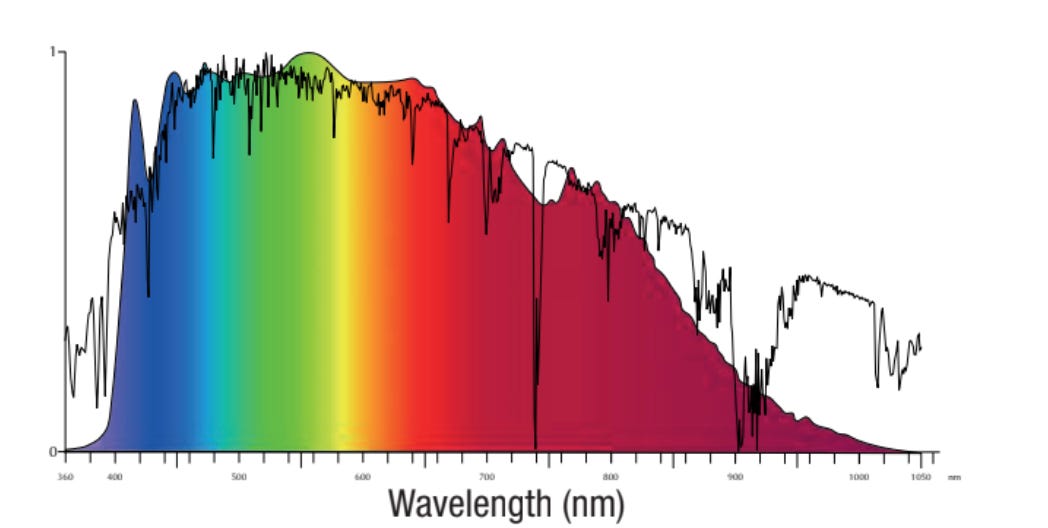
New LEDs that have a light emission in the NIR range (750-900nm) already exist and I have already been in discussion with them. Bringing lighting products to market with infrared spectrum LEDs will be a big win. (see below)
-
They will be expensive products at first because production of these LEDs are low → that is where early support is critical.
-
Demand for true full spectrum (high CRI visible + NIR) will be the only way to bring costs down, and that comes with spreading the education on the importance of infrared light.
-
A small amount of infrared 750-900nm in LEDs does not “replace” what we miss out from sunlight + filament bulbs however - so this is NOT a complete solution.
-
-
Explore hybrid lighting setups (LED + filaments).
-
Develop lighting solutions that have both filaments (incandescent/halogen) AND LEDs at the bulb/product level. This already exists with a couple products, but doesn’t output much at the filament level to make a meaningful difference in my opinion. Costs are also very high because this is totally custom.
-
Use combinations of LED (ideally with infrared) + filament lighting solutions. There is no reason why you can’t have one lamp as an LED, one as a halogen to get the best of both worlds. Now scale that to commercial level or have in the same fixture and we can make some progress.
-
-
Utilize natural light to a far higher degree.
-
How much energy do we waste by simply not utilizing the light that already exists thanks to the Sun? We need better environmental design to take in far more outdoor light → indoors.
-
Stop utilizing low E glass windows that filter out UVA + IR light, especially in places that are not boiling hot most of the year.
-
-
Use less light at night.
- The simplest solution to making “incandescents” a non problem for energy is by using less light at night. It’s better for our health and better for our fragile energy generation infrastructure.
The big piece here of course will be education surrounding the importance of our light environment. We can build better solutions from an engineering perspective if the prioritization is present. Right now, the disconnect between engineering and our biology is vast. I personally intend to change that with my work at Daylight Computer + Daylight Labs. I am actively working on points 1 through 3 above, and we are selling what is in my opinion the best nighttime light bulb already: a low wattage, ultra warm incandescent bulb.
I deeply believe that warmth is the biggest deficiency in our society today. Cold, blue dominant energy is the mainstay and that needs to change. LEDs are a main driver to that issue, and incandescents are a solution. Filaments are not perfect, but going purely off of feel I’d say the positive ambiance an incandescent brings is worth the knock on energy consumption. Some things are worth spending energy on.
Sources
-
<<https://www.energy.gov/sites/default/files/2024-08/ssl-lmc2020_apr24.pdf>>
-
<<https://policysearch.ama-assn.org/policyfinder/detail/H-135.927?uri=%2FAMADoc%2FHOD-135.927.xml>>
-
<<https://www.energy.gov/eere/ssl/articles/flicker-understanding-new-ieee-recommended-practice>>
-
<<https://www2.hawaii.edu/~dennis/GeoBook/chapter_2/sunlight.htm>>
Thanks for reading Decentralized Health! Subscribe for free to receive new posts and support my work.
Write a comment