Nuclear Pulse — October 25, 2026

Nuclear Pulse — October 25, 2026
Covering: October 19–25, 2026 | Published: October 25, 2026
The Brief
The NRC finalised a rule that lets applicants reuse data from federal demonstration reactors, its first major licensing change under the fast-review order.
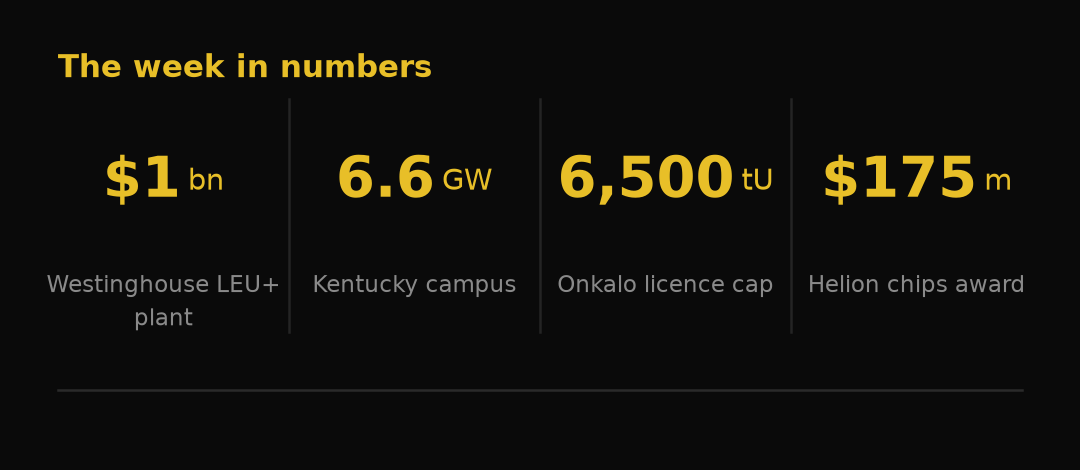
Westinghouse will spend $1 billion on a South Carolina plant to make higher-enriched LEU+ fuel for the operating fleet.
The IAEA told the UN General Assembly that nuclear capacity could more than triple by 2060, its sixth upward revision in a row.
Spot uranium ended the week near $90 a pound, flat again, while the September term price held at $96.50.
Watch whether Hungary’s audit of Paks II ends with Rosatom replaced as main contractor.
Geopolitical & Strategic Analysis
Two sellers of reactors spent the week defending their positions, and twelve governments argued that a nuclear site should be off limits in war.
Iran and eleven other countries put a joint statement to the UN General Assembly’s First Committee on Friday (4). The signatories were Belarus, Burkina Faso, China, Cuba, Eritrea, Iran, Nicaragua, Niger, Pakistan, Russia, Tajikistan and Zimbabwe (4). The text says nuclear facilities should never, under any circumstances, be attacked or threatened with attack (4). The countries said such attacks violate the UN Charter, international law and the IAEA statute (4). The group warned that silence in the face of such attacks risks normalising them (4).
Hungary is auditing the contract that supplies most of its future generation. Reuters reported that Budapest has begun sounding out alternative suppliers to Rosatom for Paks II (6). The expansion rests on a 2014 agreement to build two VVER-1200 units, financed largely by a €10 billion Russian state loan (6). Europe’s highest court annulled the European Commission’s state-aid approval for the project in September 2025 (6). Rosatom said on Friday that it hoped Hungary would keep it as main contractor and that it respected the government’s right to decide (5).
Rosatom meanwhile kept building where its position is not in question. Two small reactors are under construction at Jizzakh in Uzbekistan, with first concrete poured in May and the foundation slab due for completion this year (9). Two 1,000 MW units are planned beside them, and Alexei Likhachev said engineering surveys are under way ahead of full-scale work next year (9).
Turkey showed how open the competition has become. Mark Carney said AtkinsRéalis is in the running to help build the country’s third plant, over which Ankara has also talked to Russia, China, South Korea and Japan (7). He said a decision could come before the end of the year (7).
Brussels is writing the rule that decides who may supply Europe, and Seoul objects to it. Korea’s trade minister told his Czech counterpart that the EU Industrial Accelerator Act would restrict non-EU participation in the European nuclear market too sharply (8). He argued that the EU’s own supply chain cannot deliver its build programme without partners that have one (8).
Rafael Grossi put the demand case to the same General Assembly committee. He said nuclear capacity could more than triple by 2060, driven by electrification, AI data centres and technology companies’ appetite for firm clean power (3). More than 400 reactors in more than 30 countries produced about a tenth of global electricity in 2025, he said (3).
Regional Developments
Three regions produced firm news, and the common thread was fuel supply and licensing rather than steel in the ground.
North America
Indiana became the centre of two large proposals in one week. AEP, Amazon and X-energy are evaluating twelve 80 MW Xe-100 units at the former Breed generating station site in Sullivan County (11). Amazon would fund development and buy the output under a long-term agreement meant to cover the plant’s costs (11). The Nuclear Company proposed a 6.6 GW campus in Lewis County, Kentucky, with construction targeted for 2028 and two AP1000s in the first phase (13). Hoosier Energy and AtkinsRéalis signed a memorandum to evaluate a 6 GW Candu programme in the state (12).
The Navy put a reactor on its own property. Radiant’s Kaleidos will be installed at Naval Support Activity Crane, the first shore-based micromodular reactor for the service and the first power-producing reactor in Indiana (14). Each unit delivers 1 MW for up to five years before refuelling across a 20-year life (14). Radiant is now the only company selected by the Army, the Air Force and the Navy (14).
Europe
Finland’s repository became the first in the world to hold an operating licence. The government granted Posiva a licence covering 6,500 tonnes of used fuel from Olkiluoto and Loviisa, about 3,300 canisters (15). Disposal is planned at up to 60 canisters a year and is expected to run into the 2120s (15). Posiva may not start operating before the STUK regulator completes its pre-commissioning inspection (15).
Britain’s BWRX-300 programme found an operator. SGE SMR UK and Origin Nuclear, owned by Ontario Power Generation, will form a UK operating company for a planned fleet of 14 units across three sites (16).
Two studies mapped the industrial base underneath the build-out. Rotterdam’s port authority and regional bodies found 92 companies in the region that could serve an SMR supply chain, with the best opportunities in non-nuclear components and services (17). Slovenia weighed deep borehole disposal for the 84 fuel elements in its TRIGA II research reactor, at about EUR65.6 million as a standalone facility (18).
Asia
Southeast Asia moved from target-setting to programme-building. The Philippines’ energy secretary said peak demand has reached 20.1 GW against 32.5 GW of installed capacity, with net imports at 51.5 percent of primary energy supply (19). An IEA analyst told an ASEAN meeting that meeting national targets would add about 30 GW of nuclear capacity by 2050 (20).
Middle East & Africa
The UAE published the verdict on its own incident response. An IAEA team of six experts visited Barakah at the UAE’s request after a drone strike in May cut off-site power to unit 3 and set a generator outside the inner perimeter on fire (10). The mission credited the fast restoration of off-site power and recommended stronger emergency arrangements and more resilient critical infrastructure (10).
South Africa’s fuel venture became binding. Necsa and Quantum Leap Energy signed a heads of agreement giving the US company about 80 percent of a HALEU joint venture at Pelindaba (21). Quantum Leap has already secured offtake from TerraPower for the fuel the venture is meant to make (21).
Technology & Innovation
The week’s technology news was about the inputs to a reactor programme: a licensing shortcut, a fuel, and a machine small enough to truck to a base.
The NRC’s final rule lets applicants submit analyses, test data and technical information generated by demonstration projects at the energy and defence departments (1). It is the first major change to the agency’s reactor regulations finalised under the executive order that set an 18-month target for design approvals (1). The rule takes effect 30 days after publication in the Federal Register (1). Chairman Ho Nieh said it is “not a shortcut, this is not a compromise” (1). Edwin Lyman of the Union of Concerned Scientists said the NRC must keep making its own safety and security findings instead of following other agencies (1).
Westinghouse put $1 billion behind the fuel that uprates depend on. It will build a purpose-designed LEU+ plant next to its Columbia facility in South Carolina, because the 1968 plant cannot make the higher-enrichment product as configured (2). LEU+ is enriched above the 5 percent limit of standard fuel, and lead assemblies were loaded into Vogtle 2 last year (2). The Department of Energy’s UPRISE programme targets 5 GW of uprates across the existing fleet by 2029 (2).
Radiant’s Kaleidos is the machine the military wants first. It is factory-built, needs no cooling water and no major excavation, and requires no extensive site construction (14). It is being tested at the Idaho National Laboratory’s DOME facility, where the company has a full year of exclusive access (14).
Fusion Research
Fusion’s binding constraint this week looked like power electronics and national strategy, not plasma physics.
Helion signed a letter of intent for a $175 million federal semiconductor award, to be matched by $50 million of private money (24). The power electronics in its machines lose 5 to 10 percent of the electricity passing through them, and that loss compounds in a system that recirculates its own power (24). Halving it would roughly double the plant’s output, according to chief executive David Kirtley (24). The company is racing to finish its first plant, Orion, against a 2028 deadline to supply Microsoft (24).
Israel’s energy ministry published a strategic report that puts a price on joining the industry. It set out three options, from 50 million to 100 million shekels for academic work up to 1 billion to 2 billion shekels for a national ecosystem that could include an experimental reactor (25). The report counts more than $14 billion of private fusion investment since 2021 (25). It expects first commercial plants to connect to grids in the 2030s and a market worth hundreds of billions (25).
A MIT spinout showed the cheap end of the hardware curve. Cambridge Heavy Industries raised $6.2 million to build a benchtop laser fusion machine that reached 350 gigapascals, roughly the pressure at the centre of the Earth, using tens of millijoules (26). Its first products will be tritium, which it says sells for about $33 million a kilogram (26). The small scale allows weekly testing rather than years-long campaigns (26).
Market & Economic Intelligence
The metal did nothing this week; the companies that dig it and the funds that hold it did slightly less.
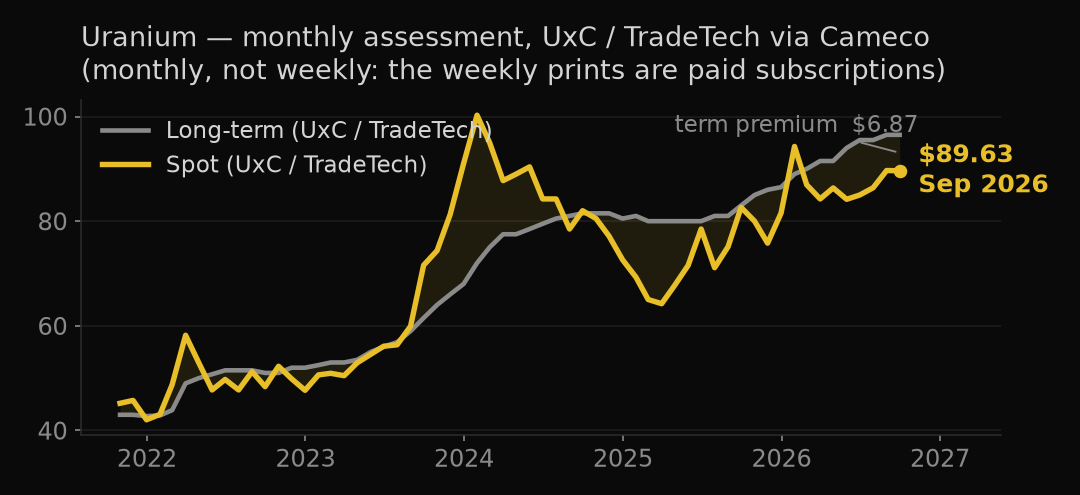
Spot uranium was $90.05 a pound on Thursday, down 0.11 percent on the day and 0.56 percent higher over the month (29). It had closed at $89.90 the previous Friday, the third week without a move of more than 20 cents (31). On those prints the week was flat. Cameco’s month-end series closed September at $89.63 spot and $96.50 long term (28).
The largest physical holder traded below the metal it owns. Sprott’s trust held 81,697,348 pounds and priced at $18.55 a unit against a net asset value of $21.56, a discount of 13.95 percent (27).
Producers added pounds into that flat price. Bannerman and CNNC took a final investment decision on Etango in Namibia, committing about USD353 million of pre-production capital for 3.5 million pounds a year (23). Aura’s bankable study for Tiris in Mauritania uses USD90.00 per pound as its base case and still returns a net present value of USD500.3 million (22).
The next large mine is being held back rather than pushed forward. NexGen’s Rook I in Saskatchewan carries a C$2.2 billion price tag, first production around 2030 and capacity of up to 30 million pounds a year (30). Its commercial chief, Travis McPherson, said prices remain too low to pay for the production a supply deficit needs (30). The company is keeping contracts short so it can sell at delivery prices instead of locking in today’s print (30).
Sources
- WHBL/Reuters, “US nuclear power regulator allows applicants to include data from agency projects” (October 22, 2026)
- World Nuclear News, “Westinghouse invests USD1 billion in US LEU+ fuel plant” (October 21, 2026)
- The Hindu/AP, “Nuclear power could more than triple by 2060, UN agency says” (October 23, 2026)
- Iran International, “Iran, Russia, China among 12 states condemning attacks on nuclear facilities” (October 24, 2026)
- MarketScreener/Reuters, “Russia’s Rosatom says it hopes Hungary decides to stick with it on nuclear plant project” (October 23, 2026)
- Hungarian Conservative, “Hungary Could Drop Rosatom from Paks II Expansion in Major Break with Moscow” (October 22, 2026)
- The Express Tribune/Reuters, “Carney says AtkinsRealis is a contender to build nuclear power plant in Turkiye” (October 23, 2026)
- World Nuclear News, “Korean concern over proposed ‘Made in EU’ act’s impact on nuclear power projects” (October 20, 2026)
- World Nuclear News, “Rosatom eyes 2027 for Uzbek large reactor construction” (October 23, 2026)
- World Nuclear News, “IAEA says Barakah drone-strike response was effective” (October 21, 2026)
- World Nuclear News, “AEP, Amazon and X-energy planning 12-SMR plant” (October 19, 2026)
- World Nuclear News, “Indiana considering 6 GW Candu nuclear project” (October 20, 2026)
- World Nuclear News, “The Nuclear Company proposes 6.6 GW Kentucky project” (October 21, 2026)
- World Nuclear News, “Radiant microreactor selected for deployment by US Navy” (October 22, 2026)
- World Nuclear News, “Posiva given go-ahead to operate Finnish used fuel repository” (October 23, 2026)
- World Nuclear News, “OPG firm joins UK BWRX-300 project” (October 22, 2026)
- World Nuclear News, “SMRs could be part of Port of Rotterdam’s future, says study” (October 22, 2026)
- World Nuclear News, “Slovenia’s deep borehole disposal options studied” (October 23, 2026)
- World Nuclear News, “Philippines advances plans for nuclear power as energy demand rises” (October 20, 2026)
- World Nuclear News, “ASEAN nations assessing nuclear energy option” (October 21, 2026)
- World Nuclear News, “Joint venture to produce HALEU in South Africa” (October 19, 2026)
- World Nuclear News, “Aura aims for final investment decision on Mauritania project this year” (October 20, 2026)
- World Nuclear News, “FID sees Etango enter full-scale construction” (October 23, 2026)
- TechCrunch, “Fusion startup Helion is developing new semiconductors that could double output of its power plants” (October 22, 2026)
- Ynetnews, “Israel weighs nuclear fusion push as AI power demand soars” (October 22, 2026)
- ESG Today, “Cambridge Heavy Industries Raises $6.2 Million to Build Mini Fusion Reactors” (October 23, 2026)
- Sprott, “Sprott Physical Uranium Trust pricing and net asset value” (October 23, 2026)
- Axis Intelligence, “Uranium Price 2026: Spot at $89.63, Term at a Record $96.50, and the Repricing Gap Utilities Still Owe” (October 2, 2026)
- Trading Economics, “Trading Economics” (October 23, 2026)
- Kitco Mining, “Uranium prices remain too low as NexGen advances Rook I” (October 23, 2026)
- Uranium Unleashed, “The Long-Term Price Hits an 18-Year High. Uranium Equities Are Acting Like It Didn’t.” (October 18, 2026)
Write a comment