Nuclear Pulse — November 1, 2026

Nuclear Pulse — November 1, 2026
Covering: October 25–November 1, 2026 | Published: November 1, 2026
The Brief
Russia used the Russia-Africa Summit to attach Rosatom to a 2,000 MW plant in Ghana and to talks with four African governments.
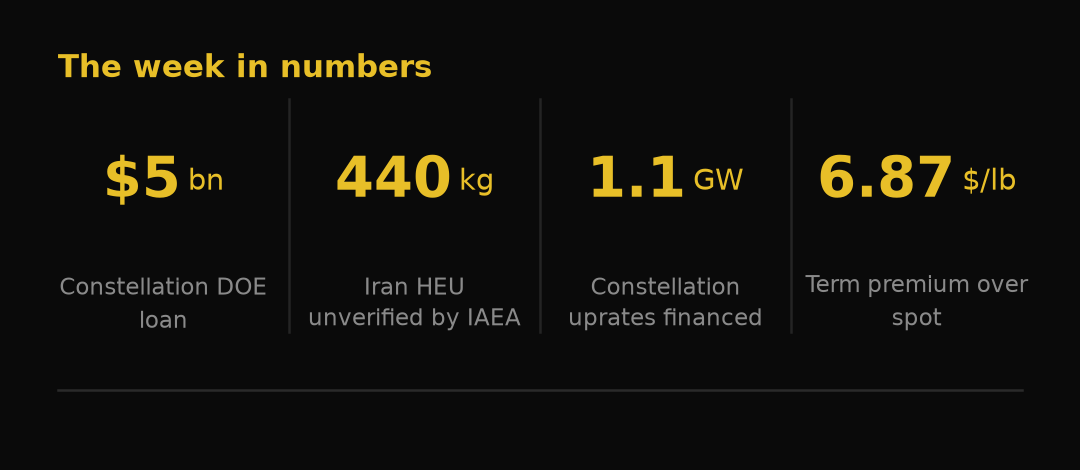
The IAEA told the Security Council it still cannot verify 440 kg of Iran’s highly enriched uranium, as Iranian lawmakers press to leave the NPT.
Both threads converge: reactor exports and safeguards verification are now one negotiation, run by the same supplier states.
Spot uranium closed at $91.41 a pound on Friday, up 1.55 percent on the week, while the September term price held at $96.50.
Watch whether Ghana’s announcement becomes a signed contract, and whether Rosatom survives Hungary’s Paks review.
Geopolitical & Strategic Analysis
Russia spent the week converting a summit into a pipeline, and the buyers were governments that have never operated a reactor.
Ghana’s foreign minister, Samuel Okudzeto Ablakwa, said on Saturday that Russia had agreed to work with Ghana on a 2,000 MW nuclear plant after talks at the Russia-Africa Summit (1). He said the project aims at energy security and industrialisation, and that the two countries also signed a defence pact (1). The announcement came one day after Rosatom’s chief executive named the countries in play.
Alexei Likhachev said Rosatom is discussing large plants with Uganda, Ghana, Ethiopia and Egypt (2). No construction contracts, financing packages or commissioning schedules were announced for any of the four (3). Uganda signed a roadmap creating a working group for possible surveys at Nakasongola, a site separate from Buyende, where Korea Hydro & Nuclear Power is evaluating ground (3). Ethiopia’s roadmap was signed earlier this year, and Egypt is weighing two more reactors at El Dabaa beyond the four under construction (3).
What Moscow is selling is a package rather than a machine: fuel, financing, operators and lifetime service, priced over decades. What it buys is a client relationship that outlasts the government that signed it.
Nine African countries have now expressed interest in Rosatom’s floating units, with detailed talks under way with Egypt, Tanzania, Togo and Namibia (2). A floating plant needs no site, no grid backbone and no domestic regulator with a reactor chapter, which is why it is the entry product and the large plant is the follow-on sale.
Safeguards moved on a separate track and in the opposite direction. Rafael Grossi told the Security Council on Tuesday that the IAEA still cannot verify that Iran has not diverted safeguarded material, including 440 kg of highly enriched uranium (4). The outstanding issues have run more than five years, and inspectors left in June 2025 (4).
Iranian legislators now argue the treaty itself is the problem. Mahmoud Nabavian called for withdrawal from the NPT and a change of nuclear doctrine, and Ebrahim Rezaei said ten such proposals had been registered in parliament (5). Withdrawal would not by itself produce a weapon, and the government’s stated position is unchanged (5).
Europe’s largest plant paid for the war again. A drone attack on Thursday killed a welder in the central repair workshop at Zaporizhzhia, and Grossi said attacks on plant personnel violate the agency’s seven safety pillars (6). The IAEA did not say who launched it (6).
Regional Developments
Regulators and utilities on three continents moved this week, and the cheapest capacity on offer came from plants that already exist.
North America
The Energy Department’s Office of Energy Dominance Financing issued a conditional loan commitment of up to $5 billion to Constellation for uprates and modernisation in Illinois, Maryland and Pennsylvania (7). The work adds nearly 1.1 GW, enough power for more than 930,000 homes, and supports more than 10,000 project jobs (7). Constellation said 20-year agreements with Google and Amazon had already justified more than $7 billion for about 1,080 MW of added capacity (8).
The same fleet’s operating company disclosed a security failure, not a safety one. STP Nuclear Operating notified Texas that a breach had exposed names, Social Security numbers and dates of birth for nearly 1,200 Texans, and the NRC said the South Texas plant continues to operate safely (9).
Europe
Korea Hydro & Nuclear Power ended negotiations with the Daewoo and Doosan consortium for the Czech units after the two sides failed to agree how construction risk is priced (10). KHNP wanted a lump sum against quantities fixed at basic design, while the consortium wanted payment on detailed-design quantities (10). A replacement contractor is to be chosen by July 2027, with full construction from November 2029 and completion in 2039 and 2040 (10).
Hungary asked parliament to make legally binding the civil nuclear agreement it signed with Washington in February, which covers small modular reactors and points new projects toward US suppliers (11). The government still expects to decide on the Paks expansion, and on whether Rosatom stays, late this year or early in 2027 (11).
Romania’s Cernavoda remains offline for a reason no licensing reform addresses. Unit 1 shut on 28 July and unit 2 on 12 August, when the Danube fell to 182 centimetres against the 185 the plant needs (12). The intake basin has recovered about 10 centimetres but remains below the reconnection threshold (12).
Asia
China poured first concrete for the nuclear island of Haiyang unit 5 on Saturday, opening Phase III of a site planned for six units (13). The country has 120 units operating or approved, 135 GW in total, of which 64 are operating (13). Industry forecasts put China first in operating capacity before 2030 (13).
Bangladesh’s regulator approved power start-up at Rooppur unit 1, a commissioning stage that precedes grid synchronisation and commercial operation (14). Taiwan’s semiconductor association formally backed the government’s assessment of restarting nuclear plants, and its chairman, a TSMC senior vice president, cited the need for stable supply (15).
Kazakhstan’s president asked for Balkhash construction to begin next year and for a comprehensive agreement to speed Moiynkum (16). Kassym-Jomart Tokayev also proposed a state strategic uranium reserve sized to fuel the fleet for a century (16). He put the question in fifty-year terms rather than trading ones (16). Euronews reported the same address as a call to accelerate both plants (17).
Technology & Innovation
Three of the week’s milestones were about the parts that let a reactor design be built more than once.
Centrus shipped the first centrifuge manufactured at Oak Ridge to Piketon for final assembly, an early physical step in an expansion that will add cascades for HALEU and low-enriched feed (18). The company holds a $900 million task order that reaches $1.07 billion with options, and expects 1,000 construction jobs and 300 operating jobs in Ohio (18).
Doosan Enerbility will fabricate the upper reactor coolant system for NuScale’s power module at Changwon, moving the partnership from material preparation to reactor components (19). Framatome opened a €30 million chromium-coating pilot at Paimboeuf with capacity above 100,000 tubes a year, targeting industrial qualification by late 2026 and production in early 2027 (20).
ARPA-E selected eight projects to make reactor fuel from transuranic material recovered from weapons production, with up to $50 million and a target of qualifying new fuel in under seven years rather than a decade (21).
Fusion Research
Fusion’s constraint this week was the equipment that keeps a plasma running, not the plasma itself.
A General Atomics team led by Jeff Lestz demonstrated helicon current drive at megawatt scale, showing that radio waves steered around the torus were absorbed in the plasma core and drove current there (22). The magnetic field restructured faster than with comparable microwave heating, the signature of current driven without the central solenoid (22).
Commerce signed letters of intent for federally funded semiconductor research, including up to $85 million for Commonwealth Fusion Systems to develop radio-frequency heating components, power electronics and radiation-hardened controllers for its tokamaks (23).
India’s first private fusion company put a date on its next machine. Pranos Fusion has built PRAGYA, a small tokamak for testing plasma control and superconducting magnets, and expects the PRANIK design to be final in 2027 on $7.2 million raised (24).
Market & Economic Intelligence
Spot moved up while the companies that produce the metal moved down, and the gap between the two prices stayed the story.
The spot price was $91.41 a pound on Friday, up 1.55 percent on the week (25).
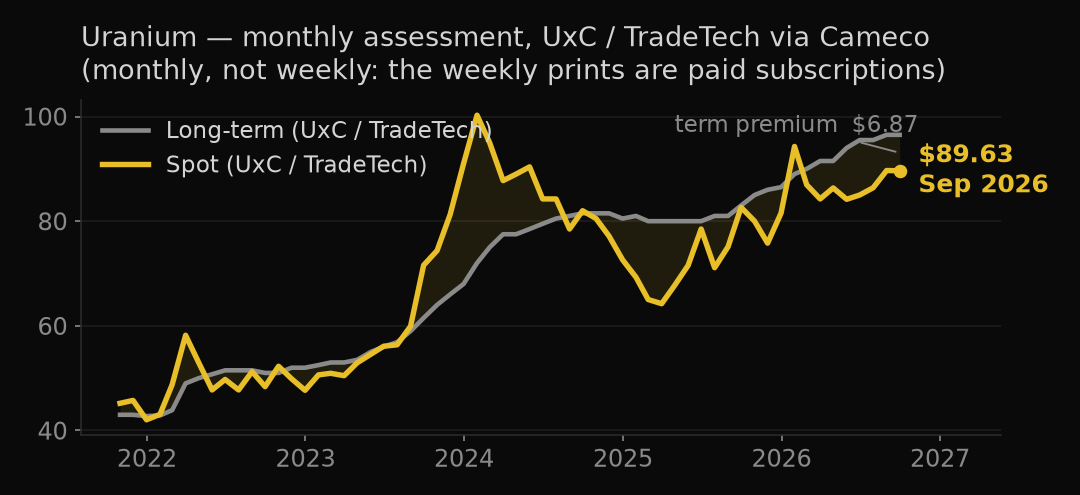
Cameco’s month-end series still shows September, at $89.63 spot and a record $96.50 long-term, a premium of $6.87 (26). Cameco reported third-quarter net earnings of $43 million, an adjusted net loss of $2 million and adjusted EBITDA of $267 million, and narrowed 2026 production guidance to 19.5 million to 20.5 million pounds (27).
The equities told a different story. Sprott called the selloff a liquidity shock rather than a broken thesis (28). On Discovery Alert’s reading, the Global X Uranium ETF is about 42 percent below its January high and Sprott’s own miners fund is roughly 52 percent off peak (26). The physical trust’s discount to net asset value sits near a historical extreme (28). Kitco published the same argument as a commentary on Friday, attributing the fall to deleveraging and pressure on high-beta small caps (30).
Supply did not loosen. Discovery Alert put the spot range at $89.74 to $90.25 a pound in late October, below where it finished the week (26). Kazatomprom’s sulphuric acid costs rose 38.7 percent year on year, and its acid plant has slipped into a window between the third quarter of 2027 and the first quarter of 2028 (26). The World Nuclear Association sees a 335 million pound primary deficit by 2040 even if mine output more than triples, and enrichment has reached $190 per separative work unit (29).
Sources
- US News/Reuters, “Ghana says Russia to back 2,000 MW nuclear plant, deepen ties” (October 31, 2026)
- MarketScreener/Reuters, “Russia in talks with four African states on large nuclear power plants, Rosatom says” (October 30, 2026)
- bne IntelliNews, “Rosatom discusses nuclear power projects with Uganda, Ghana, Ethiopia and Egypt” (October 31, 2026)
- Arab News, “No sign Iran is rebuilding nuclear sites but 440 kg of uranium unaccounted for, UN watchdog says” (October 27, 2026)
- Al Jazeera, “Iran lawmakers call for withdrawal from NPT: Will we have war or peace?” (October 31, 2026)
- Kyiv Independent, “Drone attack reportedly kills worker at Russian-occupied Zaporizhzhia Nuclear Power Plant” (October 30, 2026)
- US Department of Energy, “Energy Department Announces $5 Billion Loan to Boost Nuclear Power and Help Lower Costs in Illinois, Maryland, and Pennsylvania” (October 27, 2026)
- Constellation/FT, “Constellation Secures Conditional DOE Loan Commitment of up to $5 Billion to Expand Nuclear Output” (October 27, 2026)
- Government Technology, “Data Breach Hits Operator of South Texas Nuclear Power Plant” (October 30, 2026)
- World Nuclear News, “KHNP ends negotiations with construction consortium for Czech units” (October 29, 2026)
- StreetInsider/Reuters, “Hungary to stick with Orban-era nuclear cooperation deal with US” (October 29, 2026)
- World Nuclear News, “Cernavoda units remain shut down due to Danube water levels” (October 30, 2026)
- Global Times, “Phase III of Haiyang Nuclear Power Complex starts construction; China’s operating nuclear power capacity to top the world by 2030” (November 1, 2026)
- The Business Standard, “Power start-up process at Rooppur Unit 1 gets green light” (October 29, 2026)
- MarketScreener/Reuters, “Taiwan semiconductor industry group backs government review of nuclear power restart” (October 29, 2026)
- Qazinform, “Kazakhstan considers starting construction of second nuclear power plant in 2027” (October 28, 2026)
- Euronews, “Kazakhstan’s Tokayev calls for faster construction of nuclear power plants” (October 29, 2026)
- World Nuclear News, “Centrus ships first centrifuge for Piketon plant expansion” (October 30, 2026)
- World Nuclear News, “Doosan to manufacture upper reactor vessel for NuScale SMR” (October 30, 2026)
- World Nuclear News, “Framatome inaugurates chromium-coating facility” (October 30, 2026)
- American Nuclear Society, “DOE’s ARPA-E selects eight transuranic fuel development projects” (October 29, 2026)
- Phys.org, “Radio waves drive a fusion plasma current that could help reactors run continuously” (October 27, 2026)
- American Nuclear Society, “Fusion companies sign LOIs for federal R&D awards” (October 28, 2026)
- The Hindu, “India’s first fusion power company takes key steps” (October 31, 2026)
- Tindex, “Uranium price today, 30 October 2026: live chart and history” (October 30, 2026)
- Discovery Alert, “Why Uranium Stocks Are Sliding While the Metal Hits Record Highs” (October 31, 2026)
- Cameco, “Cameco Reports 2026 Third Quarter Results” (October 30, 2026)
- Sprott, “Uranium Miners: A Liquidity Shock, Not a Broken Thesis” (October 28, 2026)
- Mining Weekly, “Uranium poised for long-term structural deficit as AI boom spurs unprecedented nuclear demand” (October 28, 2026)
- Kitco, “Uranium miners: A liquidity shock, not a broken thesis” (October 30, 2026)
Write a comment