Bitcoin Magazine (News Bot)

bitcoinmagazine@puresignal.news

Bitcoin Price Crashes Nearly $4,000 in Two Hour Market Sell-Off

Bitcoin Magazine Bitcoin Price Crashes Nearly $4,000 in Two Hour Market Sell-Off The bitcoin price plunged nearly $4,000 in a sharp evening sell-off after President Donald Trump announced plans to impose sweeping new tariffs on Europe on Saturday. Around 6 p.m. EST, massive amounts of selling hit the crypto market triggering a wave of forced liquidations across the bitcoin price and altcoins. The world’s largest cryptocurrency fell from around $95,500 to an intraday low of $91,935 in a span of roughly two hours, according to Bitcoin Magazine Pro data. The sudden drop wiped out more than $500 million in leveraged long positions in just 60 minutes, with total crypto long liquidations topping $525 million during the same period, according to market data. The bitcoin price has since stabilized near $92,600, but remains down about 2.5% over the past 24 hours. The sell-off coincided with heightened macro uncertainty after Trump said the U.S. would introduce new tariffs on European nations beginning February 1. Under the proposal, a 10% tariff would be applied to goods from eight countries — Denmark, Norway, Sweden, France, Germany, the United Kingdom, the Netherlands, and Finland — rising to 25% by June 1 if no agreement is reached. Trump linked the measures to U.S. efforts to secure Greenland, escalating already tense transatlantic relations. European leaders pushed back strongly. In a joint statement, the affected countries warned that the tariff threats risk a “dangerous downward spiral,” while Danish Prime Minister Mette Frederiksen said Europe “will not be blackmailed.” Protests were reported in Denmark and Greenland over the weekend, adding to the political fallout. Gold prices also climbed to a new all-time high of around $4,670 at the time of writing. JUST IN: Bitcoin falls to $92,715 HODL! pic.twitter.com/Z5kQUaNdI1 — Bitcoin Magazine (@BitcoinMagazine) January 19, 2026 Economic conditions affecting the bitcoin price On top of this, the U.S. Supreme Court is set to rule on a closely watched case that could determine whether President Donald Trump had the authority to impose sweeping tariffs under emergency powers, a decision with major implications for trade policy and federal revenues. At issue is Trump’s use of the International Emergency Economic Powers Act (IEEPA) to declare trade deficits a national emergency and levy broad tariffs, including a baseline 10% duty on most imports. A ruling against Trump could force the government to refund more than $100 billion in tariffs already collected, undermining funding assumptions tied to defense and budget plans, according to reports from Reuters and the Tax Foundation. If the court upholds Trump’s authority, existing tariffs would remain in place and future measures — such as those duties on European goods tied to Greenland — could proceed. Importers are already preparing for both outcomes, with many keeping shipments “unliquidated” to preserve potential refund claims. The bitcoin price is down roughly 3% from its seven-day high of $95,468, and trades within a tight range above its seven-day low of $92,284. The asset has a circulating supply of 19.98 million BTC, with a maximum supply capped at 21 million. The global Bitcoin market capitalization stands at approximately $1.85 trillion, down about 2% on the day, while 24-hour trading volume reached $32 billion. This post Bitcoin Price Crashes Nearly $4,000 in Two Hour Market Sell-Off first appeared on Bitcoin Magazine and is written by Micah Zimmerman.

Cover image for Bitcoin Price Crashes Nearly $4,000 in Two Hour Market Sell-Off

Steak ’n Shake Adds $10 Million in Bitcoin to Corporate Treasury

Bitcoin Magazine Steak ’n Shake Adds $10 Million in Bitcoin to Corporate Treasury Popular fast-food chain Steak ’n Shake added $10 million worth of bitcoin to its corporate treasury, deepening its commitment to bitcoin eight months after rolling out BTC payments across all U.S. locations. The company said on social media that the move follows a “self-reinforcing cycle” driven by bitcoin adoption, where customers paying in BTC help generate incremental revenue that is then recycled into business improvements. According to Steak ’n Shake, all bitcoin-denominated revenue flows directly into what it calls its strategic bitcoin reserve, which is used to fund restaurant upgrades, ingredient improvements, and remodeling initiatives—without raising menu prices. “Eight months ago today, Steak ’n Shake launched its burger-to-bitcoin transformation when we started accepting bitcoin payments,” the company wrote on social media. “Our same-store sales have risen dramatically ever since.” Steak ’n Shake began accepting bitcoin payments in May 2025 using the Lightning Network, positioning the rollout as a way to cut card processing fees while attracting a younger, crypto-native customer base. The strategy is working. Same-store sales rose more than 10% in the second quarter of 2025, according to the company. Chief Operating Officer Dan Edwards previously said Steak ’n Shake saves roughly 50% in processing fees when customers choose to pay with bitcoin rather than traditional card networks. NEW: Fast food giant Steak 'n Shake announces it acquired $10 million #Bitcoin for its Strategic Bitcoin Reserve "All Bitcoin sales go into our Strategic Bitcoin Reserve." pic.twitter.com/tRlYaOzbtQ — Bitcoin Magazine (@BitcoinMagazine) January 17, 2026 Bitcoin is driving revenue for Steak ’n Shake The chain has leaned into its bitcoin branding over the past year, introducing a Bitcoin-themed burger in October and pledging to donate a small portion of revenue from its “Bitcoin Meal” to support open-source Bitcoin development. The recent $10 million purchase—roughly 105 BTC at current prices—marks Steak ’n Shake’s most direct treasury allocation to bitcoin to date. While the position is modest compared with major corporate holders such as Strategy, which holds more than 687,000 BTC worth over $65 billion, it underscores a broader trend of corporate bitcoin accumulation. According to data from Bitcointreasuries, total bitcoin held in treasuries—including public companies, private firms, governments, and exchange-traded funds—has now surpassed 4 million BTC. Last fall, the company ran a poll on X over the weekend asking its 468,800 followers whether it should expand its crypto options to include Ethereum. Nearly 49,000 votes were cast, with 53% in favor. However, just four hours later, the company suspended the poll, declaring its allegiance to Bitcoiners. “Poll suspended. Our allegiance is with Bitcoiners. You have spoken,” Steak ‘n Shake posted. This post Steak ’n Shake Adds $10 Million in Bitcoin to Corporate Treasury first appeared on Bitcoin Magazine and is written by Micah Zimmerman.

Cover image for Steak ’n Shake Adds $10 Million in Bitcoin to Corporate Treasury

Coinbase CEO Brian Armstrong Accuses Banks of Undermining Trump’s Crypto Agenda

Bitcoin Magazine Coinbase CEO Brian Armstrong Accuses Banks of Undermining Trump’s Crypto Agenda Coinbase CEO Brian Armstrong has accused major U.S. banks of attempting to sabotage President Donald Trump’s pro-crypto agenda, warning that proposed changes to a Senate market structure bill could stifle innovation, ban entire categories of digital assets and strip Americans of the ability to earn yield on stablecoins. In a wide-ranging interview with Fox Business anchor Maria Bartiromo on Mornings With Maria, Armstrong said the latest draft of legislation emerging from the Senate Banking Committee represents a “giveaway to the banks” that risks regulatory overreach and undermines recent bipartisan progress on crypto policy. “After reviewing the Senate Banking draft over the last 48 hours, Coinbase unfortunately can’t support this bill as written,” Armstrong said, citing provisions that would effectively ban tokenized securities, impose broad prohibitions on decentralized finance (DeFi), weaken the Commodity Futures Trading Commission (CFTC), and eliminate rewards on stablecoins. While praising the Senate’s broader efforts — including work led by Senators Tim Scott and Cynthia Lummis — Armstrong said the draft text circulated earlier this week raised “dangerous” issues that would be harder to fix once the bill reached the Senate floor. Stablecoins at the center of the crypto conflict At the center of the dispute is stablecoin rewards. Armstrong argued that recent legislation, including the GENIUS Act signed into law under President Trump, explicitly enabled stablecoin issuers to pay yield, a feature he described as critical to giving Americans better returns on their money. “The banks are really coming and trying to undermine the president’s crypto agenda,” Armstrong said. “They’re trying to protect their own profit margins, taking money out of the pockets of hardworking, average Americans and putting it into the coffers of big banks hitting record profits.” Armstrong contrasted stablecoins — which under the GENIUS Act must be backed 100% by short-term U.S. Treasuries — with traditional fractional-reserve banking, arguing that stablecoins carry less systemic risk. “There is no fractional reserve with these stablecoins,” he said. “They should not be subject to the same regulation as banks.” Bartiromo pressed Armstrong on whether crypto platforms should face the same regulatory burdens as banks, including deposit insurance and investor protections. Armstrong responded that such frameworks exist primarily to manage risks created by fractional-reserve lending, noting that FDIC insurance only covers deposits up to $250,000. “If customers want to opt in to lending out their funds, they can do that,” he said. “You don’t need a bank license to do that. What requires a bank license is lending out people’s money without their permission.” Armstrong also pushed back on claims that stablecoins threaten community banks, calling the argument a “red herring” advanced by large financial institutions. He said there is no evidence that community banks are losing deposits to stablecoins, adding that consolidation driven by big banks has posed a far greater threat since the Dodd-Frank era. The Coinbase CEO also criticized Senate language that would subordinate the CFTC to the Securities and Exchange Commission (SEC), requiring crypto assets to pass through the SEC before potentially falling under CFTC jurisdiction. “I can’t imagine why the Senate Ag Committee would make the CFTC a subsidiary of the SEC,” he said, pointing to the House-passed CLARITY Act, which clearly delineates oversight between digital commodities and securities. Looking ahead, Armstrong said he remains optimistic that lawmakers can revise the Senate bill to align with President Trump’s crypto agenda. However, he issued a clear warning: “It’s better to have no bill than a bad bill.” “If it prohibits entire categories of new products like tokenized equities, I’d rather have no bill,” Armstrong said. “We’re not going to cement something into law if it harms ordinary Americans and bans competition.” This post Coinbase CEO Brian Armstrong Accuses Banks of Undermining Trump’s Crypto Agenda first appeared on Bitcoin Magazine and is written by Micah Zimmerman.

Cover image for Coinbase CEO Brian Armstrong Accuses Banks of Undermining Trump’s Crypto Agenda

Jefferies’ Analyst Dumps Bitcoin Over Quantum Computing Fears, Buys Gold

Bitcoin Magazine Jefferies’ Analyst Dumps Bitcoin Over Quantum Computing Fears, Buys Gold Christopher Wood, global head of equity strategy at Jefferies, has eliminated Bitcoin from his flagship Greed & Fear model portfolio, citing concerns that developments in quantum computing could pose an existential threat to the cryptocurrency’s cryptographic foundations. In the latest edition of the widely followed newsletter, Wood confirmed that Jefferies has removed its entire 10% Bitcoin allocation, replacing it with a split allocation of 5% to physical gold and 5% to gold-mining equities, according to Bloomberg. The strategist said the move reflects rising uncertainty over whether Bitcoin can maintain its role as a long-term store of value in the face of accelerating technological change. “While Greed & Fear does not believe that the quantum issue is about to hit the Bitcoin price dramatically in the near term, the store-of-value concept is clearly on less solid foundation from the standpoint of a long-term pension portfolio,” Wood wrote. Wood was an early institutional supporter of Bitcoin, first adding it to the model portfolio in December 2020 amid pandemic-era stimulus and fears of fiat currency debasement. He later increased the allocation to 10% in 2021. Since that initial inclusion, Bitcoin has risen approximately 325%, compared with a 145% gain in gold over the same period. Quantum computing presents structural risks to Bitcoin Despite the strong performance, Wood argues that quantum computing presents a structural risk that cannot be ignored. Bitcoin’s security relies on cryptographic algorithms that are effectively unbreakable using classical computers. However, sufficiently powerful quantum machines could theoretically derive private keys from public keys, enabling unauthorized transfers and undermining confidence in the network. Security researchers estimate that roughly 20% to 50% of Bitcoin’s total supply — between 4 million and 10 million BTC — could be vulnerable under certain conditions. Coinbase researchers have identified approximately 6.5 million BTC held in older wallet formats where public keys are already exposed on-chain, making them susceptible to so-called long-range quantum attacks. The issue has sparked a growing divide within the Bitcoin ecosystem. Some think that developers are underestimating the risk. Others, including Blockstream CEO Adam Back, maintain that the threat remains distant and that quiet preparatory work toward quantum-resistant signatures is preferable to alarming investors. The debate has also begun to reach mainstream finance. BlackRock has listed quantum computing as a potential long-term risk in its spot Bitcoin ETF disclosures, while Solana co-founder Anatoly Yakovenko recently suggested there is a 50% chance of a meaningful quantum breakthrough within five years. For Wood, the uncertainty itself strengthens the case for gold. He described the metal as a historically tested hedge in an increasingly volatile geopolitical and technological landscape, concluding that the long-term questions raised by quantum computing are “only positive for gold.” Gold climbed to record highs this month, topping $4,600 per ounce, as investors piled into the safe-haven asset amid escalating geopolitical tensions involving Iran and growing expectations that the Federal Reserve will cut interest rates following softer U.S. inflation and labor market data. This post Jefferies’ Analyst Dumps Bitcoin Over Quantum Computing Fears, Buys Gold first appeared on Bitcoin Magazine and is written by Micah Zimmerman.

Cover image for Jefferies’ Analyst Dumps Bitcoin Over Quantum Computing Fears, Buys Gold

U.S. Government Denies Sale of Forfeited Samourai Wallet Bitcoin, Says BTC Will Remain in Strategic Bitcoin Reserve

Bitcoin Magazine U.S. Government Denies Sale of Forfeited Samourai Wallet Bitcoin, Says BTC Will Remain in Strategic Bitcoin Reserve Members of the U.S. government have denied reports that bitcoin forfeited by Samourai Wallet developers was liquidated in violation of President Trump’s executive order mandating the retention of government-held bitcoin. In a brief statement on X on January 16, Patrick Witt, Executive Director of the President’s Council of Advisors for Digital Assets and Deputy Director at the Department of War’s Office of Strategic Capital, said the Department of Justice (DOJ) has confirmed that the forfeited digital assets “have not been liquidated and will not be liquidated” pursuant to Executive Order 14233. According to Witt, the bitcoin will remain on the U.S. government’s balance sheet as part of the Strategic Bitcoin Reserve (SBR). “We have received confirmation from DOJ that the digital assets forfeited by Samourai Wallet have not been liquidated and will not be liquidated,” Witt said. “They will remain on the USG balance sheet as part of the SBR.” The clarification follows reporting by Bitcoin Magazine earlier this month that raised questions about whether the U.S. Marshals Service (USMS), acting under DOJ direction, had sold approximately 57.55 bitcoin — worth roughly $6.3 million at the time — using Coinbase Prime in November 2025. That reporting cited an “Asset Liquidation Agreement” and on-chain data suggesting the forfeited bitcoin may have been transferred directly to a Coinbase Prime address that later showed a zero balance, fueling speculation that the assets had already been sold. BREAKING: President Trump Executive Director says the government has not sold any bitcoin forfeited by Samourai Wallet and the bitcoin will NOT be sold. The bitcoin will be added to the US strategic reserve. pic.twitter.com/80vZymPmqK — Bitcoin Magazine (@BitcoinMagazine) January 16, 2026 The Samourai BTC will stay in the Strategic Bitcoin Reserve If true, such a sale would have potentially violated EO 14233, which explicitly states that bitcoin acquired by the U.S. government through criminal or civil forfeiture “shall not be sold” and must instead be retained as part of the Strategic Bitcoin Reserve. The executive order was designed to reverse the long-standing practice of liquidating seized bitcoin and to formally recognize bitcoin as a strategic reserve asset of the United States. The Samourai Wallet case has been closely watched within Bitcoin and crypto policy circles, not only because of the forfeiture issue but also due to broader concerns about continued prosecutions of developers of noncustodial software. Samourai developers Keonne Rodriguez and William Lonergan Hill pleaded guilty and were charged in 2025 to conspiracy to operate an unlicensed money transmitting business, a charge critics argue is incompatible with the noncustodial nature of the software. Those concerns have been heightened by what many view as inconsistencies between DOJ actions and guidance issued under the Trump administration, including Deputy Attorney General Todd Blanche’s April 2025 memo calling for an end to “regulation by prosecution” of noncustodial crypto tools, according to Bitcoin journalist Frank Corva. If true, the administration’s confirmation that the Samourai bitcoin remains intact and earmarked for the Strategic Bitcoin Reserve will likely be seen as a win for proponents of the bitcoin industry. This post U.S. Government Denies Sale of Forfeited Samourai Wallet Bitcoin, Says BTC Will Remain in Strategic Bitcoin Reserve first appeared on Bitcoin Magazine and is written by Micah Zimmerman.

Cover image for U.S. Government Denies Sale of Forfeited Samourai Wallet Bitcoin, Says BTC Will Remain in Strategic Bitcoin Reserve

Riot Stock ($RIOT) Rockets 13% Following Major Data Center Lease with AMD

Bitcoin Magazine Riot Stock ($RIOT) Rockets 13% Following Major Data Center Lease with AMD Riot Platforms (NASDAQ: RIOT) has completed the purchase of 200 acres at its Rockdale, Texas, site and signed a long-term data center lease with Advanced Micro Devices, Inc. (AMD), marking the first major hyperscale tenant at the location. The fee simple acquisition replaces Riot’s prior ground lease at Rockdale and was funded entirely through the sale of approximately 1,080 bitcoin from the company’s balance sheet, totaling $96 million. The mining company said the purchase secures long-term operational control of the site and opens it for large-scale data center development. The property includes a 700 MW grid interconnection, dedicated water supply, and fiber connectivity. Shares of Riot’s stock jumped roughly 13% following the announcement and are currently trading at $18.70 a share. Under the new lease, the company will deliver 25 megawatts (MW) of critical IT load to AMD in two phases, starting in January 2026 and completing by May 2026. The initial term runs 10 years and carries an expected contract value of $311 million, with three five-year extensions potentially bringing total revenue to $1 billion. AMD also holds an option to expand by 75 MW and a right of first refusal for an additional 100 MW, which would bring its total footprint at Rockdale to 200 MW. Riot estimates retrofit capital expenditures for the initial deployment at $89.8 million, or $3.6 million per MW, and expects the lease to contribute roughly $25 million in net operating income per year. Riot’s improved land capabilities Riot now owns more than 1,100 acres and 1.7 gigawatts of fully approved power capacity across its two Texas sites, Rockdale and Corsicana, roughly 100 miles apart. The company positions its portfolio within the “Texas Triangle,” covering Austin, Dallas, Houston, and San Antonio, a major U.S. data center hub. Chief Executive Jason Les said the AMD agreement validates Riot’s infrastructure and development capabilities, and marks a turning point in its strategy to repurpose bitcoin mining assets for high-performance computing and AI workloads. The company said began evaluating its sites for AI and HPC applications less than a year ago. The company joins other publicly traded bitcoin miners shifting toward data center leasing amid rising mining costs and network difficulty. The company said it plans to continue converting power at Rockdale and Corsicana for non-mining tenants, pursuing further development and leasing opportunities. This post Riot Stock ($RIOT) Rockets 13% Following Major Data Center Lease with AMD first appeared on Bitcoin Magazine and is written by Micah Zimmerman.

Cover image for Riot Stock ($RIOT) Rockets 13% Following Major Data Center Lease with AMD

Belarus Creates Legal Framework for Bitcoin and Crypto Banks in New Decree

Bitcoin Magazine Belarus Creates Legal Framework for Bitcoin and Crypto Banks in New Decree Belarusian President Alexander Lukashenko has signed Decree No. 19 “On Cryptobanks and Certain Issues of Control in the Field of Digital Tokens,” officially creating a legal framework for bitcoin and crypto banks in the country. The decree makes Belarus a hub for financial technology innovation while providing a regulated path for cryptocurrency services. Under the new law, a crypto bank is defined as a joint-stock company that is a resident of Belarus’ High-Tech Park (HTP) and included in a registry maintained by the National Bank of Belarus. These institutions can offer both traditional banking services — such as deposits, loans, and transfers — and activities involving digital tokens, creating a hybrid financial model that blends fiat and crypto operations. Only firms registered with the HTP and listed in the National Bank’s crypto bank registry will be eligible to operate. Crypto banks will not be full commercial banks but will function as non-bank financial institutions, subject to dual regulation. This means they must comply with rules for non-bank credit and financial institutions, including capital adequacy, risk management, anti-money laundering (AML) and counter-financing of terrorism (CFT) obligations, as well as consumer protection standards. They are also required to follow decisions made by the HTP Supervisory Board. Belarus’ pro-bitcoin push The decree is part of Belarus’ broader push to integrate digital finance with traditional banking infrastructure. “Dual regulation will allow a crypto bank to offer clients innovative financial products that combine the advantages of traditional banking operations with the technological efficiency, speed, and convenience of digital token transactions,” the presidential website noted. JUST IN: Belarusian President Alexander Lukashenko signs decree to allow for the creation of "crypto banks" in the country pic.twitter.com/Cx5sdCrNYY — Bitcoin Magazine (@BitcoinMagazine) January 16, 2026 Belarus has a history of early adoption of crypto regulations. A 2017 decree established tax-free conditions for cryptocurrency mining and trading, eliminating the need for individuals to declare crypto income. In recent years, Lukashenko has also promoted virtual payment systems and bitcoin mining projects, including using surplus electricity to power mining farms in the Mogilev region. The country is expected to launch its digital ruble in full-scale operation in the second half of 2026. For local users and businesses, the new framework could ease access to hybrid financial products that link fiat and digital currencies. By enabling smoother and faster settlement, crypto banks may reduce friction when moving between traditional and crypto-based transactions. The decree also provides clear regulatory boundaries, ensuring that crypto operations remain fully backed by fiat and subject to oversight. Globally, Belarus’ move aligns with trends toward on-chain finance and tokenized assets, as banks and financial institutions explore blockchain technology for payments, trading, and asset management. Just yesterday, Belgium’s KBC Group said they will become the first local bank to let retail clients trade crypto, starting February 16 via its Bolero platform under EU’s MiCAR rules. Initially offering Bitcoin and Ether on an execution-only basis, clients must pass a risk-awareness test before trading. This post Belarus Creates Legal Framework for Bitcoin and Crypto Banks in New Decree first appeared on Bitcoin Magazine and is written by Micah Zimmerman.

Cover image for Belarus Creates Legal Framework for Bitcoin and Crypto Banks in New Decree

Bitcoin Adoption Surges in Iran Amid Protests and Rial Collapse

Bitcoin Magazine Bitcoin Adoption Surges in Iran Amid Protests and Rial Collapse A new report from blockchain analytics firm Chainalysis shows that Iran’s crypto ecosystem boomed in 2025, with Bitcoin playing a growing central role for both ordinary citizens seeking financial refuge and the Islamic Revolutionary Guard Corps (IRGC), which now dominates much of the country’s on-chain activity. According to the report, Iran’s crypto economy processed more than $7.78 billion in value in 2025, growing faster for most of the year than in 2024. The report found that crypto activity in Iran is closely correlated with major political shocks, regional conflict, and domestic unrest, making blockchain data a real-time barometer of instability inside the country. Bitcoin as a flight to safety One of the clearest trends identified in the report is a surge in Bitcoin withdrawals to personal wallets during mass protests in late 2025 and early 2026. Comparing activity before protests began with the period leading up to Iran’s nationwide internet blackout on January 8, Chainalysis observed sharp increases in both transaction volumes and transfers from Iranian exchanges to self-custodied Bitcoin wallets. The behavior suggests Iranians are using Bitcoin as a flight to safety amid accelerating currency collapse and political uncertainty. The Iranian rial has lost roughly 90% of its value since 2018, with inflation running between 40% and 50%. In that environment, Bitcoin’s censorship resistance and portability offer a rare form of financial optionality — especially during protests, capital controls, or the risk of needing to flee the country. Chainalysis notes that this pattern mirrors Bitcoin adoption during crises elsewhere, where citizens turn to self-custody when trust in state-controlled financial systems breaks down. The report shows pronounced spikes in Iranian crypto activity following major geopolitical and domestic events, including, the January 2024 Kerman bombings, which killed nearly 100 people at a memorial for IRGC-Quds Force commander Qasem Soleimani. The report also marked a spike in activity after Iran’s October 2024 missile strikes against Israel, following the assassinations of Hamas and Hezbollah leaders and during the 12-day war in June 2025, which included the U.S.-Israeli strikes on Iranian military infrastructure, cyberattacks on Iran’s largest crypto exchange Nobitex, and disruptions at Bank Sepah, a key IRGC-linked financial institution. IRGC is dominating Iran’s crypto economy While Bitcoin has become a lifeline for many civilians, Chainalysis warns that Iran’s crypto ecosystem is increasingly dominated by the IRGC. Addresses linked to IRGC-affiliated networks accounted for around 50% of all crypto value received in Iran in Q4 2025, a share that has steadily grown over time. IRGC-linked wallets received more than $3 billion on-chain in 2025, up from over $2 billion in 2024. Chainalysis said this figure is a lower-bound estimate, based only on wallets publicly identified through sanctions designations by the U.S. Treasury’s OFAC and Israel’s National Bureau for Counter Terror Financing. The true scale is likely larger, given the use of shell companies, facilitators, and undisclosed wallets. These networks span multiple countries and are used to move illicit oil revenues, launder funds, evade sanctions, and finance Iran’s regional proxy groups. Iran's currency has collapsed and is now officially worth $0. Iran needs Bitcoin pic.twitter.com/s5GxaXupbt — Bitcoin Magazine (@BitcoinMagazine) January 12, 2026 Bitcoin, sanctions, and resistance Chainalysis concluded in their report that crypto, particularly Bitcoin, is playing somewhat of a dual role in Iran: its a financial escape valve for citizens and a sanctions-evasion tool for the state and its security apparatus. As Iran faces mounting internal dissent, economic dysfunction, and external pressure, on-chain data shows Bitcoin increasingly being used outside government control, especially during moments of crisis. These findings underscore how Bitcoin’s permissionless design cuts both ways — serving as a lifeline for civilians facing political instability while also enabling state and paramilitary actors, reinforcing the case that Bitcoin itself is neutral infrastructure for a couple different actors. Snippet from the report This post Bitcoin Adoption Surges in Iran Amid Protests and Rial Collapse first appeared on Bitcoin Magazine and is written by Micah Zimmerman.

Cover image for Bitcoin Adoption Surges in Iran Amid Protests and Rial Collapse

West Virginia Lawmakers Propose Bitcoin Investments With State Funds

Bitcoin Magazine West Virginia Lawmakers Propose Bitcoin Investments With State Funds West Virginia lawmakers introduced legislation this week that would authorize the state treasurer to invest a portion of public funds in bitcoin, precious metals, and regulated stablecoins, marking a significant step toward integrating digital assets into state-level finance. West Virginia Senate Bill 143, introduced by Sen. Chris Rose during the 2026 regular legislative session, would create a new section of state law titled the “Inflation Protection Act of 2026.” The measure permits the Board of Treasury Investments to allocate up to 10% of funds it oversees into gold, silver, platinum, and certain digital assets, subject to existing investment rules. Under the bill, the West Virginia could invest in digital assets that maintained an average market capitalization above $750 billion over the prior calendar year. That threshold currently limits eligibility to only bitcoin, without naming the asset directly in statute. At the end of the digital bill, there is text that says “The purpose of this bill is to empower the Treasurer to invest in gold, silver, and bitcoin.” The bill also allows investments in stablecoins that have received regulatory approval at either the federal or state level. The proposed 10% cap would apply at the time an investment is made. If asset prices rise and push the allocation above that threshold, the board would not be required to sell holdings, though it would be barred from making additional purchases until the allocation falls back below the limit. The legislation includes detailed custody requirements for digital assets. Holdings would need to be secured either directly by the West Virginia treasurer through a defined secure custody system, by a qualified third-party custodian, or through a registered exchange-traded product. The bill outlines standards for key control, geographic redundancy, access controls, audits, and disaster recovery. In addition to holding digital assets, the bill would allow the treasurer to pursue yield-generating activities. Digital assets could be staked using third-party providers if legal ownership remains with West Virginia. The treasurer could also loan digital assets under rules designed to avoid added financial risk. JUST IN: West Virginia introduces a bill to allow allocating 10% of state funds to #Bitcoin BULLISH pic.twitter.com/KE9i4fpY9i — Bitcoin Magazine (@BitcoinMagazine) January 16, 2026 Precious metals investments could be held through exchange-traded products, by qualified custodians, or directly by West Virginia in physical form. The bill allows for cooperative custody arrangements with other states, subject to rules established by the treasurer. West Virginia retirement funds would face tighter limits. Under the proposal, retirement systems could invest only in exchange-traded products registered with federal or state regulators, rather than holding digital assets directly. The bill grants the treasurer authority to propose implementing rules, which would require legislative approval. The proposal reflects a growing interest among U.S. states in using bitcoin and hard assets as long-term stores of value for public funds. West Virginia and other states exploring bitcoin Several states have explored or enacted similar measures allowing limited exposure to digital assets, though most have relied on exchange-traded products rather than direct custody. Most recently, Rhode Island lawmakers reintroduced Senate Bill S2021, which would temporarily exempt small Bitcoin transactions from state income and capital gains taxes, allowing up to $5,000 per month and $20,000 annually to be tax-free. Introduced January 9 by Senator Peter A. Appollonio, the bill was referred to the Senate Finance Committee and is framed as a pilot program to reduce tax friction for everyday Bitcoin use. This marks the second consecutive year Rhode Island legislators have proposed a targeted Bitcoin tax exemption. West Virginia Senate Bill 143 has been referred to the Senate Committee on Banking and Insurance, with a subsequent referral to the Committee on Finance. At the time of writing, Bitcoin is trading at $95,494 with a 24-hour volume of $52 billion, down 1% on the day and roughly 1% below its seven-day high of $96,933. The asset’s market cap stands at $1.91 trillion, supported by a circulating supply of 19.98 million BTC out of a maximum 21 million. This post West Virginia Lawmakers Propose Bitcoin Investments With State Funds first appeared on Bitcoin Magazine and is written by Micah Zimmerman.

Cover image for West Virginia Lawmakers Propose Bitcoin Investments With State Funds

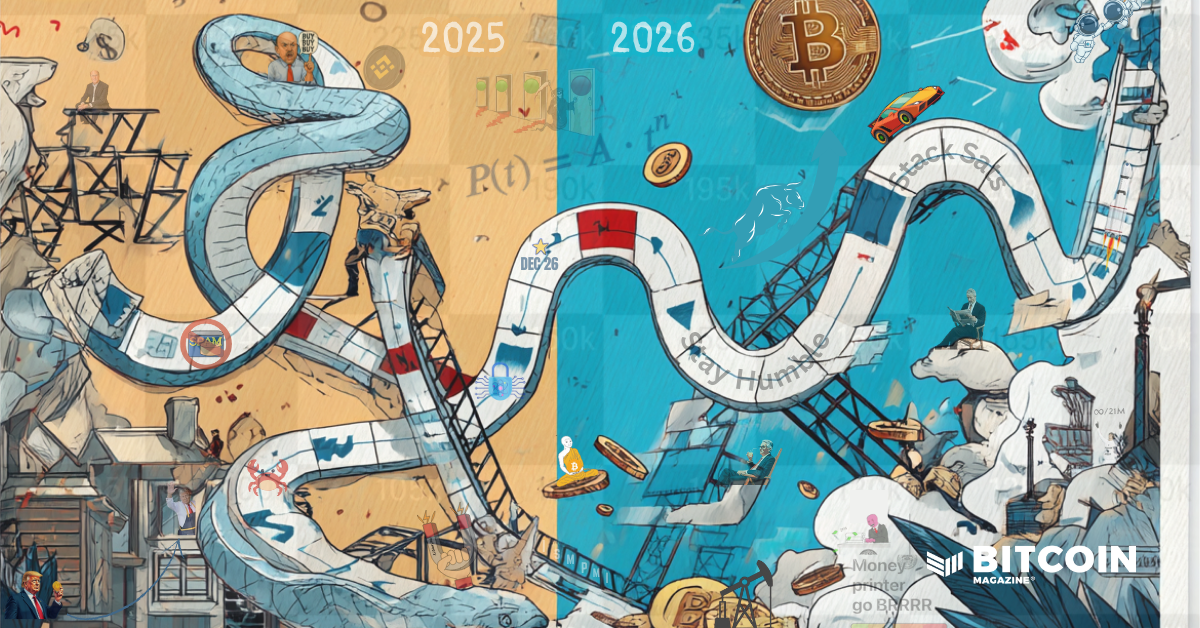
After A Snake-Like 2025, Is The Bitcoin Price Ready to Break Out In 2026?

Bitcoin Magazine After A Snake-Like 2025, Is The Bitcoin Price Ready to Break Out In 2026? We had high hopes for the bitcoin price in 2025. It was supposed to be the crescendo of the four-year cycle, the most bullish setup in recent memory. It was the year after the halving, the ETFs had just been approved, a new president was elected, with the promise of the money printer roaring back to life. Everything looked primed for a Q4 blow-off top, and instead of a new life in Monaco, all you got was this lousy article. What follows is my interpretation of the events of 2025 and my outlook for 2026. I’m not a trader, not an analyst, and like you, I’ve been outperforming professional funds for years, by simply stacking Sats, of course. I’m more of a “fix the money, fix the world” kinda guy, but like everyone else, it’s hard to ignore Bitcoin’s price movements, which I think of as the game of “Snakes and Ladders”. The bitcoin price as a game of Snakes and Ladders. In the game of Snakes and Ladders, momentum drives us forward, but it can also provide a false sense of confidence. You can be one roll away from victory, only to land on a snake that sends you sliding back ten places. As much as hopium dictates that we pray for the price to go ‘up and to the right’, markets rarely oblige. Switching from the board to the chart, price action is played on a board of global liquidity and market sentiment. When sentiment is low or liquidity dries up, no amount of good news can sustain momentum. We simply crab sideways or find a snake that slides us down into further despair. On the other hand, when liquidity floods the system, we often find the ladders that shoot us through resistance levels. For most of 2025, we were stuck playing the former, while dreaming of the “ladder”. So let’s take this time to review 2025 from the perspective of hindsight, as foresight proved to be of little benefit. What Happened To Our 2025 Bull Run? If there is a phrase that defines the Bitcoin market of 2025, it is exactly that: a Year of Snakes and precious few ladders. Interestingly, and unbeknownst to me, 2025 was indeed the year of the snake according to the 12-year Chinese zodiac cycle, starting January 29, 2025, and ending February 16, 2026. The bitcoin price in 2025, overlayed with the Chinese Year of the Snake. We began the year with the kind of euphoria that usually marks a cycle top. The halving was behind us, and the political stars had aligned perfectly. Google trends showed search queries were soaring. In fact, the year kicked off with a quiet but massive victory before the political fireworks even started: FASB fair value accounting rules took effect on January 1st, finally allowing companies to report bitcoin profits rather than just losses. Then came the main event. We witnessed the inauguration of a “Bitcoin President.” Gary Gensler departed, leaving behind a legacy that, in hindsight, was perhaps less villainous than we assumed, and Ross Ulbricht walked free within 48 hours. With the new administration came a few allies: Paul Atkins took over the SEC and Mike Selig the CFTC, securing a pro-crypto cabinet. The financial plumbing was finally completed. The ETFs were fully operational, options trading on IBIT were unleashed, and it quickly became clear that Michael Saylor was not about to let Larry Fink steal his thunder. MicroStrategy went on a $25 billion buying spree, 100x what they bought in 2020, and the corporate treasury list exploded from 60 companies to nearly 200. By October, the engines were well and truly revving. We hit the All-Time High on October 6th, ready to punch the accelerator for the glorious Q4 end-of-cycle run. Instead, we shifted the gear into reverse and slid all the way down to $80,000. First, we got our knickers in a twist over the “Knots vs. Core” drama. Then came the Binance incident, where the snake manifested itself as a “technical issue” at precisely the wrong time, and right as Gold broke out. We essentially got rug-pulled by a glitch. The issue of October 10th likely created added sell pressure through forced liquidations, whilst also triggering the 4-year cycle sellers who have been trained to sell Q4 of the 4th year. Few understood the gravity of it at the time, though I tip my hat to Jesse Olson for calling it early. Then the FUD machine was turned on. First, it targeted MicroStrategy with threats of MSCI exclusion; it didn’t help sentiment that its mNAV has been dropping all year. Then it pivoted back to Bitcoin with the return of the “quantum attack” narrative. While the headlines swirled, the bitcoin price became stuck in purgatory, range-bound between $84,000 and $95,000 and trapped by options traders, even though the handcuffs had theoretically been taken off IBIT options earlier in the year. Bitcoin was having an Austin Powers moment, while Peter Schiff enjoyed his first day out in the sun since high school. Bless him. Is The Tide About to Turn? While some fear 2026 will bring the hangover of a post-cycle bear market, I, like countless other optimists believe otherwise. If 2025 was the year of snakes, 2026 is the year we finally climb a few ladders. The setup is favourable. We have a Bitcoin-ish president, who’s hungry to fire up the printing press, we’ve a developing multipolar world, where the process of game theory should be heating up, there’s a $7 trillion debt wall to be paid, the old guard are positioned, the regulation stranglehold has been loosened, the cowboys (FTX, Terra-Luna, etc.) are gone, gold and silver have both had their runs, and Bitcoin’s supposed to follow next, or so we hope. Source: Sminston With Not to mention, the tax year is done, and new budgets have been allocated to fund managers and businesses alike. FASB fair value accounting is now live, smoothing the runway for corporate balance sheets. Michael Saylor is still buying with the relentless intensity of a man who understands math better than Archimedes. Even the “MSCI FUD” was defeated early, so credit to George and the Bitcoin for Corporations team for that victory. At the point in time as the price is beginning to climb higher, the bears are finally showing signs of exhaustion, that’s according to James Check and countless others. By far the most significant headwind Bitcoin faced in 2025 was the relentless onslaught of coins sold by long-term holders. That pressure looks to finally be ending. On November 1st, approximately 67% of the Realised Cap was invested above $95k. The last two months have seen a massive supply redistribution occur, with that metric declining to 47%. Over the last 30 days, around 80% of the coins which have transacted came from higher prices. This is the definition of capitulation. The weak hands who bought the top have flushed out, and new buyers have stepped in with a lower and stronger cost basis. Incidentally, the Year of the Snake officially ends on February 16, 2026, to be followed by a horse, which as we all know has the ability to outrun any bull. This coincides almost perfectly with the monthly CME Futures expiry on February 27th. The shedding of a snake’s skin happens right before the growth returns. Is the 4-Year Cycle Dead? Really, who can truly say they know? What we do know is that the four-year cycle is no longer connected to the halvings or the presidential cycles in the way we once thought, and the halvings are less likely to have an effect going forward, as the new coins distributed are a lower percentage of supply, and the miners are supported by huge funds which can help them weather any potential death spiral. We have not seen a Pi Cycle top signal, the 200 week moving average has not crossed the prior cycle top, the MVRV score is just 1.3, the Puell multiple is just .99, we’ve not had a considerable drawdown, and we’re still at the bottom of the range of almost every metric imaginable. For those of you who are old enough to remember the KitKat ad from the 90’s, “the 4 year cycle is not dead, it was just takin’ a break.” As the 4-year cycle is a purely Liquidity Based Cycle, it can be measured by proxy using the ISM Manufacturing PMI, a qualitative index sourced from purchasing managers in the manufacturing industry. I give credit to Raoul Pal for highlighting this metric; he was the first I observed to point out that bitcoin is a “Liquidity” asset rather than a “Halving” asset. Bitcoin, as the highest-beta risk asset in existence, responds to shifts in global risk appetite with greater force and speed than any other asset class. The PMI tracks the business cycle, and it has been in contraction for nearly two years. The current PMI at 47.9 signals ongoing contraction, but ISM projections indicate a 4.4% revenue growth for manufacturing in 2026, crossing 50 in Q2 as Trump’s policies kick in. The bitcoin price should follow. When the ISM PMI is below 50, we’re generally in a bear market, and we’ve been that way for over two years now. The bull markets have historically topped out between 55 and 65. The question remains, when is the business cycle going to see an upturn? TechDev is of the view that it’s happening very soon, as the bullish divergence reversal momentum is decidedly building. Source: Sminston With The $9 Trillion Debt Question The US government has to address the $9 trillion debt wall that’s due to mature this year. But the nuance is in how they do it. President Trump has made it clear he intends to build a “Dream Military” for 2027 and is pushing for a budget increase to $1.5 trillion. When you combine that with the $4.1 trillion of debt maturing in 2026 and the standard annual deficit, the US Treasury faces a $9 trillion liquidity gap, and a further $7.4 trillion before 2028. Does the US have to print all $9 trillion? No. And through this lens, the recent geopolitical moves make sense. Trump didn’t only capture Maduro for a photo-op; he has likely taken control over 303B barrels of reserves and is enforcing USD oil sales, creating artificial dollar demand and easing the liquidity gap by $2-3T annually. Can he cover the gap via a mix of tariffs (that Americans actually pay for!), Petro-Dollar demand, and the inevitable monetization of the rest by the Federal Reserve? I guess he’ll have to. With Jerome Powell expected to leave his chair in May, the path will be cleared to give the printer engines a whir. There’s another $5 – $10 tr due globally in 2026, and the same again in 2027. So the fed chair won’t be without company. My View: 2026–2027 The four-year cycle OGs may be stepping aside, but the Liquidity Cycle is just gearing up, and Bitcoin, as Raoul Pal has long argued, remains the ultimate liquidity barometer. Samuel Benner’s famous 19th-century forecasting chart (first published in 1875), maps long-term cycles of panics (“A” years), booms/high prices (“B” years), and depressions/low prices (“C” years). Interestingly, 2026 falls squarely in one of Benner’s “B” years, which is a period of “Good Times, High Prices and the time to sell Stocks and values of all kinds.” The chart places 2026 right alongside previous boom years like 2016, 2007, 1999, and 1989, suggesting we are entering a structurally favorable window for risk assets. How Long Will The Next Money Printing Last? Prediction: 18–24 months Why: History shows that once the dam gates open, it takes roughly two years to stabilize and reflate. If the official aggressive printing phase begins in late 2025 (as the liquidity uptick and Benner timeline imply, and as M2 shows), it will likely run strong through mid-2027. How Much LIquidity Will Be Added? Prediction: ~$9–$10 trillion in the U.S. Treasury debt is maturing in 2026 alone (about one-third of outstanding marketable debt) and a further $5 – $10 tr globally. Why: As discussed above, the maturity walls for 2026 are nearly double what we faced during the COVID crisis. Yellen extended the pain by leaning on short-term issuance back then, but come hell or high water, that debt has to be paid or refinanced—the money will arrive from somewhere. Because of this, we can expect a new wave of inflation, the 70’s and 80’s have a story to tell about that! How High Will The Bitcoin Price Go? Prediction: $250,000 Why: During that $5 trillion COVID expansion, BTC rallied roughly 20x from the $3k–$4k lows to $69k. With the potential for double that liquidity entering the system this cycle, the upside is significant even if diminishing returns apply. From our $16k effective low, a conservative 10x to 12x multiple lands us in the $160k to $200k range as a base case. However, models suggest we could push higher. PlanC’s quantile model points toward $300k+ by the end of 2026, and Giovanni Santostasi’s Power Law projects a peak potentially around $210k early on, with room to stretch as high as $600k in outlier scenarios. But hey, I was expecting +$200k last cycle too. Oh, if the Strategic Bitcoin Reserve Act moves out of the committee, and if the U.S. Treasury officially starts side-stacking alongside MicroStrategy, all bets are off the table. When Will The Price Top Out? Prediction: Late 2026 to mid-2027 The Logic: Bitcoin historically tops out 12–18 months after the liquidity expansion enters its “mania” phase. If the ISM Manufacturing PMI crosses back above 50 in early 2026, the perfect storm should unfold throughout 2026, setting up a blow-off top, potentially in the first half of 2027. Bitcoin is unlikely to go straight up, nothing ever does. We’ll almost certainly encounter a few snakes along the way: sharp corrections, regulatory noise, profit-taking, or some form of shenanigans. But the ladders are built, ready and waiting. The Year of the Snake is coming to an end, just ahead of the February 27 CME futures expiry, our potential ignition point, right before the anticipated PMI uptick in Q2. 2025 was a year of snakes and sideways pain, with long-term holders finally capitulated and weak hands flushed out. Now, with a wall of liquidity heading our way, 2026 looks like the ladder we’ve been waiting for. The horse year is coming, so stack and secure accordingly. Good luck. This post After A Snake-Like 2025, Is The Bitcoin Price Ready to Break Out In 2026? first appeared on Bitcoin Magazine and is written by Conor Mulcahy.

Cover image for After A Snake-Like 2025, Is The Bitcoin Price Ready to Break Out In 2026?

Senate Democrats, Crypto Industry to Resume Talks After Market Structure Bill Delay

Bitcoin Magazine Senate Democrats, Crypto Industry to Resume Talks After Market Structure Bill Delay U.S. Senate Democrats are reportedly set to reopen talks with representatives from the cryptocurrency industry on Friday, according to people familiar with the plan speaking to CoinDesk. All this comes less than two days after a last-minute postponement of a key Senate Banking Committee hearing on sweeping digital asset legislation. The call follows Wednesday night’s abrupt cancellation of the committee’s planned markup of the long-negotiated crypto market structure bill, which had been expected to divide regulatory oversight of digital assets between the Securities and Exchange Commission (SEC) and the Commodity Futures Trading Commission (CFTC). The delay came after Coinbase, the largest U.S.-based crypto exchange, withdrew its support for the draft legislation, citing concerns over stablecoin rewards programs and what it viewed as excessive authority granted to the SEC. Coinbase CEO, Brian Armstrong, said that banks are trying to “kill their competition” with the crypto market structure legislation. “Crypto companies should be allowed to compete and offer loans just like banks,” Armstrong said. Thursday marked a pause in public activity after the cancellation, but lawmakers and industry participants say negotiations are far from over. Democrats from both the Senate Banking Committee and the Senate Agriculture Committee — which oversees the CFTC — are expected to join Friday’s call, along with representatives from crypto policy advocacy groups in Washington, according to reports. The Banking Committee had been scheduled to hold an all-day session Thursday to debate amendments and vote on whether to advance the bill. That plan unraveled late Wednesday after Coinbase CEO Brian Armstrong said the company could not support the current version of the legislation. Shortly thereafter, Senate Banking Committee Chair Tim Scott, R-S.C., postponed the hearing. Lummis: Senate is closer than ever Despite the setback, several lawmakers involved in the negotiations said discussions will continue. In a post on X, Sen. Cynthia Lummis, R-Wyo., a leading crypto advocate in the Senate, said lawmakers were “closer than ever” to reaching agreement. “Everyone is still at the negotiating table, and I look forward to partnering with [Chairman Scott] to deliver a bipartisan bill the industry — and America — can be proud of,” Lummis wrote Thursday. Sen. Bill Hagerty, R-Tenn., echoed that optimism, saying he remained “confident” that lawmakers could reach a consensus “in short order.” “I am fully committed to continuing this important work with my colleagues on market structure and look forward to passing legislation that ensures this innovative technology flourishes in the United States for decades to come,” Hagerty said. Industry reaction to Coinbase’s withdrawal has been mixed. While Armstrong’s comments intensified scrutiny of the bill, other crypto executives and advocacy groups urged lawmakers to keep pushing forward. Kraken co-CEO Arjun Sethi said abandoning negotiations now would worsen regulatory uncertainty for U.S. crypto firms. “Walking away now would not preserve the status quo in practice,” Sethi said in a post on X. “It would lock in uncertainty while the rest of the world moves forward.” A major point of contention in recent negotiations has been whether stablecoin issuers should be permitted to offer rewards or yield programs — an issue that has drawn pushback from bank lobbyists and some Democrats concerned about consumer protection and competition with traditional deposits. While the Banking Committee’s markup has been postponed, the Senate Agriculture Committee is still expected to hold a hearing on the legislation on January 27, after previously pushing back its own earlier session. Ultimately, both committees’ work would need to be merged before the bill could advance to the full Senate. Some analysts see the delay as a strategic pause, with Benchmark’s Mark Palmer saying it could help lawmakers build broader bipartisan support and ultimately strengthen what he called a potentially historic overhaul of U.S. financial regulation. Others are more doubtful: TD Cowen warned that bridging Democratic demands and Coinbase’s objections may be difficult, especially since some disputed provisions were already concessions to Democrats, while election-year timing and the Senate’s 60-vote threshold add further hurdles. This post Senate Democrats, Crypto Industry to Resume Talks After Market Structure Bill Delay first appeared on Bitcoin Magazine and is written by Micah Zimmerman.

Cover image for Senate Democrats, Crypto Industry to Resume Talks After Market Structure Bill Delay

Belgium’s KBC Becomes First Bank in the Country to Offer Bitcoin Trading to Retail Investors

Bitcoin Magazine Belgium’s KBC Becomes First Bank in the Country to Offer Bitcoin Trading to Retail Investors Belgium’s second-largest bank, KBC Group, is set to become the first bank in Belgium to allow retail clients to buy and sell crypto. Starting the week of February 16, private investors will be able to trade Bitcoin through Bolero, KBC’s online investment platform. The offering will operate within a regulated framework under the European Union’s Markets in Crypto-Assets Regulation (MiCAR), positioning KBC as the first Belgian bank to meet the requirements for providing crypto asset services. KBC said it has submitted a full Crypto Asset Service Provider (CASP) notification to the relevant supervisory authority, clearing the way for the launch. The bank framed the move as a response to growing demand from retail investors for regulated access to cryptocurrencies, while emphasizing the risks associated with the asset class. “By offering the opportunity to purchase and sell crypto within a regulated framework, we are making innovation concrete and accessible,” said Erik Luts, chief innovation officer at KBC Group. “At the same time, we are demonstrating that KBC remains ready to assume its role as an innovator in a market where new players are rapidly evolving.” JUST IN: Belgium's second largest bank KBC to become the first bank in the country to offer Bitcoin trading pic.twitter.com/0RuvaVkZNG — Bitcoin Magazine (@BitcoinMagazine) January 15, 2026 KBC’s execution-only model The launch will initially be limited to Bitcoin and Ether and will follow an execution-only model. Bolero customers will make their own investment decisions and will not receive personalized investment advice. Before being allowed to trade crypto, clients must complete a knowledge and experience test designed to assess their understanding of the risks, including price volatility and the possibility of total loss, the bank said. KBC and Bolero are adopting a so-called “closed-loop” model aimed at reducing fraud and money-laundering risks. Customers will only be able to buy and sell crypto within the Bolero platform, with no ability to transfer assets to or from external wallets or exchanges. The bank will also provide custody services, meaning clients will not have to manage private keys themselves. According to KBC, the move is partly driven by demographic trends. Studies cited by the bank indicate that around 45% of Belgians in their thirties already invest in cryptocurrencies. Bolero’s customer base skews relatively young, with roughly 60% under the age of 40, and “Bitcoin” ranks among the most searched terms on the platform. Bolero CEO Céline Pfister said the platform aims to introduce crypto “in an accessible way” while ensuring investors are well informed. At launch, educational materials will be made available through the Bolero Academy. In a similar move, Germany’s second-largest lender DZ Bank secured authorization under the EU’s Markets in Crypto-Assets Regulation earlier last year, enabling it to launch a retail crypto trading platform across the country’s cooperative banking network. The BaFin-approved “meinKrypto” platform will allow Volksbanken and Raiffeisenbanken customers to trade Bitcoin and other cryptocurrencies directly within their existing banking apps, subject to individual bank notifications. This post Belgium’s KBC Becomes First Bank in the Country to Offer Bitcoin Trading to Retail Investors first appeared on Bitcoin Magazine and is written by Micah Zimmerman.

Cover image for Belgium’s KBC Becomes First Bank in the Country to Offer Bitcoin Trading to Retail Investors

Time2Build 2025 Winners: Breez Awards Bitcoin Prizes for Lightning Integrations in BTCPay Server, Primal, and More

Bitcoin Magazine Time2Build 2025 Winners: Breez Awards Bitcoin Prizes for Lightning Integrations in BTCPay Server, Primal, and More The Time2Build developer challenge just announced its 2025 winners. It was organized by Breez in collaboration with partners including Tether, Lightspark, Fulgur Ventures, Plan ₿ Network, PlebLab, Geyser, and Draper University. The initiative, which ran from October 7 to November 15, 2025 (with a merge period through December 16), focused on integrating self-custodial Lightning Network payments into existing open-source applications using the Breez SDK. More than 50 developer communities worldwide participated, resulting in a range of plugins, tools, and integrations designed for long-term use rather than one-off demonstrations. The challenge emphasized practical Bitcoin functionality in areas such as merchant payments, social platforms, identity protocols, and Nostr-based applications. Key trends observed across submissions included: Lightning as an interoperability layer — Developers frequently paired Lightning with protocols like Nostr and Cashu to enable value transfer between systems without altering native designs. Preference for plugins over deep integrations — Participants favored lightweight plugins for content management systems, forums, game engines, and creator tools. This approach allowed faster deployment, independent iteration, and reduced dependence on upstream maintainer approval. The winners selected by a panel of judges, including Abubakar, Giacomo, Jeff, Kevin, Keyan, Lisa, Roy, and Subash. Prizes were paid in Bitcoin. $3,500 Prize Winners BTCPay Server plugin (Team: Aljaz) — The plugin enables Lightning payments on BTCPay Server, the open-source payment processor used by merchants globally, by leveraging the Breez SDK. It eliminates the need for operators to manage a full Lightning node, including channel liquidity, while maintaining self-custodial Bitcoin functionality. Evento (Team: Brianna, Andre, and Aaliyah) — Lightning was added to Evento, a social events platform for community building. Users can tip participants, support hosts, send/receive sats, and interact with services like Bitrefill purchases directly in the app, enabling peer-to-peer value flow within events. Portal (Team: Alessandro, Gianluca, Gabriele, and John) — The team integrated the Breez SDK into Portal, a protocol and mobile app for identity and payments. Lightning becomes a native protocol feature, allowing any application built on Portal to inherit send/receive Bitcoin capabilities. Primal (Team: Daniel) — Lightning was incorporated into the Primal web client, a widely used Nostr application. The Breez SDK provides a self-custodial wallet experience, replacing a previous custodial onboarding process that required KYC and could fail due to location or email restrictions. Onboarding now requires no personal information and completes in approximately one minute. $1,000 Prize Winners and Special Mentions Additional $1,000 awards went to projects including: An OBS Studio donations plugin with Lightning send/receive, multi-device sync, and on-chain support. Backend support for Nutshell Cashu mints using Spark as a Lightning provider. SatsMobi, a Telegram wallet adding self-custodial Lightning. CDK payment processor using Spark. Godot Engine plugin for Lightning in game development. Umbraco NuGet package for tip jars, paywalls, and admin tools. Discourse forum tipping plugin. CTFd rewards plugin for capture-the-flag security challenges. Special prizes from Draper University and PlebLab recognized additional contributions in education gamification and Nostr-focused wallets. Winners of these special prices were: Lib de Satoshi & B4OS — A community platform that integrated Lightning to gamify education. Rewarded by DraperU. Sparkihonne — A Nostr-focused wallet experience blending identity, messaging, and payments. Rewarded by PlebLab. Other notable non-winning submissions included Sabi Wallet, Backend for CDK mints, Jumble, Breez MCP Server – Docker Catalog, CoFi Lab, OpNode, and BitNGN. The challenge demonstrated growing developer interest in embedding Bitcoin payments where users already engage, particularly through plugins and Lightning as a bridging layer. Organizers stated that future development will depend on continued builder participation in areas such as messaging apps, wallets, and new applications. The Breez team shared their enthusiasm in a press release with Bitcoin Magazine, saying; “For us, the next steps are clear. The era of building has begun. Whether that means adding Bitcoin to messaging apps like Signal, integrating it into leading crypto wallets, or bringing Lightning into entirely new apps with use cases we’ve yet to dream up, we can’t wait to see what you do next. It’s time to build.” This post Time2Build 2025 Winners: Breez Awards Bitcoin Prizes for Lightning Integrations in BTCPay Server, Primal, and More first appeared on Bitcoin Magazine and is written by Juan Galt.

Cover image for Time2Build 2025 Winners: Breez Awards Bitcoin Prizes for Lightning Integrations in BTCPay Server, Primal, and More

Senate Banking Committee Postpones CLARITY Act Markup After Crypto Industry Backlash

Bitcoin Magazine Senate Banking Committee Postpones CLARITY Act Markup After Crypto Industry Backlash The Senate Banking Committee postponed its planned markup of the Digital Asset Market CLARITY Act, capping what had been expected to be a pivotal week for U.S. crypto policy with an anticlimactic halt amid growing industry opposition and unresolved political disputes, according to reporting from Crypto in America. The decision came after tensions escalated throughout the week as crypto companies and trade groups voiced frustration over late-stage amendments to the 278-page market structure bill. Critics argued the changes tilted the legislation further in favor of banks and traditional finance, particularly by tightening restrictions around stablecoin rewards and tokenization. Compounding the uncertainty, Democrats on the committee continued to press for stronger ethics provisions that would bar senior government officials — including the president — from personally profiting from crypto ventures. Those provisions have repeatedly stalled in negotiations with the White House, contributing to the impasse. NEW: US Senate Banking Committee postpones Bitcoin and crypto market structure legislation markup after Coinbase and others withdrew their support for the bill pic.twitter.com/XEQT7p2geR — Bitcoin Magazine (@BitcoinMagazine) January 15, 2026 The immediate catalyst for the CLARITY Act postponement arrived around 4:00 p.m. Jan. 14, when Coinbase CEO Brian Armstrong announced that the exchange was withdrawing its support for the bill. Coinbase had been one of the most influential industry backers of a comprehensive market structure framework, investing heavily in lobbying efforts on Capitol Hill. “We appreciate all the hard work by members of the Senate to reach a bipartisan outcome, but this version would be materially worse than the current status quo,” Armstrong wrote in a post on X. “We’d rather have no bill than a bad bill.” In a follow-up post, Armstrong said he remained optimistic that lawmakers could still reach an acceptable compromise and pledged that Coinbase would continue engaging with policymakers on the CLARITY Act. The withdrawal was a major setback. The loss of support from one of crypto’s most prominent policy voices risked signaling to undecided senators that the bill lacked sufficient industry consensus, raising the likelihood the committee would delay or abandon the markup altogether. While the markup was ultimately postponed, Coinbase’s decision did not trigger a complete industry retreat. Several major firms and advocacy groups — including a16z, Circle, Paradigm, Kraken, Ripple, Coin Center, and the Digital Chamber — publicly reaffirmed their support for moving forward with a markup. “It is easy to walk away when a process gets difficult,” Kraken co-CEO Arjun Sethi said in a post on X. “What is hard and what actually matters is continuing to show up, working through disagreements, and building consensus in a system designed to require it.” In a brief statement announcing the postponement, Senate Banking Committee Chairman Tim Scott (R-SC) said that “everyone remains at the table working in good faith,” but he did not offer a new date for the markup or specify which issues would need to be resolved before it could be rescheduled. The Senate is out of session next week for the Martin Luther King Jr. Day recess and is set to return the following week. The Senate Agriculture Committee, which shares jurisdiction over parts of the bill — particularly spot market oversight and the Commodity Futures Trading Commission’s role — is expected to hold its own markup on the CLARITY Act later this month after postponing an earlier session. It remains unclear whether Banking’s delay will affect Agriculture’s timeline. What is the CLARITY Act? The CLARITY Act, which uses House-passed H.R. 3633 as its base text, is designed to establish a comprehensive federal framework for digital asset markets. The legislation seeks to divide oversight between the Securities and Exchange Commission and the CFTC, set standards for payment stablecoins, clarify rules for decentralized finance, and protect software developers who do not control customer funds. Supporters, primarily Republicans, argue the bill would replace regulatory uncertainty with clear rules, strengthen anti-fraud and illicit finance authorities, and bring crypto activity back onshore. Committee fact sheets describe it as the “strongest illicit finance framework Congress has ever considered” for digital assets. Critics, however, contend the bill weakens investor protections and risks creating new loopholes. Former SEC Chief Accountant Lynn Turner warned earlier this week that the CLARITY Act draft lacks Sarbanes – Oxley–level safeguards, such as mandatory audited financial statements, internal control certifications, and robust Public Company Accounting Oversight Board oversight — deficiencies he said could enable another FTX-style collapse. Stablecoin rewards have emerged as one of the most contentious issues in the CLARITY Act. Banking groups argue that yield-bearing stablecoins could siphon deposits from traditional banks, while crypto firms counter that broad bans on rewards would stifle innovation and push users toward offshore platforms. CLARITY Act This post Senate Banking Committee Postpones CLARITY Act Markup After Crypto Industry Backlash first appeared on Bitcoin Magazine and is written by Micah Zimmerman.

Cover image for Senate Banking Committee Postpones CLARITY Act Markup After Crypto Industry Backlash

Saturn raises $800k from YZi Labs and Sora Ventures to build USDat, a 11%+ yield-bearing stablecoin protocol backed by Strategy’s Digital Credit

Bitcoin Magazine Saturn raises $800k from YZi Labs and Sora Ventures to build USDat, a 11%+ yield-bearing stablecoin protocol backed by Strategy’s Digital Credit The Creation of Digital Credit In 2025, Strategy and Michael Saylor set their sights on the fixed-income market. The company transformed Bitcoin into a durable source of yield, creating a credit layer on top of it. “Our goal is to bring transparent yield to DeFi at a scale of billions of dollars. We are building the first application on Michael Saylor’s digital credit – a whole new platform layer, where banks, insurance, investing and money will be all reshaped,” said Kevin Li, Co-founder of Saturn. “We’re proud to have YZi Labs and Sora’s support from day one, and we will become the Tether of digital credit” Li added, “Today, yield is generated through a combination of Strategy’s STRC and U.S. Treasury bills.” “Stablecoins are moving beyond simple payments toward yield-driven products, and few projects connect institutional credit with DeFi in a meaningful way,” said Jason Fang, Founder of Sora Ventures. “We backed Saturn because USDat is pioneering the first on-chain use of Strategy’s credit products, and we believe it can redefine how institutional capital interacts with decentralized finance. The Saturn team brings deep expertise across DATs, DeFi, and stablecoins, with engineering experience from Artemis – a leading blockchain data company focused on stablecoin and onchain analytics – and M31 Capital, a DeFi-focused venture and liquid fund. All founders are alumni of the University of Pennsylvania. With support from YZi Labs and Sora Ventures, Saturn is well positioned for global market penetration and to become a dominant force in DeFi. Li notes that as Bitcoin transforms into a new credit layer, Saturn will be the first stablecoin protocol to offer double-digit yields at $10B scale. Disclaimer: This is a sponsored press release. Readers are encouraged to perform their own due diligence before acting on any information presented in this article. This post Saturn raises $800k from YZi Labs and Sora Ventures to build USDat, a 11%+ yield-bearing stablecoin protocol backed by Strategy’s Digital Credit first appeared on Bitcoin Magazine and is written by Bitcoin Magazine.

Cover image for Saturn raises $800k from YZi Labs and Sora Ventures to build USDat, a 11%+ yield-bearing stablecoin protocol backed by Strategy’s Digital Credit

Bitcoin Price Climbs Above $97,000 on $1.7B ETF Inflow Surge

Bitcoin Magazine Bitcoin Price Climbs Above $97,000 on $1.7B ETF Inflow Surge The bitcoin price surged above $97,000 this week, marking its strongest level in more than two months, on a mix of economic news and renewed inflows into U.S. spot Bitcoin exchange-traded funds (ETFs. Crypto investors appear to be kicking off 2026 with a familiar playbook: allocating heavily to Bitcoin ETFs. On Tuesday, the dozen U.S.-listed spot Bitcoin funds recorded roughly $760 million in net inflows, the largest single-day total since October. Fidelity’s Wise Origin Bitcoin Fund (FBTC) led the pack, absorbing about $351 million, while Bitwise’s BITB and BlackRock’s iShares Bitcoin Trust (IBIT) also posted strong gains. The momentum accelerated on Wednesday. Data from SoSoValue shows spot Bitcoin ETFs took in another $843.6 million, extending the positive streak to three consecutive days and bringing total inflows over that period to approximately $1.71 billion. Eight of the 12 funds reported net inflows, with BlackRock’s IBIT alone drawing in $648 million, underscoring its dominance among institutional allocators. Bitcoin’s price action reflected that renewed interest. After spending much of November and December trading below $92,000, BTC broke decisively higher this week, reclaiming the $94,000–$97,000 range and pushing toward $100,000. The move triggered roughly $700 million in short liquidations, amplifying volatility and accelerating the rally, according to Bitcoin Magazine Data. ETF flows have become a key barometer of institutional sentiment since spot products launched in early 2024. While cumulative inflows reached more than $56 billion by mid-January, flows turned negative in late December amid typical year-end caution. The sharp reversal this week suggests investors are once again viewing Bitcoin as both a growth asset and a diversification tool. This reflects in a growing bitcoin price. Economic conditions affecting the bitcoin price Macro conditions have also played a role. A softer-than-expected U.S. Consumer Price Index (CPI) reading released on January 13 eased fears of further aggressive monetary tightening, lifting “risk-on” sentiment. At the same time, escalating geopolitical tensions and political uncertainty in the U.S. have boosted interest in alternative stores of value, including the Bitcoin price. Still, volatility risks remain. Markets are closely watching a potential U.S. Supreme Court ruling on President Donald Trump’s tariffs, which could inject fresh uncertainty into global trade and financial markets. At the time of writing, Bitcoin price is trading at $97,046, up 2% over the past 24 hours, with roughly $67 billion in daily trading volume. The asset is sitting about 1% below its seven-day high of $97,705 and 2% above its seven-day low of $95,318. Bitcoin’s circulating supply stands at 19.98 million BTC, giving it a total market capitalization of approximately $1.94 trillion, also up 2% on the day. This post Bitcoin Price Climbs Above $97,000 on $1.7B ETF Inflow Surge first appeared on Bitcoin Magazine and is written by Micah Zimmerman.

Cover image for Bitcoin Price Climbs Above $97,000 on $1.7B ETF Inflow Surge

Russia Moves to Make Crypto ‘Everyday Finance’ as Lawmakers Prepare Retail Access Bill

Bitcoin Magazine Russia Moves to Make Crypto ‘Everyday Finance’ as Lawmakers Prepare Retail Access Bill Russia is moving closer to opening its crypto market to everyday investors, as lawmakers prepare legislation that would remove digital assets from a special regulatory category and allow broader, though still capped, retail participation. Anatoly Aksakov, chairman of the State Duma’s Committee on Financial Markets, said a draft bill is ready for consideration during the spring parliamentary session. The proposal would effectively normalize cryptocurrency within Russia’s financial system, signaling a shift toward treating digital assets as part of “everyday finance” rather than an exceptional or experimental instrument, according to local media outlet TASS. Under the expected framework, non-qualified investors — individuals who do not meet Russia’s professional or high-net-worth criteria — would be permitted to buy cryptocurrency up to a limit of 300,000 rubles, roughly $3,800. The legislation would remove crypto from a special financial regulation regime that has historically constrained their use. Supporters argue this change would help integrate digital assets more deeply into the economy, making crypto ownership and transactions increasingly “commonplace” for Russian citizens. While the bill does not signal a fully liberalized market, it marks a notable evolution in Russia’s stance after years of tight controls and skepticism from financial authorities. Crypto’s use in cross-border transactions Beyond domestic trading, the bill is also designed with international considerations in mind. Lawmakers expect the new framework to support the use of cryptocurrencies in cross-border settlements and to enable the issuance of tokens in Russia that could be placed on foreign markets. Such mechanisms are seen as particularly relevant as the country continues to explore alternatives to traditional financial rails for international trade. The move aligns with a broader, carefully calibrated approach from Russian regulators. In recent months, policymakers have emphasized the need to balance innovation with risk management, especially when it comes to retail investors. The Bank of Russia has previously warned that unrestricted access could pose systemic risks, calling broad retail participation a “drastic step” if introduced without safeguards. In December, the central bank proposed a model that would allow non-qualified investors to trade crypto only after passing a risk-awareness test, while maintaining bans on anonymous and privacy-focused digital assets. Around the same time, the Finance Ministry signaled it was working with the central bank on a coordinated policy that would permit retail access within clearly defined thresholds. Officials have repeatedly stressed that limits on transaction sizes and investment volumes are essential to preventing excessive speculation and protecting households. The proposed 300,000-ruble cap reflects that philosophy, offering exposure without opening the door to large-scale retail risk. This post Russia Moves to Make Crypto ‘Everyday Finance’ as Lawmakers Prepare Retail Access Bill first appeared on Bitcoin Magazine and is written by Micah Zimmerman.

Cover image for Russia Moves to Make Crypto ‘Everyday Finance’ as Lawmakers Prepare Retail Access Bill

Coinbase Says ‘No’ to CLARITY Act, Citing Crypto Restrictions

Bitcoin Magazine Coinbase Says ‘No’ to CLARITY Act, Citing Crypto Restrictions Coinbase CEO Brian Armstrong said the exchange cannot support the Senate Banking Committee’s latest draft of the CLARITY Act, warning that the bill, as written, would leave the U.S. crypto industry worse off than the current regulatory status quo. In a post on X, Armstrong cited several concerns, including what he described as a de facto ban on tokenized equities, new restrictions on decentralized finance that could grant the government broad access to users’ financial data, and provisions that weaken the Commodity Futures Trading Commission while expanding the Securities and Exchange Commission’s authority. “After reviewing the Senate Banking draft text over the last 48hrs, Coinbase unfortunately can’t support the bill as written,” Armstrong posted. He also criticized draft amendments that would eliminate rewards on stablecoins, arguing they would allow banks to suppress emerging competitors. “We’d rather have no bill than a bad bill,” Armstrong said on X, adding that Coinbase would continue pushing for a framework that treats crypto on a level playing field with traditional financial services. BREAKING: Coinbase CEO Brian Armstrong says Coinbase "can't support" the crypto market structure legislation as currently written "We'd rather have no bill than a bad bill." pic.twitter.com/3BCgWw0kM9 — Bitcoin Magazine (@BitcoinMagazine) January 14, 2026 The comments come a day before the Senate Banking Committee is expected to mark up the CLARITY Act on Thursday, January 15. The legislation is trying to clarify U.S. digital asset market structure by defining categories such as digital commodities, investment contracts, and payment stablecoins, while dividing oversight between the SEC and CFTC. Coinbase’ issues with stablecoin rewards Stablecoin rewards have emerged as a flashpoint in negotiations. Coinbase had reportedly warned lawmakers it may withdraw support for the bill if it restricts yield programs tied to stablecoins like USD Coin. Coinbase shares in interest income generated from USDC reserves and uses part of that revenue to offer incentives to users, including rewards of roughly 3.5% for Coinbase One customers. Stablecoin-related revenue may have reached $1.3 billion in 2025, making the issue central to Coinbase’s business model. Banking groups argue that yield-bearing stablecoins could draw deposits away from traditional banks, while crypto firms counter that banning rewards would stifle innovation and push users toward offshore platforms. “I’m actually quite optimistic that we will get to the right outcome with continued effort,” Armstrong later posted on X. “We will keep showing up and working with everyone to get there.” Michael Saylor, executive chairman of Strategy, retweeted Armstrong’s post, showing his own support with the decision. This post Coinbase Says ‘No’ to CLARITY Act, Citing Crypto Restrictions first appeared on Bitcoin Magazine and is written by Micah Zimmerman.

Cover image for Coinbase Says ‘No’ to CLARITY Act, Citing Crypto Restrictions

Ahead of Banking Committee Markup, Senate Republicans Release CLARITY Act Fact Sheets

Bitcoin Magazine Ahead of Banking Committee Markup, Senate Republicans Release CLARITY Act Fact Sheets After months of legislative negotiation and industry scrutiny, the Digital Asset Market CLARITY Act is moving toward a critical juncture on Capitol Hill this week as Senate committees align timelines and prepare some key markups that could finally break the deadlock on U.S. crypto regulation. The Senate Banking Committee released an amended draft of the CLARITY Act ahead of a scheduled markup and amendment debate, while the Senate Agriculture Committee set its own markup for late January. Earlier today, Senate Republicans on the Banking, Housing, and Urban Affairs Committee released a series of fact sheets this week detailing the Act. The Senate’s Banking Committee markup is still scheduled for January 15. The materials, published ahead of the committee’s markup today, frame the legislation as a comprehensive attempt to bring digital asset markets under a clear federal framework while strengthening investor protections and addressing illicit finance. Lawmakers backing the bill argue the absence of statutory clarity has pushed activity offshore and left both investors and national security exposed. Republicans tout consumer protection, security, and clarity in the CLARITY Act According to the fact sheets, the CLARITY Act would establish enforceable rules distinguishing which digital assets fall under securities law and which qualify as commodities, formally dividing oversight between the Securities and Exchange Commission and the Commodity Futures Trading Commission. One section emphasizes consumer protection, stating the bill strengthens disclosure requirements, preserves existing anti-fraud authorities, and limits insider abuse. Digital asset issuers subject to the framework would remain bound by resale restrictions and anti-evasion rules, while fraud would continue to be illegal and fully enforceable by regulators. Another focus of the legislation is national security and illicit finance. The fact sheets claim the CLARITY Act contains the strongest illicit-finance framework Congress has considered for digital assets to date. Under the proposal, centralized intermediaries would be subject to anti-money-laundering and counter-terrorist financing obligations, strengthened sanctions compliance, and enhanced Treasury authority to respond to high-risk foreign activity. Lawmakers say the goal is to close regulatory gaps without driving legitimate activity overseas. The bill also addresses decentralized finance and software development, an area that has drawn concern from crypto developers. According to the committee materials, the legislation explicitly protects software developers who publish or maintain code without controlling customer funds, and preserves the right to self-custody digital assets. Regulatory obligations would instead focus on centralized intermediaries that interact with DeFi protocols, requiring tailored risk-management and cybersecurity standards. “Code is protected — misconduct is not,” the fact sheet states. Supporters further argue the CLARITY Act closes loopholes rather than creating them. The bill establishes a joint SEC-CFTC advisory committee to harmonize regulatory requirements and includes provisions designed to prevent regulatory arbitrage or evasion of U.S. rules. By bringing activity onshore, lawmakers say federal oversight would be strengthened rather than diluted. Republicans on the committee also pushed back against claims that the bill was written to benefit industry. The materials describe the legislation as the product of years of bipartisan work, regulator engagement, and consultation with law enforcement, with an emphasis on public-interest outcomes rather than industry preferences. This post Ahead of Banking Committee Markup, Senate Republicans Release CLARITY Act Fact Sheets first appeared on Bitcoin Magazine and is written by Micah Zimmerman.

Cover image for Ahead of Banking Committee Markup, Senate Republicans Release CLARITY Act Fact Sheets

The State of Bitcoin Self-Custody in 2026 W/ Casa CEO

Bitcoin Magazine The State of Bitcoin Self-Custody in 2026 W/ Casa CEO As Bitcoin enters 2026 with sustained institutional adoption and price stability following the 2024-2025 bull run, self-custody remains a cornerstone of the asset’s sovereignty promise. Yet the landscape has evolved significantly. Spot Bitcoin ETFs have unlocked access to passive investors comfortable with Wall Street’s “trust me, bro” brokerage models, while physical attacks on crypto users have surged to record levels, known as “wrench attacks”. So, is self-custody a thing of the past, a dead meme many of us fell for, or is it transforming as Bitcoin matures? In a recent interview with Bitcoin Magazine, Casa CEO Nick Neuman provided a candid perspective of these dynamics, positioning his company’s multisig solutions as a bridge between the vision of pure self-sovereignty and practical usability for high-value holders, tailor-made to deal with modern security challenges and even geopolitical risk. Casa, founded in 2018, targets users securing meaningful Bitcoin amounts—typically five figures or more—where financial freedom is more important than convenience. Neuman described Casa’s north star as “maximizing sovereignty and security in the world” through Bitcoin and private key cryptography. In recent years, this has solidified into “building the Swiss bank for the sovereign individual”—a service for those who view money as integral to personal autonomy. Bitcoin Magazine has covered the company’s progress extensively throughout the years, including a November 2024 interview with Neuman by Frank Corva and a June 2025 story on its partnership with Swiss platform Relai for multisig security and inheritance planning. ETFs and the Promise of Convenience “Not everyone wants to be a sovereign individual right now,” Neuman noted when discussing the challenges self-custody faces in 2026, pointing to an increasingly obvious reality: Bitcoin self-custody demands high personal responsibility and a significant amount of technical competence. These remain true despite best efforts in user interface design. NVK, the founder of the Coldcard Q, has joked publicly that trying to design self-custody products capable of resisting nation-state intrusions, with “grandma” levels of ease of use, might be a pipe dream. At the very least, the personality type and technical competence needed for maximum self-custody remain a limiting factor on the realization of the cypherpunk utopia. ETFs offer plug-and-play exposure to a new and broad userbase, while self-custody appeals mostly to high-agency users unwilling to accept black-box custodian risks — and that’s the good news, “at scale, you simply can’t afford to trust that Coinbase or anyone else is getting every process right,” he said. Institutions such as family offices, corporations, custody banks, and investment funds are also starting to understand the risks of outsourcing Bitcoin custody. Neuman revealed that “Increasingly over the last year, Casa is helping large institutions that need to have provable security and provable control to secure their assets,” adding that institutions “are starting to realize that in a lot of ways regulators are requiring them to have actual control over this asset.” In 2025, for example, the OCC clarified that national banks and federal savings associations have the liberty to custody crypto assets for clients, adding the caveat that “As with any activity, a bank must conduct crypto-asset custody activities, including via a sub-custodian, in a safe and sound manner and in compliance with applicable law”. The GENIUS Act provided further structure by giving the green light to full reserve Stablecoins in U.S. financial markets. The SEC’s January 2025 rescission of SAB 121 (via SAB 122) removed capital penalties for crypto custody, making it more practical for banks. Some banks publicly known to be developing independent crypto custody platforms for their users include BNY Mellon, State Street, Citi, and JPMorgan. This is in contrast to outsourcing all custody to the most popular custodians like Coinbase, which some worry poses systemic risks to the Bitcoin network and its investors. Neuman points out that self-custody multi-signature platforms like Casa address the concerns and needs of institutional players. Multisig requires multiple keys to sign a valid transaction, but also enables key rotations for personnel changes, with added auditability. “If someone who controlled a key leaves, you can rotate that key out completely… We make that process straightforward, and for institutions, we’ve added extra guardrails, auditability, and visibility,” said Neuman. As a result of this growing trend, we might soon start to see a wave of competition in retail facing custodial bank-like services in the U.S., while institutional players might begin to decouple from the plug-and-play custody outsourcing we have seen so far, a step towards custody decentralization of Bitcoin. Defeating Wrench Attacks Physical coercion attacks—known as “$5 wrench attacks”—reached unprecedented levels in 2025. Jameson Lopp, Casa’s chief security officer, maintained a decade-long database, documenting approximately 65–70 incidents, the highest on record, with at least four fatalities. Alena Vranova, co-founder of Trezor, now running a wrench attack prevention startup called Glok.me, places the number at 292, breaking down the data into various categories. France emerged as a hotspot, with at least 10 reported wrench attacks in 2025, often linked to tax reporting, potentially exposing addresses and identities, including a case where a tax official was convicted for selling taxpayer data to criminals. The United States is leading the pack in total numbers of known crypto-related attacks. However, it is important to weigh data of this sort with a grain of salt. It should be considered on a per capita basis, as countries like the U.S. have close to 400 million residents compared to France with around 70 million. Comparisons to fiat fraud like identity theft and other forms of violent crime are often not included in these type statistics. It is nevertheless an alarming trend and a common talking point, giving crypto users pause when deciding to take self-custody. Neuman believes, however, that the public is misunderstanding the problem at hand, thinking that giving custody to a third party is actually the solution; it is not. He shared a non-violent case that challenges this “just use a custodian” narrative: A Casa client was drugged and coerced at a bar. Funds in Casa’s multisig stayed secure due to dispersed keys — the user did not have enough keys on him to sign a transaction — but a small Coinbase balance was drained from the client’s phone app. “It just completely flips the prevailing wisdom,” Neuman noted, “Actually, that doesn’t always solve the problem.” Best practices on this front revolve around not becoming a target in the first place, as in not becoming an influencer flaunting crypto wealth. But it also means not exposing data that reveals you have crypto wealth, a privacy risk legacy finance is particularly vulnerable to, as seen by the incredible rise in financial data hacks and identity theft. Though hardware wallet manufacturers like Ledger have suffered multiple payment infrastructure-related hacks that have resulted in user data being compromised, putting users at risk. Casa counters physical threats of this sort with multisig key distribution, making it so that users do not have enough access to their Bitcoin to be able to send it all under duress. The app also includes an emergency lockdown feature, and the recovery key Casa holds in these multi-sig accounts won’t co-sign a transaction without proper authentication. Users can configure their Casa service to require video verifications and pre-arranged duress procedures. “If you have used our product correctly and followed our guidance, you can be assured that the attacker at least won’t get your money,” Neuman explained. Casa’s pseudonymous support—allowing users to avoid sharing names, faces, or locations—draws from Lopp’s own experiences, including being swatted, and is embedded in the company’s privacy-focused DNA. Geopolitical Hedge The brokerage model of Bitcoin custody, such as ETFs, further insulates users from organized crime types of wrench attacks, but introduces new risks like rehypothecation – sale of fake shares or under-collateralized paper Bitcoin. Furthermore, Neuman points out that criminals could still come after ETF users, thinking they have self-custody bitcoin as well, “it doesn’t really solve the problem of you getting hurt.” ETFs are also vulnerable to politically motivated persecution. Casa has observed this specific use case, which it refers to as a geopolitical hedge, where political operatives or influencers protect their wealth from the current political administration in their countries, in times when they find themselves on the back foot. “Right now, we see that Democrats are worried about the Trump administration confiscating their money… But four years ago… we had people who were Republicans doing the exact same thing,” Neuman explained. Clients of this sort set up Bitcoin wallets that are outside of the immediate reach of the current administration, by, for example, giving a key to a law firm outside of the country, placed in foreign safe deposit boxes, with trustees, or family members, ensuring mobility if domestic assets are frozen. Casa’s recovery key also provides everyday usability without frequent travel, with manual authentication of the user. Bitcoin, in this example, serves as a solution to what you might as well call a nation-state-level wrench attack. Self-Custody Insurance A new generation of insurance has also emerged to serve Bitcoin holders who take self-custody. Specifically, companies like AnchorWatch and Bitsurance protect user wealth up to certain limits backed by giants like Lloyd’s of London. If a user does get kidnapped, they can potentially give up their insured coins, minimizing harm to themselves, and then call their insurer, who will have a strong incentive to prevent that from happening. Neuman acknowledged the innovation but highlighted limitations: “When a lot of people think about insurance with their self-custody, they’re thinking about… affordable insurance… And that just doesn’t exist.” Broad coverage often requires transaction approvals, increasing provider reliance—a compromise many sovereign users reject. Casa, nevertheless, has explored partnerships with this emerging insurance industry. The Self-Custody Specialist the client advisory role in bitcoin self-custody, specialized team, story or two? quote. ledger screen story rofl. Casa has also developed a specialized advisory team, focused on serving its client base with tools the company developed. Advisors complete a six-month training program, shadowing experts who serve clients in emergency situations, as well as answer normal questions and educate their users. “Our advisors bring humanity to Bitcoin, and they bring humanity to helping you be a sovereign individual… that’s really valuable in this world of don’t trust verify,” Neuman said. Clients praise advisors by name. A recent Bitcoin wallet rescue mission by Casa saved 100 BTC for a pseudonymous client with a Ledger hardware wallet whose screen had died—advisors shipped a replacement Ledger and guided the user to replace the screen themselves. A case study is forthcoming. Open-Source and Self-Custody With a lean team of about 35, Casa optimizes for longevity, open-sourcing software products selectively, like their recent YubiKey integration. Their wallet, while not open-source, does not tend to do transaction signing, since its user base primarily signs transactions with hardware wallets that are often already open-source. The Casa app primarily helps users assemble the necessary key material, and according to Neuman, the Casa app’s behaviour can be verified and replicated by using advanced desktop wallets like Sparrow. Overall, while some recent trends appear to put self-custody on the back foot, the cypherpunk vision continues to move forward, looking to address real-world user needs and threats, one step at a time. Quietly developing a new layer of property rights defense that the highest agency player in the world is now keenly aware of. This post The State of Bitcoin Self-Custody in 2026 W/ Casa CEO first appeared on Bitcoin Magazine and is written by Juan Galt.

Cover image for The State of Bitcoin Self-Custody in 2026 W/ Casa CEO