I Let My Son Walk to His Grandma’s House. Then the Police Showed Up.
Source: I Let My Son Walk to His Grandma’s House. Then the Police Showed Up. Publisher: The Free Press | Author: Anna Keating Published: April 17, 2026 | Archived: April 20, 2026
Do you want to judge my parenting? Then let me tell you: The police brought my 7-year-old son home last week because he was walking alone to my mom’s house.
Does it help if I tell you he turns 8 in a few days?
What if I tell you that we live in a nice neighborhood in downtown Colorado Springs where everyone knows one another?
I’m not fond of most parenting trends, but I do like free-range parenting; it makes intuitive sense to me that we are raising kids for adulthood, not childhood, and so we need to let them do things on their own. A 2023 nationally representative survey found that three in four parents of a child 5 to 8 years old say they make it a point to have their child do things themselves. Worry about the child’s safety, the same survey found, is the number one reason kids don’t do things independently.
I was born in 1984. We didn’t wear bike helmets. I had a summer job at 14. We walked alone to school and then walked home for lunch. No sign-out, no phone call. My parents gave me a lot of freedom. There were high expectations for grades, behavior, and chores, but once I completed what was expected at home, I was pretty much allowed to roam.
In middle school, I went to see NOFX at an all-ages show, and was patted down at the door by scary-looking punks. There was a mosh pit. It was liberating. We brought a papier-mâché replica of the lead singer’s head and gave it to him backstage. I worry my own kids won’t understand what it feels like to have a crazy idea in art class—“Let’s make Fat Mike’s head out of papier-mâché!”—and act on it. So I let them do things: ride their bikes down stairs, jump off rocks into the ocean with their dad, have jobs, climb trees, walk to their grandma’s house.

*Anna Keating and her family. (Courtesy of Anna Keating)*
My 7-year-old is the youngest; he has two siblings, who are 11 and 14. A lot of what they do wouldn’t even have registered as noteworthy when I was growing up: walk and bike to school, go downtown and window-shop, use tools, bake. Over spring break, I sent all three of them to ride the Colorado Springs city bus together, on their own, because I want them to know how to use public transportation. It was the best thing my 7-year-old did all week.
“It was so fun!” he said.
“Riding the bus was better than the zoo or the arcade?” I asked.
“Yes,” he said. “It buzzes your bottom and you get to put the cord at your stop.”
My kids will never have quite the freedom we had. (I studied abroad in high school with no phone or internet connection!) But I want to give them a taste of it.
Still, when the police brought my second grader home, I felt like a horrible mother.
It was Saturday morning. My son had been begging for more independence lately, and that day he asked to walk to his Ma-Maw’s house three blocks away. We’ve practiced crossing streets, and he knows the way. We live in a nice neighborhood. Usually he walks with his older sister, but I didn’t want to pass my own anxiety on to him, so I said yes—even though he’s just on the cusp of being able to do this. I texted my mom that he was coming, so she would be expecting him, and I let him go.
A little while later, my dad called. The police had brought my son to their door, sobbing.
My son told me he was stopped by a police officer who saw him bounding across the street. I think the officer wanted to drive him home, because my son said he told the officer, “I’m not supposed to talk to strangers. I’m not supposed to get into stranger’s cars.”
The cop assured him that he was different, my son said. A second officer was called to the scene. My son said he knew this was bad and got in the policeman’s car. He was crying now. They started asking him: “Do you have a phone on you?” No. “Do you know your address? Your phone number?” He lied and said no—for reasons that later became clear. Now the officers were frantic. My son said they drove around for a while with him in the back of the cruiser as he refused to answer their questions.
---
---
Finally, my son pointed the police officers to Ma-Maw’s house. “That’s where I was going,” he said. They took him to the door and talked to my folks, then called me. The officer, who was kind, asked me some questions: Had I considered getting my son a phone? Did I know he was out there? Why didn’t he know his address—his phone number? I immediately apologized and told him I would walk with my son next time. I wasn’t sure of the laws in Colorado, and I was scared. I was scared of child protective services getting involved, even though I knew I was a devoted parent.
After it was over, I asked my son, “What’s your address? What’s your phone number?” He rattled them off perfectly. “You know them. Why didn’t you tell the police?” I asked. He said, “I didn’t want you or Daddy to be arrested.”
My son thought he was keeping his parents out of jail. The officers thought they were rescuing a child who had been let loose with no one looking after him.
I told my kid all the things you are supposed to tell your kid in this kind of situation: “It’s my fault. I’m so sorry. I shouldn’t have let you go.” And also: “Never lie to the police. Always tell them the truth.” And: “You can’t walk alone to your Ma-Maw’s house anymore.” I needed him to know that what happened was on me, not him. He had done everything right.
But inwardly I was proud. My little boy wanted to protect me. His actions made me think. First, that kids can do more than we let them. And second, that our world could use a little more of his bravery.
One of my favorite books as a kid was *[Number the Stars](https://bookshop.org/a/93116/9780547577098)* by Lois Lowry. It’s based on the true story of the Danish resistance—ordinary people who risked their lives to smuggle nearly the entire Jewish population of Denmark to safety during Nazi occupation. The main character is a little girl about my son’s age named Annemarie.
In the climactic scene, Annemarie’s mother sends her to her uncle’s boat with a handkerchief doused in a chemical that would ruin the Nazi dogs’ sense of smell, designed to protect a Jewish family hidden in a compartment below deck. Soldiers stop her along the way. She plays dumb and cries. They let her go, and she runs to the boat and delivers the handkerchief, and the Jewish family escapes safely. “You risked your life,” her uncle tells her afterward. “You were so very brave.”
Our parents read us these stories as kids so that when the time came, we too would be decent and brave. We read these stories to our children so that courage becomes familiar before it’s required. And the way you build courage is the same way you build anything: You practice. You do small, hard, real things on your own until they don’t feel so hard anymore.
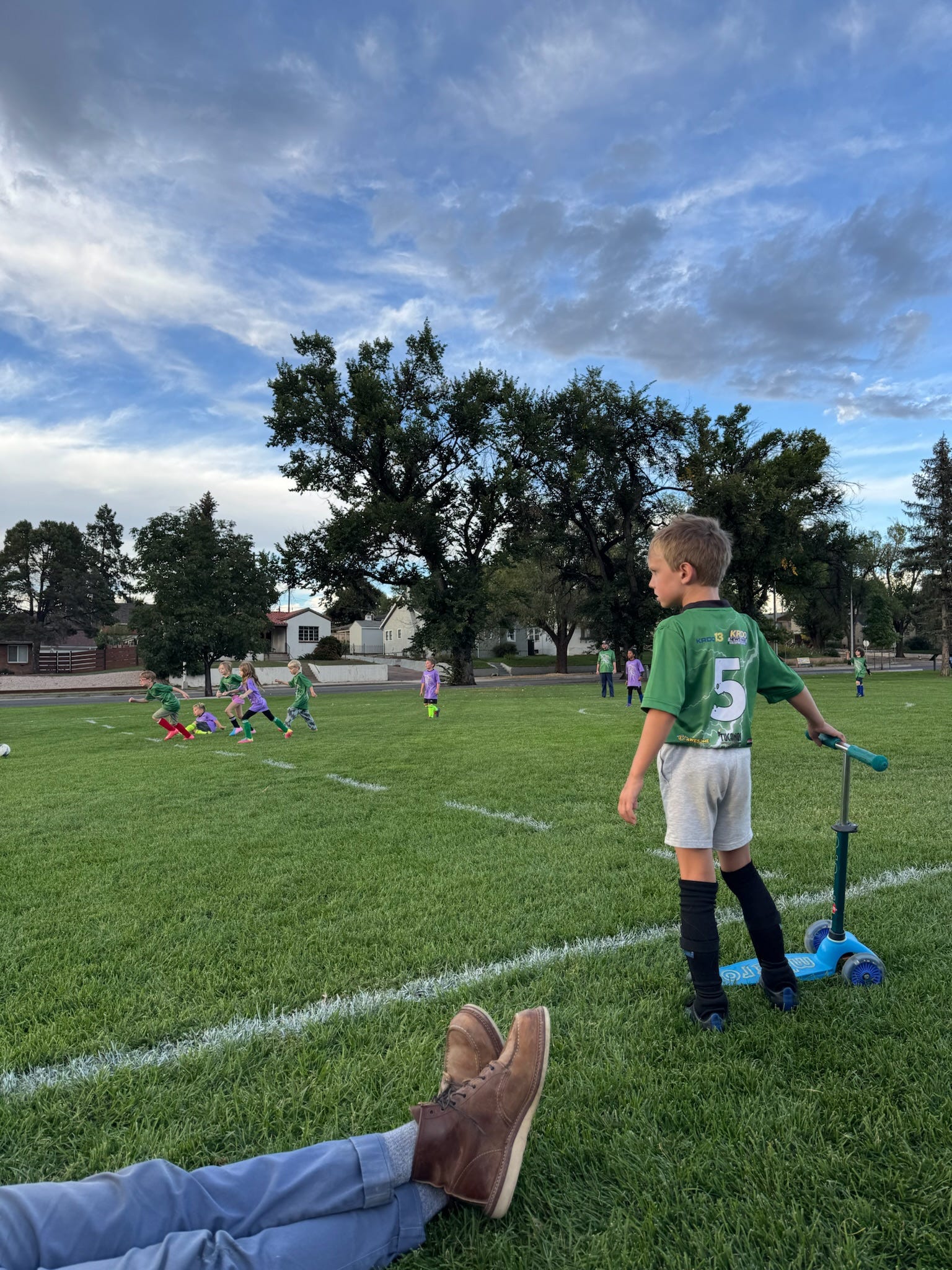
s_!-1eg!,w_1456,c_limit,f_auto,q_auto:good,fl_progressive:steep/https%3A%2F%2Fsubstack-post-media.s3.amazonaws.com%2Fpublic%2Fimages%2F79f05b31-9156-4b82-a3e6-24c6e3cbb69e_2016x2048.jpeg) “Our children are, in some ways, more constrained than any generation in recent memory,” writes Anna Keating. (Courtesy of Anna Keating)
“Our children are, in some ways, more constrained than any generation in recent memory,” writes Anna Keating. (Courtesy of Anna Keating)
Kids need to do more things in the real world. We are trying to keep our kids physically safe—and that matters—but no psychological theory has ever concluded that humans thrive by staying inside and passively consuming 30-second reels. We thrive from doing, helping, creating, being a part of something.
Our kids are doing this less often, and it’s not a coincidence that we are raising the most anxious, most highly medicated generation in human history. One in five children in 2021 had been diagnosed with a mental, emotional, or behavioral health condition, with anxiety being the most prevalent, according to the Centers for Disease Control and Prevention. And my son’s generation, Gen Alpha, isn’t exempt—even children largely free from smartphones are showing serious signs of anxiety.
And one of the most effective treatments for anxiety is exposure therapy: getting gradually closer to the thing that scares you until it doesn’t anymore. Research has established exposure-based therapies as a first-line, evidence-based treatment for anxiety disorders.
The way you build courage is the same way you build anything: you practice.
Walking to school is exposure therapy. First, you talk your kid through the route. Then you walk with them and practice crossing the streets. This might take a year. Eventually, they walk with an older sibling or classmate. When they’re ready, they go on their own.
After it was all over, I researched the laws in Colorado. Governor Jared Polis signed the Reasonable Independence for Children act in 2022. It states that if a responsible guardian finds their child mature enough to walk to school or the park, it is not neglect for them to do so. So, while I am still walking with my son to his Ma-Maw’s for now, I am sure he will be walking there on his own again in the future.
When you read books like Number the Stars, you realize how safe and free we are compared to those who came before us. But you also realize that our children, as they grow up increasingly scheduled and watched, are in some ways more constrained than any generation in recent memory. And you realize that courage is a muscle. The more you use it, the stronger it gets.

Anna Keating has a Substack newsletter and podcast called Inner Émigré. She is the co-author of The Catholic Catalogue (Penguin Random House) and the co-owner of Keating Woodworks.**
Write a comment