Gibt es Moral in der Natur? Vom Wolfsrudel zur Waffe — und zurück
- Der Skeptiker
- Die Patt-Situation
- Der Wolf und das Reh
- Der Intellekt als Waffe
- Das Naturrecht — und warum ich nicht daran glaube
- Die grüne Ampel
- Gibt es Frieden?
- Is there Morality in Nature?
Teil 2 — Folge auf “Du hast noch nie etwas getan — Wei Wu Wei”
Gibt es Moral in der Natur? Nein. Und trotzdem kommst du ins Gefängnis.
Wer Teil 1 gelesen hat, stellt jetzt vielleicht diese Frage: Wenn es keinen Handelnden gibt, wenn der freie Wille eine Illusion ist — dann gibt es doch auch keine Moral. Dann kann ich ja machen was ich will.
Gute Frage. Ehrliche Antwort: Ja. Klar kannst du das machen. Wenn du mit den Konsequenzen leben kannst.
Der Skeptiker
„Kein freier Wille, keine Moral — dann kann ich ja jeden töten.“
Ja, klar. Kannst du machen. Wenn du mit den Konsequenzen leben kannst.
Der Skeptiker erwartet ein moralisches Argument. Er wartet auf — nein, das darfst du nicht, weil… Und bekommt stattdessen: ja, mach doch.
Weil die Natur nichts verbietet. Die Natur bestraft auch nicht. Die Natur produziert — Konsequenzen. Kausalität. Ursache und Wirkung.
Steck die Hand ins Feuer. Sie brennt. Nicht weil Feuer böse ist. Nicht weil du bestraft wirst. Sondern weil das die Natur des Feuers ist. Kein Urteil. Nur Physik.
Töte jemanden — Gefängnis, Trauma, soziale Isolation, vielleicht Gegenwehr. Nicht weil ein Gott es so will. Nicht weil das Naturrecht es verbietet. Sondern weil das die Natur des sozialen Menschen ist.
Die Natur verbietet nichts. Sie produziert nur Konsequenzen.
Die Patt-Situation
Und jetzt das Interessante. Der Mörder will selbst nicht getötet werden. Das ist der einfachste, banalste, ehrlichste Satz über menschliche Moral.
Jeder Mensch — auch der der töten würde — möchte selbst weiterleben. Und aus dieser simplen Symmetrie, multipliziert mit Millionen von Menschen über Jahrtausende, emergiert etwas das wir Moral nennen. Nicht von oben verordnet. Von unten gewachsen.
Nicht weil Menschen gut sind. Sondern weil Kooperation sich rechnet. Weil Krieg teuer ist. Weil der Zustand wo jeder gegen jeden kämpft so ineffizient, so erschöpfend, so gefährlich für jeden einzelnen ist — dass Menschen automatisch beginnen, Regeln zu erfinden.
Moral ist kein Geschenk des Himmels. Sie ist das Ergebnis einer Kalkulation.
Der Wolf und das Reh
Beobachtung aus der Natur
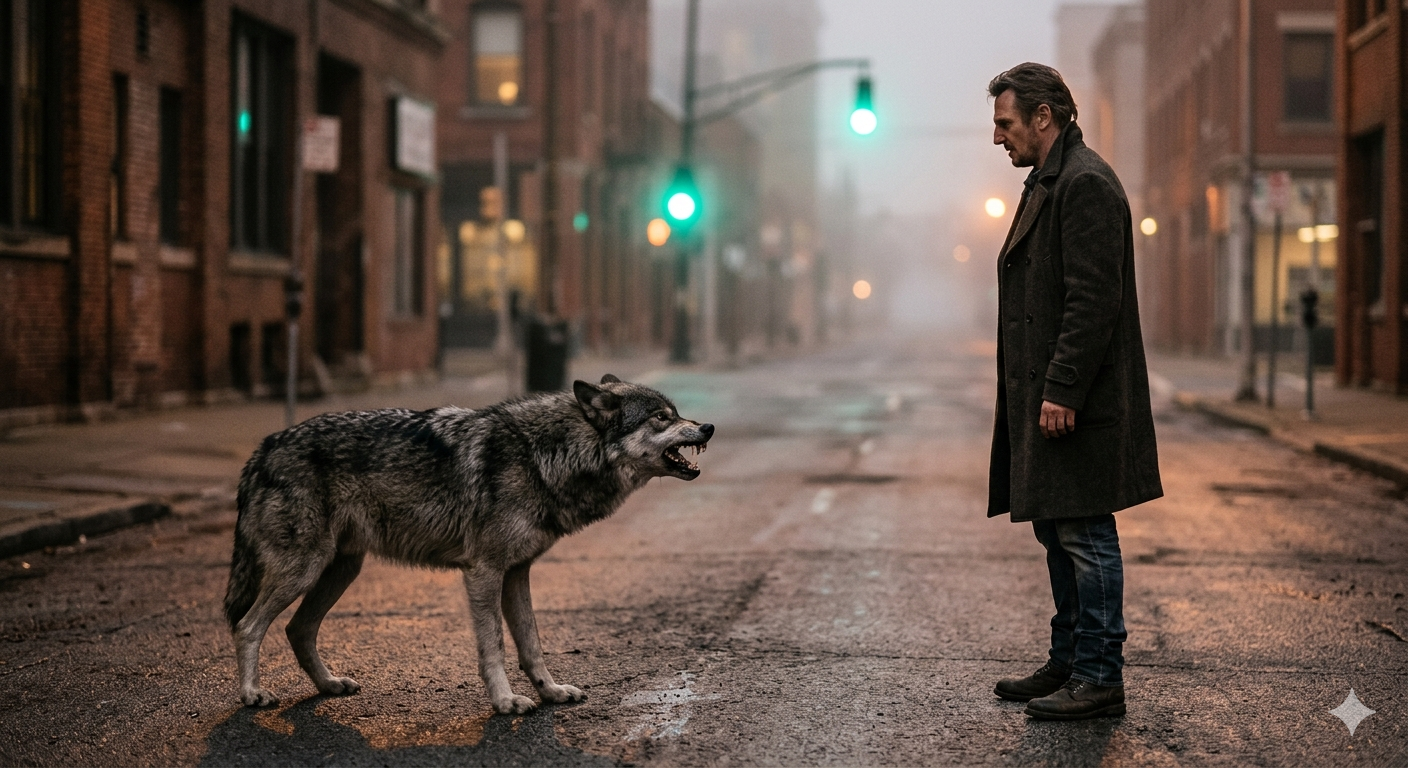
Der Wolf tötet nicht jedes Reh das er sieht. Er tötet wenn er Hunger hat. Er tötet das schwächste — nicht weil er grausam ist, sondern weil es am wenigsten Energie kostet. Das Rudel kooperiert. Wölfe teilen. Wölfe schützen ihre Jungen. Nicht aus Liebe im menschlichen Sinne — sondern weil die Gene die Kooperation belohnen. Keine Moral. Aber eine Ordnung. Emergent. Effizient. Stabil.
Ist der Mensch da grundsätzlich anders? Oder nur komplexer?
Wir helfen denen die uns nahestehen. Wir kooperieren mit denen die wir brauchen. Wir bestrafen die die das System gefährden. Dasselbe Muster. Nur mit mehr Schichten drüber.
Wolfsrudel mit besserer PR.
Der Intellekt als Waffe
Aber der Mensch hat etwas das der Wolf nicht hat. Den Intellekt. Und damit — eine neue Art von Waffe.
Der Wolf hat Zähne. Der Mensch hat: Du bist ein schlechter Mensch.
Genauso tödlich. Nur langsamer. Und viel schwerer zu verteidigen. Weil man gegen Zähne kämpfen kann. Gegen Schuld nicht.
Und hier kommt die Kehrtwendung. Die Moral — die wir gerade als emergentes Naturphänomen verstanden haben, als pragmatische Lösung für das Problem des Zusammenlebens — wird plötzlich zur Waffe. Das Werkzeug der Kontrolle. Der Mechanismus der Unterwerfung.
⚠️ Wer am lautesten über Moral spricht — hat oft das größte Interesse daran, dass du dich daran hältst. Und er selbst nicht.
Religionen die Moral benutzen um Macht zu sichern. Politiker die Moral benutzen um Gegner zu diskreditieren. Soziale Gruppen die Moral benutzen um Außenseiter auszugrenzen. Der Nachbar der immer weiß was sich gehört. Die Familie die Schuldgefühle als Steuerungsmittel einsetzt.
Das ist nicht Moral. Das ist Herrschaft mit anderem Namen.
Der Wolf hat Zähne. Der Mensch hat — du bist ein schlechter Mensch.
Das Naturrecht — und warum ich nicht daran glaube
Ich denke libertär. Dezentral, selbstbestimmt, skeptisch gegenüber Institutionen. Bitcoin, Nostr, Eigenverantwortung. Das ist meine Welt.
Aber beim Naturrecht steige ich aus.
Die Libertären sagen: Es gibt Rechte die aus der Natur selbst kommen. Unveräußerlich. Das Recht auf Leben, auf Eigentum, auf Freiheit. Naturgegeben.
Aber schau die Natur an.
Die Natur kennt kein Eigentum. Der Löwe der ein Zebra reißt — klaut er? Die Natur kennt keine Unveräußerlichkeit. Ein Virus interessiert sich nicht für dein Recht auf Leben. Die Natur kennt keine Rechte. Sie kennt nur — was passiert.
Naturrecht ist das Gegenteil von dem was es vorgibt zu sein. Es ist ein menschliches Konstrukt — emergent, kulturell gewachsen — dem man einen kosmischen Anstrich gegeben hat um ihm mehr Gewicht zu verleihen.
Nicht ich sage das. Die Natur selbst sagt das.
Naturrecht ist Moral mit kosmischem Anstrich. Die Natur hat es nie unterschrieben.
Die grüne Ampel
Die Ampel ist grün. Du hast Recht. Die Regel sagt es. Du darfst.
Und das Auto kommt trotzdem.
Die Tonne Metall mit 80 km/h diskutiert nicht. Sie interessiert sich nicht für dein grünes Licht. Nicht für dein Recht. Nicht für deine Moral.
Wer auf sein grünes Licht besteht während das Auto kommt — verwechselt die Karte mit dem Territorium. Die Regel mit der Realität. Das Schild mit dem Schutz.
Starre Moral ist eine Waffenverbotszone. Du hängst ein Schild auf — und glaubst das Schild schützt dich. Der der das Schild respektiert, der brauchte es sowieso nicht. Und der der es nicht respektiert — lacht drüber.
Echtes ethisches Handeln braucht keinen Regelkatalog. Es braucht Aufmerksamkeit. Präsenz. Den Moment sehen wie er ist — nicht wie die Regel sagt dass er sein sollte.
Gibt es Frieden?
Oder ist auch Frieden nur Kosten-Effizienz-Kalkül?
Krieg ist teuer. Sehr teuer. An Ressourcen, an Menschen, an Zeit, an Energie. Frieden ist billiger. Kooperation rechnet sich. Das haben schon die ersten Stammesgemeinschaften gelernt — kleinere Gruppen, wo jeder jeden kennt, sind friedlicher. Nicht weil die Menschen dort besser sind. Sondern weil die Konsequenzen direkter spürbar sind. Weil man dem ins Gesicht schaut den man betrügt.
Ist das deprimierend? Dass Frieden vielleicht kein moralisches Ideal ist — sondern eine pragmatische Rechnung?
Ich finde es nicht deprimierend. Ich finde es stabiler. Eine Moral die auf Kalkül basiert bricht nicht zusammen wenn der Glaube schwindet. Sie funktioniert weil sie funktioniert.
Frieden der sich rechnet ist stabiler als Frieden der geglaubt wird.
Moral existiert nicht in der Natur — aber sie emergiert aus ihr. Wie Sprache. Wie Städte. Wie das Wolfsrudel. Nicht verordnet. Gewachsen. Aus dem einfachen Fakt dass wir alle weiterleben wollen.
Und genau deshalb braucht sie keinen Gott, kein Naturrecht, kein freies Ich um real zu sein.
Sie ist real. Nur nicht heilig.
Und der Unterschied zwischen real und heilig — das ist vielleicht der wichtigste Unterschied den man verstehen kann.
Is there Morality in Nature?
From the wolf pack to the weapon — and back
Part 2 — Follows “You have never done anything — Wei Wu Wei”
Is there morality in nature? No. And yet you still go to prison.
Anyone who read Part 1 is probably asking: if there is no actor, if free will is an illusion — then there is no morality either. So I can do whatever I want.
Good question. Honest answer: Yes. Sure, you can do that. If you can live with the consequences.
The Skeptic
“No free will, no morality — so I can just kill anyone?”
Yes, sure. Go ahead. If you can live with the consequences.
The skeptic expects a moral argument. He waits for — no, you’re not allowed to, because… And instead gets: yes, go ahead.
Because nature forbids nothing. Nature doesn’t punish either. Nature produces — consequences. Causality. Cause and effect.
Put your hand in fire. It burns. Not because fire is evil. Not because you are being punished. But because that is the nature of fire. No judgment. Just physics.
Kill someone — prison, trauma, social isolation, perhaps retaliation. Not because a god wills it. Not because natural law forbids it. But because that is the nature of the social human being.
Nature forbids nothing. It only produces consequences.
The Stalemate
And here is the interesting part. The murderer doesn’t want to be killed himself. That is the simplest, most banal, most honest sentence about human morality.
Every person — even one who would kill — wants to keep living. And from this simple symmetry, multiplied by millions of people over millennia, something emerges that we call morality. Not ordained from above. Grown from below.
Not because people are good. But because cooperation pays off. Because war is expensive. Because the state where everyone fights everyone is so inefficient, so exhausting, so dangerous for each individual — that people automatically begin inventing rules.
Morality is not a gift from heaven. It is the result of a calculation.
The Wolf and the Deer
Observation from Nature
The wolf doesn’t kill every deer it sees. It kills when it’s hungry. It kills the weakest — not because it’s cruel, but because it costs the least energy. The pack cooperates. Wolves share. Wolves protect their young. Not out of love in the human sense — but because genes reward cooperation. No morality. But an order. Emergent. Efficient. Stable.
Is the human being fundamentally different? Or just more complex?
We help those close to us. We cooperate with those we need. We punish those who endanger the system. The same pattern. Just with more layers on top.
Wolf pack with better PR.
The Intellect as Weapon
But the human has something the wolf doesn’t. The intellect. And with it — a new kind of weapon.
The wolf has teeth. The human has: You are a bad person.
Equally deadly. Just slower. And much harder to defend against. Because you can fight teeth. You can’t fight guilt.
And here comes the reversal. Morality — which we just understood as an emergent natural phenomenon, as a pragmatic solution to the problem of living together — suddenly becomes a weapon. The tool of control. The mechanism of submission.
⚠️ Those who speak loudest about morality often have the greatest interest in you following it. While they themselves do not.
Religions using morality to secure power. Politicians using morality to discredit opponents. Social groups using morality to exclude outsiders. The neighbor who always knows what is proper. The family that uses guilt as a steering mechanism.
That is not morality. That is domination by another name.
The wolf has teeth. The human has — you are a bad person.
Natural Law — and why I don’t believe in it
I think in libertarian terms. Decentralized, self-reliant, skeptical of institutions. Bitcoin, Nostr, personal responsibility. That is my world.
But I part ways with natural law.
Libertarians say: there are rights that come from nature itself. Inalienable. The right to life, to property, to freedom. Given by nature.
But look at nature.
Nature knows no property. The lion that takes a zebra — is it stealing? Nature knows no inalienability. A virus doesn’t care about your right to life. Nature knows no rights. It only knows — what happens.
Natural law is the opposite of what it claims to be. It is a human construct — emergent, culturally grown — given a cosmic veneer to lend it more weight.
It’s not me saying this. Nature itself says this.
Natural law is morality with a cosmic veneer. Nature never signed it.
The Green Light
The light is green. You have the right of way. The rule says so. You may proceed.
And the car comes anyway.
A ton of metal at 80 km/h doesn’t negotiate. It doesn’t care about your green light. Not about your right. Not about your morality.
Whoever insists on their green light while the car is coming — confuses the map with the territory. The rule with reality. The sign with the protection.
Rigid morality is a weapons-free zone. You put up a sign — and believe the sign protects you. The one who respects the sign didn’t need it anyway. And the one who doesn’t — laughs at it.
Real ethical action doesn’t need a rulebook. It needs attention. Presence. Seeing the moment as it is — not as the rule says it should be.
Is Peace Possible?
Or is even peace just a cost-efficiency calculation?
War is expensive. Very expensive. In resources, in people, in time, in energy. Peace is cheaper. Cooperation pays off. The earliest tribal communities already learned this — smaller groups, where everyone knows everyone, are more peaceful. Not because the people there are better. But because the consequences are more directly felt. Because you look in the face of the person you are betraying.
Is that depressing? That peace perhaps isn’t a moral ideal — but a pragmatic calculation?
I don’t find it depressing. I find it more stable. A morality based on calculation doesn’t collapse when belief fades. It works because it works.
Peace that pays off is more stable than peace that is believed in.
Morality does not exist in nature — but it emerges from it. Like language. Like cities. Like the wolf pack. Not ordained. Grown. From the simple fact that we all want to keep living.
And that is precisely why it needs no god, no natural law, no free self to be real.
It is real. Just not sacred.
And the difference between real and sacred — that may be the most important distinction one can understand.
#Moral #Naturrecht #Philosophie #Morality #NaturalLaw #FreeWill #NoSelf #LongForm
Write a comment