El internet no está muerto — está en Nostr
Un vistazo íntimo a cómo construyo mi flujo de trabajo descentralizado sobre Nostr: desde hojas de cálculo colaborativas hasta cartografía comunitaria, todo en sintonía con los principios de Bucéfalo.


Eine Sammlung von npubs, die auf Deutsch kommunizieren. Zusammengestellt für alle, die sich vernetzen, Ideen austauschen oder in der Sprache zusammenarbeiten möchten. Diese Liste erleichtert das Finden deutschsprachiger Teilnehmer*innen auf Nostr, egal ob du Diskussionen, Übersetzungen oder Community‑Projekte suchst. Durchstöberen, folgen und mit den npubs interagieren. Diese npubs halten die Unterhaltung auf Deutsch am Laufen. A collection of npubs who converse in German. Gathered for anyone looking to connect, share ideas, or collaborate in the language. This list makes it easy to discover German‑speaking participants across nostr, whether you’re seeking discussions, translations, or community projects. Feel free to browse, follow, and engage with the npubs who keep the conversation flowing in German.
Un vistazo íntimo a cómo construyo mi flujo de trabajo descentralizado sobre Nostr: desde hojas de cálculo colaborativas hasta cartografía comunitaria, todo en sintonía con los principios de Bucéfalo.
Why voting is the worst way to determine who will govern, excepting all of the other ways.

Heart Words #28 – Meine Lehre aus 2025

The first generation born entirely under Bitcoin does not remember inflation, bailouts, or negotiated truth. To them, money has always been final, transparent, and impersonal. This essay explores how that quiet inheritance reshaped Martian culture—not through slogans or struggle, but through instinct—and why those who remembered Earth sometimes found the new normal unsettling.
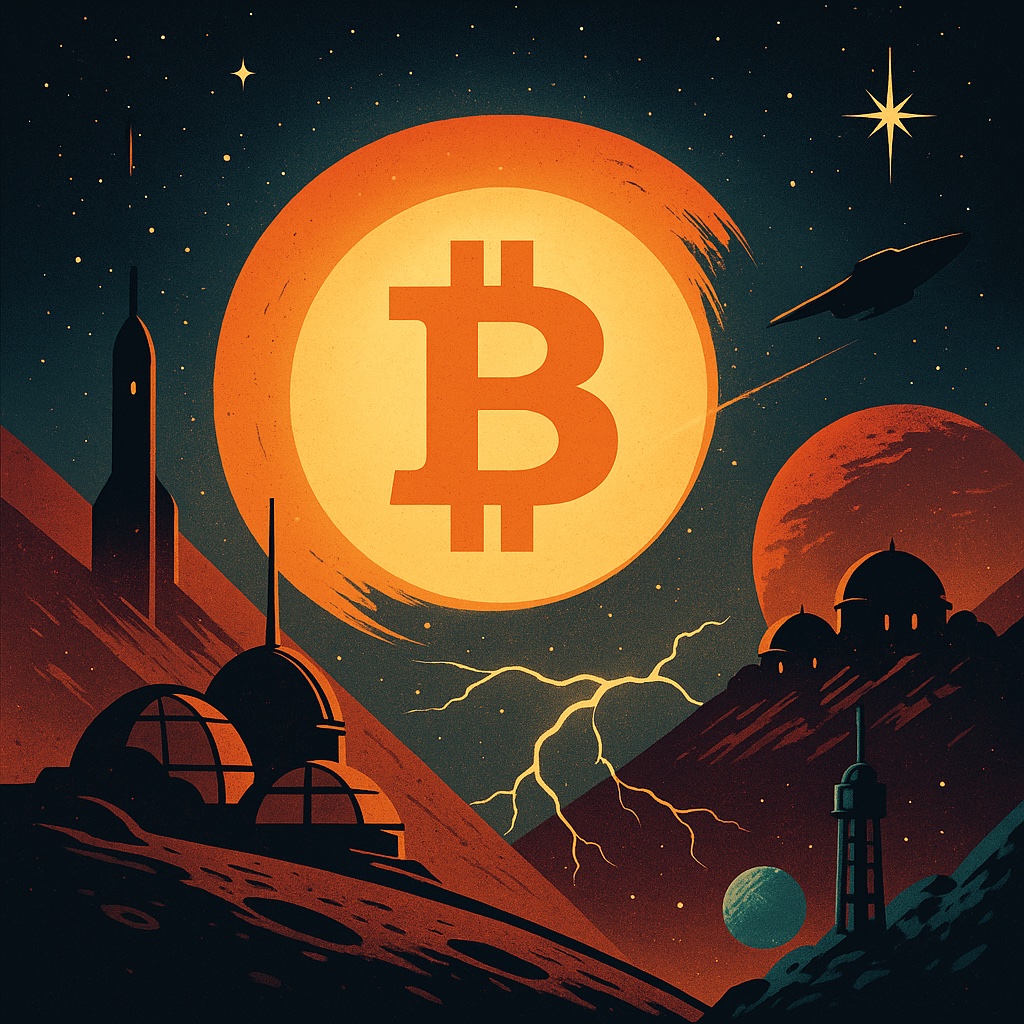
Mars does not reject Earth out of hatred or pride. It rejects Earth because dependency, once accepted, never leaves quietly. When a powerful consortium offers Mars a temporary financial bridge “with no strings attached,” the colony must confront its own fear—not of collapse, but of relief. This essay chronicles the final moment when Mars could have compromised its monetary sovereignty, and why it chose not to.
On Mars, survival depends on precision, honesty, and irreversible consequences. When a young systems engineer makes a mistake that cannot be undone, Bitcoin does not intervene, forgive, or soften the outcome. It records. This essay explores how finality reshaped Martian ethics—not as punishment, but as clarity—and why a civilization that cannot rely on mercy by abstraction learned to practice responsibility in full daylight.
Earth once assumed its voice carried first—and last. This Chronicle records the quiet, irreversible moment when Earth chose restraint, and in doing so, relinquished central authority forever.
The first interplanetary vote to span Earth, Luna, Mars, and the Belt was never concluded. Not because it failed—but because closure itself became impossible across distance. This Chronicle records the moment humanity learned that consensus does not end; it decays.
Law once assumed immediacy. Across worlds, obedience became delayed—not defiant. This Chronicle follows the creation of the Delayed Obedience Ledger, a system that accepted time itself as a lawful variable.
Waiting was once treated as inefficiency. At the outer edges, it became a moral practice. This essay examines how civilizations learned to live responsibly when answers would arrive too late to matter.

At the farthest edges of light-bound expansion, humanity reached equilibrium. Not utopia, not collapse—but rest. This essay closes Arc 1 by portraying a civilization that had learned how to live within separation without seeking to overcome it.
At the outer edges of light-bound expansion, humanity discovered that distance was not merely a constraint but a civilizational gift. This essay explores how separation preserved sovereignty, restrained empire, and taught humanity how to govern itself without reach.
Most modern “protest” is loud, visible, and ultimately harmless. It vents frustration without withdrawing consent. Real protest is quieter and far more demanding: it is the long-term reduction of dependency, the refusal to become an instrument of harm, and the disciplined choice to build alternatives rather than perform outrage. This excerpt introduces a different definition of protest—one rooted in trajectory, not spectacle.

Most modern “protest” is theater. It signals dissent while leaving the underlying systems intact—and often strengthens them. Real protest is quieter, slower, and far more uncomfortable: it is the long-term withdrawal of dependency, the refusal to become an instrument of harm, and the disciplined construction of parallel capacity. This essay defines protest not as spectacle, but as trajectory—and offers concrete, livable examples.
Native nations have long fought to preserve sovereignty within systems that routinely undermine it—monetary, legal, and administrative. Bitcoin offers no exemptions, favors, or special recognition. Paradoxically, that neutrality is precisely why it may be one of the most powerful tools available for strengthening tribal sovereignty. By restoring monetary agency, verifiable ownership, and intergenerational coordination without intermediaries, Bitcoin aligns structurally with the principles that sovereign nations—especially Native nations—have been forced to defend for centuries.
Bitcoin’s conservatism is often framed as weakness in a world obsessed with disruption. In reality, conservative systems dominate at the civilizational layer because they preserve trust, memory, and coordination over time. Bitcoin’s restraint is not accidental—it is what makes it uniquely capable of supporting innovation, freedom, and sovereignty across generations.
Bitcoin is often criticized for moving slowly while alternative blockchains experiment aggressively. This critique misunderstands the nature of innovation at the civilizational layer. Bitcoin is more innovative precisely because it constrains change. By enforcing hard rules rather than chasing features, Bitcoin enables durable, permissionless innovation on top of a stable foundation—something no constantly mutating system can achieve.
Bitcoin is often framed as a technology competing with other technologies. This framing misses its true significance. Bitcoin is not a product, a platform, or a trend—it is a coordination layer. By providing a shared, incorruptible reference point for value, time, and trust, Bitcoin enables large-scale human cooperation without centralized authority. That shift is civilizational, not technological.
Immutability is often framed as a technical feature of Bitcoin. In reality, it is a civilizational constraint—one that forces honesty, responsibility, and long-term thinking. Systems that can rewrite their past eventually lose their future. Bitcoin’s immutability matters because it restores memory where modern civilization has learned to forget.
Modern technology optimizes for speed, convenience, and short feedback loops. Civilizations, however, are built over centuries. This tension explains why most digital systems decay while Bitcoin endures. Bitcoin is not a product to be optimized like software-as-a-service; it is a cathedral—slow to build, difficult to alter, and designed to outlast its builders.